BLOG: Two mills showcase ‘green’ growth of Chinese steel
Source: Mysteel
Sep 25, 2019 14:30
To be fair, though, not all Chinese steel mills are dusty and dirty.
“Chinese mills are much cleaner than I’d expected!” admitted a clearly surprised steel industry official during a visit to the works of Jiangsu Yonggang Group (Yonggang) and Jiangsu Shagang Group (Shagang), two large mills in East China’s Jiangsu province located about 116 km north-west of Shanghai.
The foreign mill official was among a group of over 50 visitors from Japan, South Korea, Netherlands, United States and China to pay a visit to the two steelworks as part of the Asia Steel Forum 2019 over September 18-19 in Shanghai. Arriving at the carbon and specialty steelmaker Yonggang after traveling for two and a half hours from the downtown Shanghai, visitors were immediately impressed by the brand new and advanced facilities, and their efficient layout.
Established in 1984, Yonggang in Nanfeng Town in Zhangjiagang, boasts a 9 million tonnes/year crude steel capacity. With over 10,000 employees, it produces and sells wires rod, rebar, bar-in-coil, bearing steel, gear steel, and other products.
After a brief introduction to the company, visitors were guided to its steelmaking shop and cast house where the 1 million tonnes/year capacity EAF-based plant is producing 380-800mm blooms. Nearby is the 800,000 t/y rolling mill for 75~350mm dia round bars.
“The length of the production line – from roughing mill through precision rolling and finally cut-to-length – is 550 meters, and during the process, the temperature can be as high as 900 degrees Celsius,” the official explained.
“The size of the mill and advanced level of production facilities are very impressive,” an engineer from the Netherlands admired, adding, “by comparison, our mill’s plant components are more widely disbursed, and the equipment is older.”
A delegate from Japan where steelmaking technology is well recognized for its eco-friendliness and advancement admitted that Yonggang’s facilities are on par with those in steel mills in Japan.
Visitors had an equally eye-opening experience at Shagang Group’s Zhangjiagang works, located about 18 km from Yonggang’s plant.
Being China’s largest privately-owned steelmaker, Shagang Group – comprising the Zhangjiagang works and three other worksites across Jiangsu and Henan provinces – boasts 45 million t/y of steel capacity with Zhangjiagang hosting some 25 million t/y, and the group claims to employ 30,000.
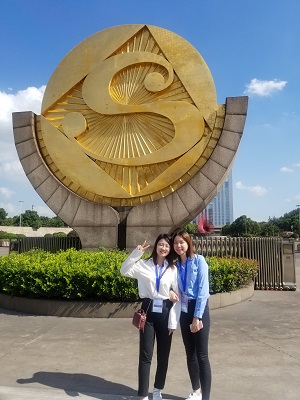 At Shagang’s entrance with golden statue “S”, the company logo.
Shagang hosts three wide and thick heavy-plate mills with a total capacity of 6 million t/y, and the visitors were ushered into the 5,000mm plate mill for a brief walk-through.
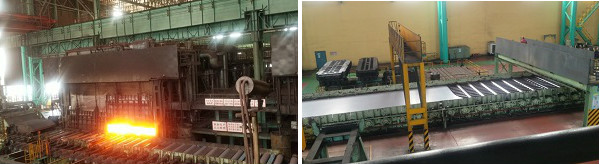 The slabs from the continuous caster into Shagang’s 5,000mm heavy plate mills.
In fact, to “live” amongst more than 10,000 villagers shows just how green the mill is. On route to the plant the buses crossed small bridges built among willow trees and over cool flowing water. At lunch at the works, the fresh food served nearly all came from the farm, the official mentioned.
The surprise did not stop at the plants and when the visitors arrived at Shagang’s own berths at the Zhangjiagang port on the southern bank of the Yangtze River, they were welcomed with the fully-covered coal storage silos. “China’s central government requested steel mills to fully enclose all the raw materials storage facilities last year,” a company official explained.
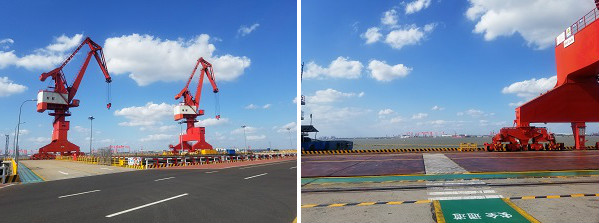 Shagang’s ports along the riverbank
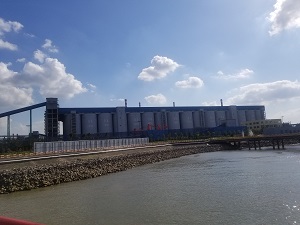 The fully-covered coal storage silos opposite Shagang’s ports
Shagang has been using the berths for steel exports and to receive and unload most of its imported raw materials. “Our port terminal stretches over 10 km along the riverbank,” he said.
Other than completely covering coal from the naked eye, Shagang’s efforts to minimize air pollution from raw materials stocking also stretch to building roofs over iron ore and scrap stockyards. And Yonggang, as a subsidiary of Shagang, has been on a similar route, investing heavily in installing covers over its raw mats yards which visitors could see from afar, silhouetted against the beautiful clear sky with clouds floating.
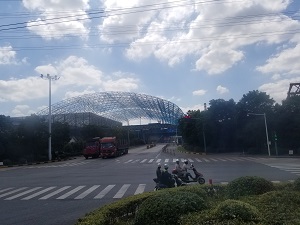 Yonggang’s cover over raw mats yards.
Since 2006, Shagang has invested over Yuan 6 billion ($843 million) in developing environment-related projects including the addition of 49 eco-friendly production projects, according to the company’s official website.
It may still take a few more years for more “garden” steel plants to emerge in China, but Beijing’s greater emphasis on environmental protection since 2016 has already seen the initial results, and the few showcases such as Nanjing Iron & Steel, Shagang, Yonggang are offering glimpse of China’s steel industry future.
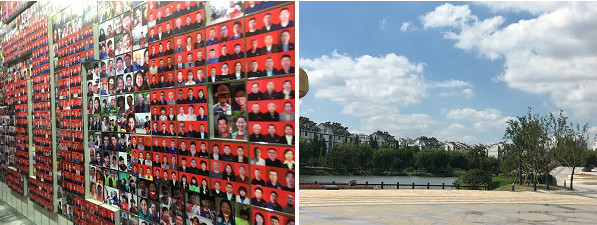 The portrait wall of Yonggang’s employees and the residential zone.
Written by Anna Wu, wub@mysteel.com, Zhiyao Li, lizy@mysteel.com
Edited by Russ McCulloch, russ.mcculloch@mysteel.com, Hongmei Li, li.hongmei@mysteel.com
You May Also Like
Price Curve
Daily Prices
Iron ore concentrates procurement prices: China's major mills
Oct 11, 2026 15:02
Iron ore concentrates prices: China's major miners
Oct 11, 2026 11:01
Mysteel Portside Iron Ore Indices (PORTDEX)
Oct 10, 2026 18:40
Mysteel Iron Ore Index
Oct 10, 2026 18:38
Imported iron ore prices: China's major cities
Oct 10, 2026 18:16