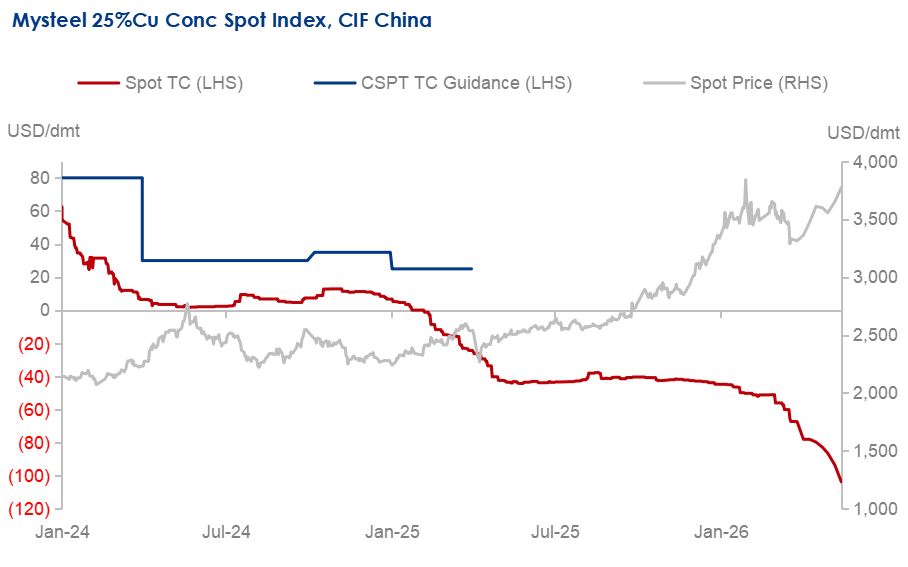
Entering 2026, the sharp decline in copper concentrate treatment charges (TCs) has caused severe losses for smelters. However, sulfuric acid, a by-product of pyrometallurgical copper smelting, has recorded significant price gains since March 2026, becoming a key profit driver for Chinese copper smelters, supporting high refined copper output and even beginning to influence TC pricing. Following the implementation of China's sulfuric acid export ban in May, sulfuric acid prices have shifted from a rapid upward trend to high-level fluctuations, driving market concerns. If sulfuric acid prices decline significantly, Chinese copper smelters may be forced to reduce operating rates amid raw material shortages and persistently low TCs.
Data Source: Mysteel
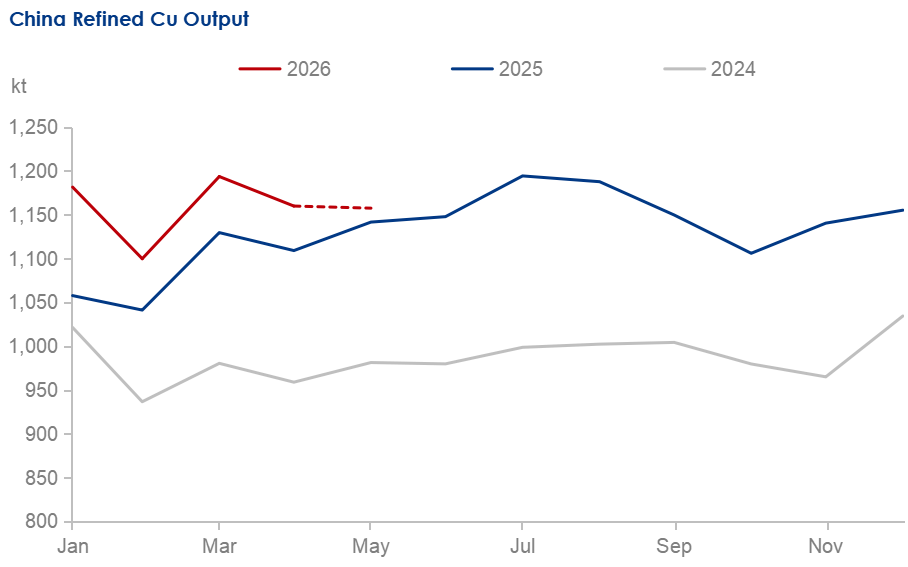
According to Mysteel's estimates, Chinese smelters' cost to produce one tonne of refined copper is approximately $17-$25, excluding by-product revenue. However, Mysteel's clean copper concentrate spot TC index, CIF China, reached -$103.62/dmt on May 15, dropping sharply by 137% from early 2026's -$44.76/dmt, far below the level needed to cover smelting costs. Normally, Chinese smelters would cut production to reduce losses under negative TCs, but their refined copper output stayed high in 2026, standing at 4.6353 million tonnes during January to April, rising by 6.85% year on year, based on Mysteel's survey of 60 Chinese copper smelters, covering a combined annual capacity of 16.98 million tonnes.
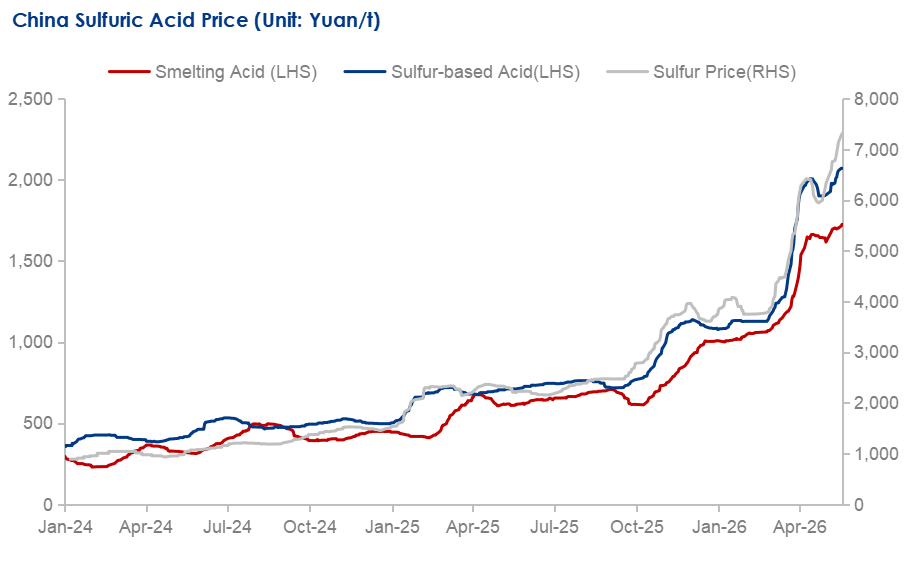
Smelters' high operations were supported by surging by-product sulfuric acid prices, which were mainly driven by tighter sulfur supply amid Middle East geopolitical tensions. Based on Mysteel's assessment, China's 98% smelting acid price was Yuan 1,717.63/tonne as of May 22, growing by 71.13% from Yuan 1,003.68/tonne on January 5.
Data Source: Mysteel
Based on market feedback, producing one tonne of refined copper generates approximately 3-4 tonnes of sulfuric acid. After deducting acid costs, the profit from by-product sulfuric acid in copper smelting reaches roughly 4,000-Yuan 5,000/tonne. At Mysteel's current TC of -$106.2/dmt and RC of -¢10.62/lb for 25% clean copper concentrate (assuming 98.5% smelting and refining recovery), the smelter's combined treatment and refining charges total approximately -$665.4/tonne, equivalent to roughly -Yuan 4,527.25/tonne. Consequently, the revenue from acid sales can largely cover TC/RC losses and the smelting cost. Moreover, elevated precious metal prices driven by geopolitical factors have also provided additional margin support. As a result, China's refined copper output has been able to maintain year-on-year growth in January-April 2026, despite deeply negative TC/RCs.
Though May's refined copper output in China is expected to decline month on month due to concentrated maintenance, growth is anticipated in the third quarter, as the maintenance impact will gradually diminish. However, in year-on-year terms, raw material supply and sulfuric acid prices will be key factors determining whether smelters can maintain the earlier growth pace.
Data Source: Mysteel
On the raw material side, China depends on imports for over 80% of its copper concentrate. With Chile lowering its copper output forecast, the energy crisis in Peru, and the Grasberg mine not expected to fully resume until the end of 2027, global concentrate supply is unlikely to improve significantly in the short term. As a result, China's copper concentrate TC/RCs are expected to remain deeply negative and could even slide further, worsening smelting losses.
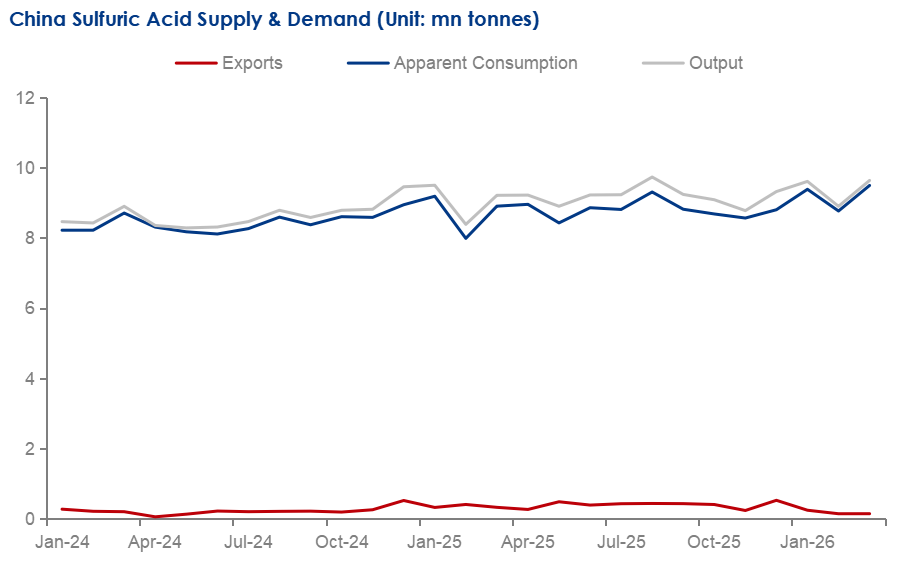
Regarding sulfuric acid prices, as China's export ban on industrial sulfuric acid and smelting by-product sulfuric acid took effect entering May, exports are expected to sharply fall going forward. As a result, the market has grown concerned that volumes originally destined for exports will be diverted to the domestic market, loosening supply and suppressing sulfuric acid prices, which could in turn reduce smelting profits. However, according to Mysteel's estimates, the impact of the export ban on sulfuric acid prices is expected to be limited.
On one hand, April to June marks the peak maintenance season for China's sulfuric acid producers. Meanwhile, surging sulfur prices continue to severely compress margins for sulfur-based acid producers, leading to lower operating rates and even early maintenance or production cuts, further constraining sulfuric acid output. Based on Mysteel's survey on 234 sulfuric acid producers in China with a capacity coverage of 80%, total output losses caused by maintenance were 785,400 tonnes in April, estimated to reach around 600,000 tonnes in May, which still exceeds the volume of exports returning to the domestic market. On the other hand, data from Mysteel and the General Administration of Customs of China (GACC) showed that China's sulfuric acid production reached 109,832 million tonnes in 2025, while exports totaled only 4.6494 million tonnes. Over 95% of China's output was consumed domestically, with exports accounting for only about 4%. Therefore, even after the maintenance season, the additional supply from the export ban is expected to be relatively limited, and the consequent downward pressure on prices is likely to remain modest.
Data Source: GACC, Mysteel
Overall, as sulfuric acid producers' concentrated maintenance periods gradually conclude and exported sulfuric acid volumes return to the domestic market, the supply-side may exert limited downward pressure on China's sulfuric acid prices in the short term. Additionally, weakening demand for phosphate fertilizers is likely to further constrain acid consumption and dampen prices. However, with the Middle East conflict unlikely to ease in the near term, sulfur supply is expected to remain tight and prices elevated, continuing to provide strong cost support for sulfuric acid. Consequently, sulfuric acid prices are unlikely to significantly drop, and will continue to support profit margins for Chinese copper smelters.
Consequently, cushioned by sulfuric acid prices, Chinese smelters are unlikely to breach the threshold for voluntary output cuts in the near term, despite deeply negative copper concentrate TC/RCs. As smelters' maintenance will gradually end, a quarter-on-quarter increase in China's refined copper output is expected in Q3. However, disruptions related to the Middle East conflict will persist. If geopolitical tensions ease and global sulfur supply recovers, the support for sulfuric acid prices may weaken. In that case, potentially plunging sulfuric acid prices may no longer be sufficient to sustain copper smelting profit margins, and Chinese copper smelters may face the risk of proactive production cuts then.
Written by Mingyuan Wang, wangmingyuan@mysteel.com, Zhaorui Cui, cuizhaorui@mysteel.com