In the first half of 2026, nickel prices traded in a volatile range, driven by policy changes and cost fluctuations in Indonesia. Tightening nickel ore supply and rising production costs were the main features of the period. On the demand side, the market sought a balance between steady growth in stainless steel and moderate expansion in battery nickel. The overall market transitioned from a broad surplus to structural tightening.
Source: Mysteel
I. Impact of Indonesian policy on nickel costs from the supply side
1. Indonesian nickel ore: Tighter RKAB quotas and new HPM rules pushed up the cost curve
The core variable in the first half was policy shifts in Indonesia. Nickel ore RKAB quotas were slashed from 379 million tonnes in 2025 to 260-270 million tonnes, a reduction of 30%, while approval pace slowed notably. Although Philippine exports surged after the rainy season ended, they were far from sufficient to fill the Indonesian gap, and tight ore supply persisted throughout the first half.
More far-reaching than the volume contraction was the overhaul of the pricing mechanism. On April 15, the Ministry of Energy and Mineral Resources officially introduced new HPM rules, with a sharp upward revision to the nickel correction factor and the inclusion of cobalt, iron, and chromium in the pricing system for the first time. Taking a typical laterite ore used in pyrometallurgy as an example, the HPM under the new rules jumped from US $26.66/wmt to above US $62.5/wmt, more than doubling. For low-nickel hydrometallurgical ore, where iron was not priced, the increase was relatively moderate, at about 35%, though actual market transaction prices did not rise. This adjustment directly pushed up the cost centre across the entire industry chain, building a stronger floor under nickel prices.
2. Nickel intermediates: Sulfur supply disruption triggered MHP production cuts, pushing the payable rate higher
Meanwhile, sulfur shortages became another factor affecting intermediate nickel prices. Affected by geopolitical conflicts in the Middle East, sulfur prices rose above USD 1,000 per tonne. Most Indonesian hydrometallurgical projects had raw material inventories that would only last until June or July. Major projects including Huafei, Huayue, and Lygend were forced to cut production, with reductions ranging from 10% to 50%. MHP output in May was nearly 27% lower than the same period last year. Tight supply pushed the MHP nickel payable rate from 91% in April to 94.5% by early June, and cost pressures gradually transmitted down the industry chain.
Source: Mysteel
3. Nickel pig iron and refined nickel: Clear divergence across different products
In May, combined NPI production in China and Indonesia reached 166,000 tonnes, up slightly from the previous month but still down 8.86% year-on-year. In Indonesia, the production continued to decline, affected by tight ore supply and the switch of some production lines to nickel matte. Chinese NPI smelters, by contrast, saw a slight recovery from low levels as profit margins improved. Separately, the Indonesian government announced the establishment of a natural resource export management agency and planned to gradually have state-owned enterprises monopolize resource exports. Although NPI was exempted in the initial phase, this policy signal heightened market concerns over tighter supply controls and became an important driver of the nickel price rebound in mid-to-late May. High-grade NPI experienced structural tightness due to declining feed ore grades, with prices holding firm at Yuan 1,150-1,170/mtu. Low-grade NPI, by contrast, had relatively more room for negotiation.
Source: Mysteel
Refined nickel: Supply-demand imbalance more pronounced in the first half
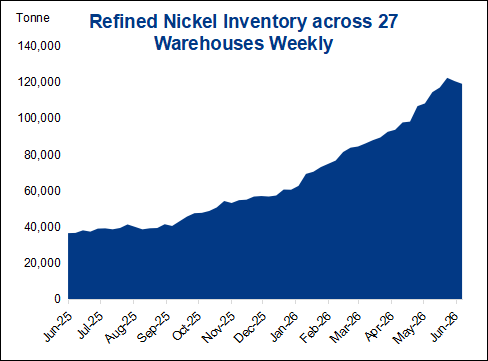
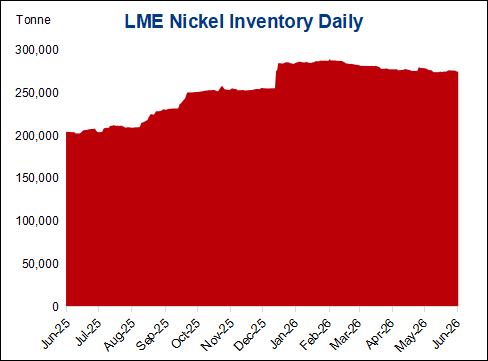
The supply-demand imbalance in the refined nickel market became more pronounced in the first half of the year. In April, China's refined nickel imports surged 85%, with large volumes from Russia and Indonesia flooding in. At the same time, the export window closed, causing exports to plummet 94%, and China's refined nickel inventories subsequently broke through 100,000 tonnes. Although China's refined nickel production edged down due to maintenance, new capacity continued to come online gradually, and supply pressure remained unabated. LME inventories declined slowly, creating a clear divergence between Chinese and overseas markets. Overall, the refined nickel market faced rising imports, restricted exports, and high inventories. Fundamentals were weak, and spot premiums/discounts remained under pressure.
Source: Mysteel
II. Demand side: Stainless steel stable with slight progress, battery nickel momentum slightly cooling
On the demand side, stainless steel remained the cornerstone of nickel consumption, maintaining its share at about 65% of global nickel use. New stainless steel production capacity in 2026 was concentrated mainly in China, with limited additions in Indonesia due to policy constraints. Steel mill profit margins improved somewhat in the first half, but end-demand did not show significant volume increases, and procurement remained largely just-needed. Social inventories were at moderate levels for the past two years.
On the battery nickel front, growth momentum slowed notably, transitioning from explosive growth to moderate expansion. Three factors jointly suppressed ternary material demand growth: the continued expansion of lithium iron phosphate market share, the rising share of plug-in hybrids, and the promotion of nickel-free battery technologies. Ternary precursor output in May edged up month-on-month and surged more than 50% year-on-year, though this was due to a low base in the prior year. Ternary cathode materials, affected by declines in lithium carbonate and nickel sulfate prices, lost nearly Yuan 10,000/tonne within a month, leaving producers struggling near break-even levels. The nickel sulfate market was characterized by high costs and weak demand, with prices fluctuating in a slight range.
III. Nickel price review and outlook
In the first half of the year, the most-traded SHFE nickel contract started from around Yuan 148,000/tonne at the end of the first quarter, briefly broke through the previous high to reach Yuan 155,000/tonne in late April, then pulled back to near Yuan 145,000/tonne by the end of May, and further declined to around Yuan 125,000/tonne in June. Tightening on the Indonesian mining side and rising sulfur costs supported the lower bound of prices, while high inventories, weak demand, and expectations of rate hikes capped the upside. By mid-year, the market had begun to anticipate a potential increase in Indonesian ore supply, leading to a stalemate between buyers and sellers.
Looking ahead to the second half, supply-side disruptions remained numerous. In July, the market expected that RKAB quotas might be supplemented, which could put near-term downward pressure on nickel prices. However, the Indonesian government had clearly indicated that it would control the pace of releases, and the tight ore supply pattern was unlikely to be fundamentally alleviated. Whether sulfur supply could recover as geopolitical tensions in the Middle East eased would directly affect the pace of adjustment in MHP payables.
On the demand side, the traditional peak consumption season in the third quarter was expected to provide some support, with stainless steel production schedules likely to increase modestly. However, battery nickel faced limited growth potential due to thin margins in ternary materials and strong downstream wait-and-see sentiment. Overall, the nickel market in the second half is expected to maintain a tight supply-demand balance. The most-traded SHFE nickel contract is expected to trade in a range of Yuan 120,000-145,000/tonne, with the price centre moving lower compared with the first half.
Risks to watch included the possibility that Indonesia's export centralisation policy could be extended to NPI, Fed rate hikes exceeding expectations, and renewed Middle East tensions disrupting sulfur supply chains. Any of these factors could exceed expectations and break the current fragile balance, triggering a new round of nickel price volatility.
Written by Cora Ji, jiruyan@mysteel.com