China's copper tube trade showed a clear divergence in the first half (H1) of 2026, with exports facing continued pressure while imports recorded strong growth. Export performance was weighed down by weakening overseas demand, rising trade barriers, and the expansion of overseas production capacity. Meanwhile, growing demand for high-end products and temporary supply gaps in the domestic market drove a notable increase in imports, highlighting the changing structure of China's copper tube supply chain.
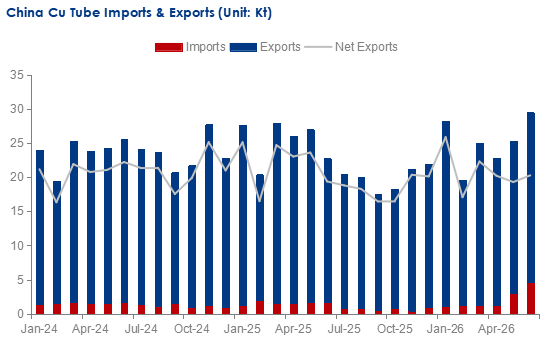
According to data from the General Administration of Customs of China (GACC), China's copper tube exports totaled 194,100 tonnes in January to June 2026, down 6,200 tonnes year on year, or 3.12%. Imports reached 14,400 tonnes, increasing by 3,100 tonnes year on year, or 27.14%.
Source: GACC, Mysteel
China's copper tube exports declined moderately in H1 2026, mainly due to structural changes in global supply chains and trade policies. In recent years, overseas markets have accelerated investment in local copper processing capacity, while some Chinese manufacturers have expanded production overseas, reducing reliance on China-origin products. At the same time, anti-dumping measures and tariff barriers in major markets further constrained export growth. Demand weakness in key overseas markets, particularly Europe and the U.S., also contributed to the decline. Domestically, the air-conditioning and refrigeration sector entered a finished-product destocking phase, delaying overall demand recovery.
In contrast, copper tube imports increased significantly during the same period, driven mainly by a temporary supply shortage of certain high-end products. In June, domestic buyers increased overseas purchases to fill supply gaps of certain high-end products, resulting in a sharp rise in monthly import volumes. Overall, the growth in imports reflected continued reliance on overseas suppliers for specialized copper tube products where domestic supply remains relatively limited.
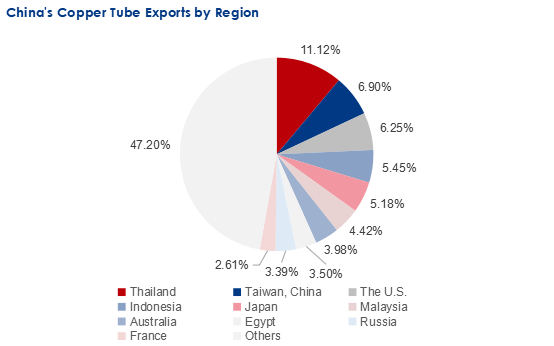
By export destination, China's copper tube exports remained relatively diversified. Thailand was the largest destination, accounting for 11.12% of total exports, followed by Taiwan, China at 6.90%. The top ten destinations accounted for 52.8% of total exports, indicating that export demand was distributed across multiple markets rather than concentrated in a single region.
Source: GACC, Mysteel
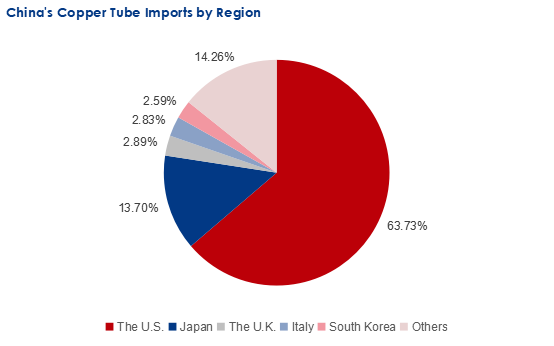
On the import side, supply sources were highly concentrated. The U.S. was China's largest copper tube supplier, with imports totaling 9,202.15 tonnes, accounting for 63.73% of total imports. Japan ranked second with a 13.7% share. The top five suppliers together accounted for 85.74% of total imports, highlighting China's dependence on a limited number of overseas suppliers for high-end copper tube products.
Source: GACC, Mysteel
Looking ahead, China's copper tube exports are expected to recover slightly in H2 2026, but the overall improvement is likely to remain limited. Full-year exports are expected to decline modestly as overseas capacity expansion and trade barriers continue to weigh on external demand. On the import side, growth is likely to slow significantly from H1 levels as temporary restocking demand fades. However, demand for high-end copper tube products will continue to provide underlying support, keeping imports at relatively elevated levels.
Written by Mingyuan Wang, wangmingyuan@mysteel.com