In July, Norsk Hydro published its earnings report for the second quarter of 2026. While Middle Eastern aluminium output remains constrained by regional disruptions, European smelters are staging a cautious, policy-driven recovery.
Qatalum: Output declines, no recovery prior to July
According to the company's capacity schedule, Qatalum, a 50/50 joint venture between Hydro and Qatar Energy, has an annual smelting capacity of approximately 628,000 tonnes. In Q2 2026, however, Qatalum produced roughly 90,000 tonnes aluminium, implying an annualized run-rate of about 360,000 tonnes and a capacity utilization rate of around 55.6%. This aligns closely with earlier disclosures indicating operations at roughly 60% of normal levels and further confirms that no material recovery had taken place before July.
Norwegian Smelters: Still in ramping up, but upside is limited
Hydro's total primary aluminium production in Q2 stood at 497,000 tonnes, down 3% year-on-year and 20,000 tonnes lower than in Q1. Within this, Hydro's share from Qatalum fell by 29,000 tonnes quarter-on-quarter, implying a 9,000-tonne increase from other regions. According to the report, previously curtailed capacity across Hydro's Norwegian smelters continued to ramp up.
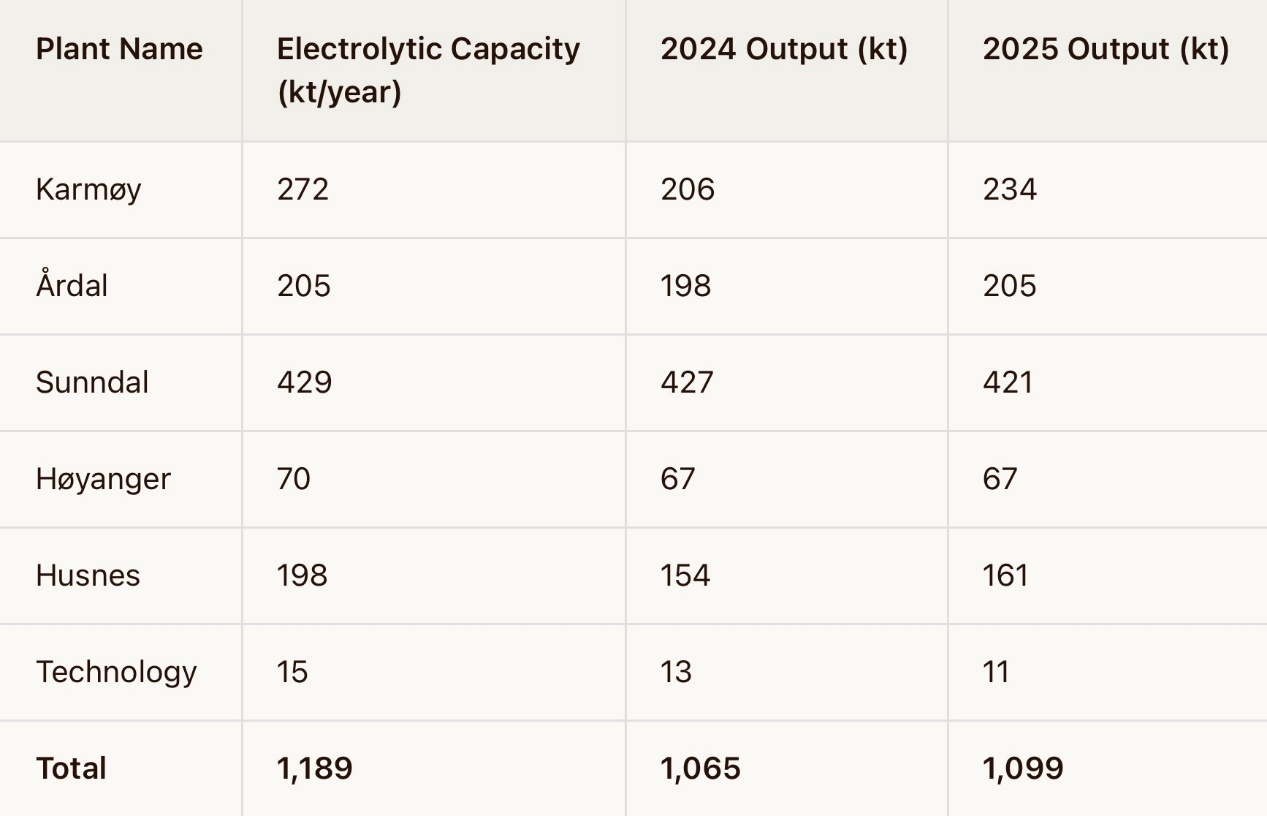
Hydro's Norwegian aluminium smelter capacity and output for 2025 are summarized as follows:
Source: Mysteel
Based on compiled data for Hydro's Norwegian smelters in 2025, the ongoing recovery appears concentrated at Karmøy and Husnes, while the remaining plants are already operating at or near full capacity. Using the quarterly 9,000-tonne gain as a reference, the Q2 restart equates to at least 40,000 tonnes per annum of capacity, suggesting limited additional upside going forward.
Slovalco (Slovakia): Full restart remains uncertain
On July 1, Hydro announced plans to restart 75,000 tonnes of capacity at its Slovalco smelter in Slovakia (around 43% of the site's total 175,000 tonnes). The restart is scheduled to begin in H2 2026, with aluminium output expected to ramp up from the fourth quarter. Two key drivers underpin the decision: a long-term power purchase agreement (PPA) signed between Slovalco and local utilities, and an agreement between Hydro and the Slovak government regarding compensation for indirect carbon costs.
However, the latter remains contingent on formal approval by the European Commission. As for the remaining 100,000 tonnes of capacity, any further restart will depend on post-2030 framework conditions and the availability of additional power contracts, both of which remain uncertain at this stage.
Outlook
Overall, Hydro's Q2 capacity profile reflects a global aluminium supply chain still undergoing structural rebalancing. On one hand, the disruption caused by Middle East tensions continues to linger, with Qatalum operating at only around 60% utilization and no meaningful recovery prior to July.
On the other hand, supported by higher aluminium prices and policy incentives, European domestic capacity is gradually being repaired, evidenced by the continued ramp-up in Norway and the partial restart announcement at Slovalco. That said, the pace remains slow, and the sustainability of these recoveries hinges on the execution of long-term power agreements and the continued implementation of carbon cost compensation mechanisms.
In conclusion, it is clear that the recovery of aluminium capacity in the Middle East is proceeding far more slowly than the market had anticipated, consistent with Mysteel's previous analysis. Mysteel will continue to monitor upcoming reports and capacity developments among overseas aluminium producers.
Written by Regina WANG
wangjiaqie@mysteel.com