Reassessing Indonesia's nickel ore supply-demand balance in 2026 after the RKAB quota turmoil
Introduction: A Quota Rumor Triggers a Nickel Price Rollercoaster
Recently, market rumours circulated that a major Indonesian nickel mining company had been granted an additional RKAB quota of 25 million wet metric tonnes of nickel ore, with market expectations suggesting that the company's full-year 2026 quota could rise from 12 million to approximately 37 million tonnes. Driven by expectations of increased supply, the SHFE nickel main contract quickly retreated, falling from above Yuan 133,000/tonne to around Yuan 127,000/tonne, as market expectations of looser Indonesian nickel ore supply intensified.
However, the following day, Indonesia's Ministry of Energy and Mineral Resources (ESDM) clarified the market rumours. The government stated that while the company had indeed submitted a 25-million-tonne supplementary application, the application did not equate to approval, and no official approval documents had been issued to date, with the company's 2026 base RKAB remaining at 12 million tonnes. Following the reversal of the news, nickel prices recovered. Meanwhile, on August 7, weaker-than-expected US nonfarm payrolls data further reinforced macro-level support.
A quota rumour that had yet to receive formal approval triggered notable short-term price volatility in nickel, reflecting the market's heightened sensitivity to changes in Indonesian nickel ore supply.
So, what is the actual state of Indonesia's nickel ore supply-demand balance in 2026?
Considering base RKAB, subsequent supplementary quotas, Philippine ore imports and other factors, can full-year nickel ore supply cover downstream NPI, nickel matte and MHP production demand? Based on Indonesia's major nickel product output, combined with ore consumption parameters across different process routes, Mysteel has re-estimated the 2026 nickel ore supply-demand balance.
I. Demand Side: Nickel Metal Output Declines, Yet Wet Tonne Ore Consumption Rises
In 2026, Indonesia's nickel ore demand primarily comes from downstream NPI, nickel matte and MHP production. Mysteel tracks Indonesia's major nickel product output and production schedules, combined with parameters such as feed grade, moisture content and recovery rates corresponding to different production routes, to estimate actual nickel ore consumption for the full year.
In terms of production routes, Indonesia's nickel industry chain is primarily divided into pyrometallurgical and hydrometallurgical processes. The pyrometallurgical route mainly includes NPI, ferronickel (FeNi) and nickel matte (including high-grade and low-grade matte); the hydrometallurgical route is primarily focused on MHP production.
In 2026, Indonesia's major nickel product output is expected to decline year-on-year. On the pyrometallurgical side, production schedules at some lines have slowed due to the tightening of RKAB at the start of the year and increased profitability pressures at certain smelting projects. On the hydrometallurgical side, MHP output has also been affected by sulphur supply disruptions and temporary production cuts at some projects. According to Mysteel tracking data, Indonesia's nickel metal production is expected to decline from approximately 2.665 million tonnes in 2025 to an estimated 2.571 million tonnes in 2026.
However, it is noteworthy that while nickel metal output has declined, actual nickel ore consumption in wet tonnes has increased. The core reason lies in changes in ore quality this year.
Market participants generally use historical ore consumption parameters to estimate nickel ore demand. However, since 2026, as Indonesian nickel ore supply has tightened, smelter procurement structures have shifted, and the actual ore grades used have declined. For example, the feed grade for the pyrometallurgical RKEF process has fallen from an average of approximately 1.55% last year to around 1.45% this year; the feed grade for the hydrometallurgical HPAL process has also declined from around 1.2–1.3% previously to approximately 1.0–1.2%. At the same time, recovery rates for certain processes have also changed compared to last year.
When producing the same amount of metal product, a decline in ore grade means that more wet tonnes of ore are required, so ore consumption does not simply move in tandem with metal output.
Mysteel uses the following formula for estimation:
Nickel ore consumption = Nickel metal output ÷ Nickel ore grade ÷ Recovery rate ÷ (1 - Moisture content)
Based on parameters across different product routes and actual operating conditions, Indonesia's nickel ore demand in 2026 is estimated at approximately 312 million wet metric tonnes, with monthly average ore consumption in the second half of the year expected to be around 25–28 million wet metric tonnes.
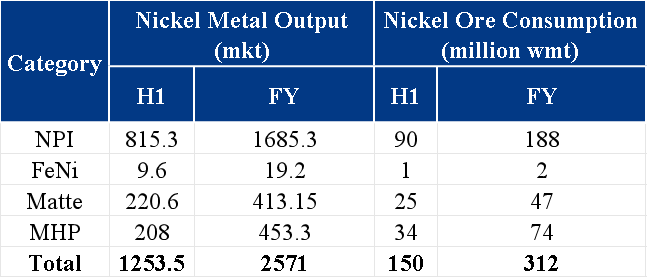
It is important to emphasize that the biggest difference in this year's ore consumption estimates compared to previous years is that historical ore consumption coefficients cannot be simply applied. When ore grades decline, even if nickel metal output decreases, the actual wet tonne ore consumed by smelters may still increase. Therefore, when assessing Indonesia's 2026 nickel ore supply-demand balance, greater attention should be paid to actual ore consumption rather than simply observing changes in nickel product output.
II. Supply Side: RKAB Determines Supply Ceiling, Supplementary Quotas a Key Variable
Unlike the relatively certain demand side, Indonesia's nickel ore supply in 2026 still faces considerable uncertainty, with the core variable being the final approval status of RKAB supplementary quotas. Indonesia has abundant nickel ore resources, and mining capacity is not the supply bottleneck; the key factor currently determining the supply ceiling is the RKAB quota approved by the government. In 2026, Indonesia's nickel ore RKAB mechanism shifted from the previous three-year cycle to an annual approval system, with the national nickel ore RKAB target set at approximately 260–270 million wet metric tonnes, down more than 30% from the final approved level of approximately 379 million wet metric tonnes in 2025.
From a full-year supply perspective, Indonesia's nickel ore consists of three components:
(1) Approved RKAB supply.
At the start of 2026, the Indonesian government approved nickel ore mining plans under the new RKAB system, with the current national base quota at approximately 260–270 million wet metric tonnes. As the initial quota is significantly lower than last year's actual supply level, the market has expressed some concern over supply in the second half of the year.
(2) Supplementary RKAB supply.
Under Indonesia's RKAB system, mining companies can submit one adjustment application mid-year. After the July 31 supplementary application window closed, the market began to hear reports that some large mining companies had received additional quota approvals. Among these, the rumoured 25-million-tonne supplementary quota for a large nickel mining company--which triggered the recent nickel price volatility--remains at the market rumour stage with no official approval documents issued. The additional quota volumes for other mining companies will be a key variable determining full-year nickel ore supply flexibility.
(3) Imported ore supply.
As domestic ore supply is constrained by RKAB, imports from the Philippines have become an important supplementary source. In the first half of 2026, Indonesia imported approximately 8.57 million wet metric tonnes of nickel ore from the Philippines, with full-year imports expected to reach around 20 million wet metric tonnes.
Looking at major nickel mining companies, the current situation shows that "some companies have sufficient quotas while others are awaiting adjustments," with subsequent supply increments mainly concentrated in the RKAB adjustment room of large mining companies.
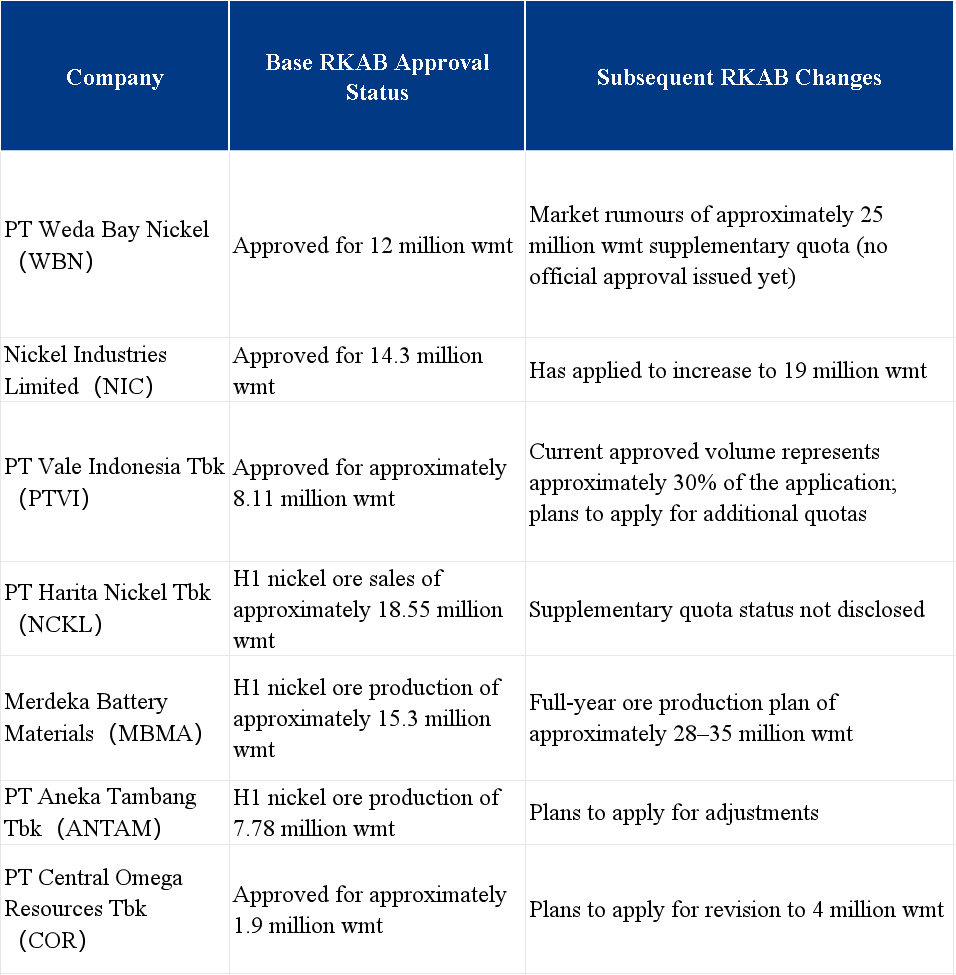
Overall, the core of Indonesia's 2026 nickel ore supply is not whether resources are sufficient, but rather the pace of RKAB releases and the scale of supplementary quota volumes. Under the combined effect of base RKAB, imported ore and subsequent supplementary quotas, there remains some flexibility in actual full-year supply--this is the biggest variable in judging the nickel ore supply-demand balance going forward.
III. Supply-Demand Balance: Under Static Estimates, a Full-Year Nickel Ore Supply Gap Remains
Combining the above estimates, Indonesia's nickel ore demand in 2026 is approximately 312 million wet metric tonnes. On the supply side, known supply primarily consists of three components: base RKAB, subsequent supplementary quotas and imported ore.
Among these, Indonesia's 2026 base RKAB target is approximately 260–270 million wet metric tonnes. For Philippine ore imports, full-year imports are expected to reach approximately 20 million wet metric tonnes. If only these two components are considered, full-year nickel ore supply would be approximately 280–290 million wet metric tonnes, leaving a gap of approximately 30 million wet metric tonnes against full-year demand.
If the rumoured 25-million-tonne supplementary quota for a large nickel mining company, as well as potential approvals for other nickel mining companies, are further considered, full-year supply could increase to approximately 305–320 million wet metric tonnes. On a static basis, this would broadly cover or even exceed full-year nickel ore demand.
However, it should be noted that supplementary quotas still face approval uncertainties, and the final scale of supplementary applications from other mining companies has also not been fully determined. Therefore, as of now, Indonesia's 2026 nickel ore supply cannot be simply defined as either in deficit or surplus.
From a static balance perspective, the full-year nickel ore supply-demand balance is in a tight equilibrium:
- If supplementary quota releases fall short, supply may be below actual demand;
- If supplementary quotas are smoothly implemented, supply may cover full-year production demand;
- However, even if supply reaches around 320 million tonnes, there would only be limited surplus compared to the demand scale.
Therefore, the core issue in Indonesia's 2026 nickel ore market is not whether resources are sufficient, but how much supplementary RKAB volume will ultimately be released, and whether the pace of release can match downstream production demand.
IV. Refinements to the Balance Estimates
The above estimates indicate that Indonesia's nickel ore demand in 2026 is approximately 312 million wet metric tonnes, while the currently known supply scale varies depending on supplementary quota releases--after supplementary quota releases, it could reach 320 million wet metric tonnes. From a static balance perspective, full-year nickel ore supply may be in a tight equilibrium.
However, in actual industry operations, nickel ore supply-demand dynamics are not simply matched on an annual supply-versus-demand basis; two additional factors need to be considered: safety redundancy and industry chain inventory.
1. Safety Redundancy: Actual Demand Requires Higher Supply Assurance
Nickel ore RKAB quotas do not equate to final effective supply. Mining operations may be affected by weather, equipment, transportation and other factors, and actual output may fall short of quotas. At the same time, there may be mismatches between quota approval timing and smelter production schedules.
Therefore, the industry typically does not operate on a "approve quotas exactly in line with demand" basis; a certain percentage of supply redundancy needs to be maintained to cover risks such as resource mismatches between companies, production fluctuations and timing mismatches.
Based on historical experience, nickel ore supply typically needs to exceed actual consumption by approximately 5–10%. Based on 2026 demand of approximately 312 million wet metric tonnes, a supply scale of over 330 million tonnes would theoretically be required to achieve a relatively stable supply state.
From this perspective, even if supplementary RKAB is smoothly released, Indonesia's 2026 nickel ore supply would not be loose.
2. Park Inventory: A Buffer for Short-Term Supply Pressure
Beyond the supply-demand balance sheet, industry chain inventory is also an important factor affecting actual supply pressure.
In the first half of 2026, under tight RKAB approvals, most Indonesian nickel smelters still maintained normal production--one important reason being the ore inventories built up from earlier procurement. According to Mysteel surveys, most industrial parks in Indonesia currently hold significant nickel ore inventories. Based on a conservative estimate of two months of safety stock, the corresponding inventory scale would be approximately 50 million wet metric tonnes. This inventory can provide a buffer for smelters when supplementary quota releases are insufficient or supply pace is slow, allowing actual production to not rely entirely on current-period incremental ore supply.
However, it should be noted that inventories are more of a "reservoir" than a new source of supply. Under normal circumstances, smelters do not resell their own ore inventories to the market, so inventory can reduce supply tightness risks but will not create additional surplus in the nickel ore market.
Overall, Indonesia's 2026 nickel ore market remains in a rather delicate state: safety redundancy means that actual supply requirements exceed theoretical balance, while park inventory provides a buffer for periodic supply shortfalls. Therefore, the current market is neither simply nor statically in "shortage" or "surplus"--the key going forward remains the ultimate scale and pace of supplementary RKAB releases.
V. Future Outlook: Focus on Supply Release Pace, Nickel Prices Require Comprehensive Multi-Factor Assessment
1. Nickel Ore Supply-Demand Balance: Supplementary RKAB, Imports and Demand Changes Will Determine Second-Half Trajectory
Based on the current situation, the core issue in Indonesia's 2026 nickel ore market is not resource insufficiency, but whether supply releases can match downstream production demand.
On the supply side, further supplementary RKAB approvals bear watching. If more mining companies' supplementary quotas are smoothly implemented, Indonesian nickel ore supply pressure will be further alleviated; if the supplementary scale falls short of expectations, full-year nickel ore supply may remain relatively tight.
Beyond RKAB, Philippine ore imports are also an important variable affecting second-half supply. In the first half of 2026, Indonesia imported approximately 8.57 million wet metric tonnes of Philippine nickel ore, with full-year imports expected to reach around 20 million tonnes. However, with the Philippines entering the rainy season in the second half of the year, weather factors may affect mine production and export schedules--whether actual imports meet expectations requires continued monitoring.
On the demand side, nickel ore consumption also has room for variation. Although Mysteel estimates full-year nickel ore demand at approximately 312 million wet metric tonnes, actual second-half consumption still depends on changes in Indonesia's nickel product output. For example, hydrometallurgical project production is significantly affected by sulphur supply--if raw material supply is disrupted again, MHP output may be adjusted; pyrometallurgical projects remain affected by NPI margins and smelter operating conditions.
Therefore, Indonesia's 2026 nickel ore supply-demand balance still faces multiple variables, and the market needs to focus on:
- The final scale of supplementary RKAB approvals;
- The pace of new quota releases;
- Actual Philippine ore import arrivals;
- Changes in downstream nickel product output.
Based on current estimates, if supplementary quota releases meet market expectations, full-year nickel ore supply-demand is likely to remain in a tight balance; if supply releases fall short of expectations, ore-side pressure may intensify periodically.
2. Nickel Price Trends: Fundamentals Provide Underlying Support, Macro and Policy Factors Drive Short-Term Volatility
From a fundamental perspective, changes in Indonesia's 2026 nickel ore supply-demand will affect industry chain profit distribution and market sentiment, but cannot fully determine nickel price trends.
In recent years, the global nickel market has long been characterized by rapid supply growth, and the release of new nickel product capacity in Indonesia remains an important factor affecting nickel prices. Therefore, even if Indonesian nickel ore becomes periodically tight, it is more reflected in profit redistribution within the industry chain and changes in price elasticity.
In the short term, nickel prices still need to consider multiple factors.
On the macro front, changes in US Federal Reserve monetary policy, dollar trends and changes in global manufacturing demand will affect overall risk appetite for non-ferrous metals.
On the policy front, Indonesia's nickel industry policies remain a market focus, including RKAB approval pace, export management policies and changes in nickel product export regulations, all of which may trigger periodic market movements.
On the cost front, sulphur supply remains an important variable affecting hydrometallurgical project operations. The earlier disruption to Strait of Hormuz shipping led to tight sulphur supply and production cuts at some MHP projects; subsequent developments in Middle East geopolitics and sulphur trade recovery still bear watching.
Overall, the core logic of the 2026 nickel market is not a simple supply shortage, but rather a search for a new balance among Indonesian policy adjustments, industry chain cost changes, global supply-demand patterns and the macro environment. Tight nickel ore supply-demand may provide support for prices, but whether it can sustain an upward trend still requires comprehensive assessment in conjunction with the global nickel industry supply-demand landscape and external factors.
Nickel sulfate prices: China
Sep 28, 2026 12:09
Nickel ore prices: China's major cities
Sep 28, 2026 11:31
MHP seaborne cargo prices: CIF China
Sep 28, 2026 11:30
Nickel ore offer prices: Philippines
Sep 28, 2026 11:29
Nickel ore freight rates to China
Sep 28, 2026 11:29