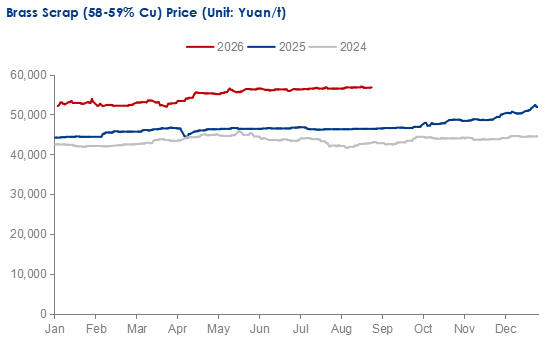
China's brass scrap market has remained notably resilient despite fluctuations in copper prices. Since Q4 2025, prices have generally moved higher alongside copper, staying well at historically high levels and showing a tendency to rise more readily than fall. As of August 25, 2026, the mainstream market price of mixed brass scrap reached Yuan 57,500/tonne, nearly Yuan 10,000/tonne above the same period last year. Behind this resilience lies a combination of tightening domestic scrap supply, increasingly reluctance to sell among upstream holders, and demand growth from the smelting sector.
Source: Mysteel
Tight supply underpins price resilience
From the supply side, the persistent firmness of brass scrap prices in China is primarily rooted in difficulties in domestic scrap collection, which have been further reinforced by upstream market sentiment and trading strategies.
First of all, China's property sector and other traditional end-use industries remain in an adjustment cycle, resulting in a significant decline in scrap generation from these sources, which has directly tightened the availability of brass scrap in the domestic market. Meanwhile, a large proportion of available brass scrap is dispersed among small-scale dealers, who tend to be highly sensitive to price movements. When copper prices decline, these collectors are often reluctant to sell and instead hold back material in anticipation of a rebound. Consequently, limited low-priced scrap enters the market, providing firm support for brass scrap prices.
Additionally, upstream inventory strategies further amplify this effect. During periods of rising copper prices, some traders with scrap inventory accumulated at lower levels are willing to release and lock in profits. However, many tend to be bullish and prefer to hold inventory in anticipation of further price gains, limiting the amount of scrap available for immediate trading. When copper prices undergo a moderate correction, upstream selling interest tends to weaken even further. The resulting contraction in spot supply amid frequent copper price fluctuations makes it difficult for brass scrap prices to decline, reinforcing their characteristic of being more responsive to upward movements than downward corrections.
Emerging smelting demand adds support
From the downstream demand side, the currently weak traditional brass processing sector is unlikely to support brass scrap prices. Stronger support instead comes from copper smelting, particularly amid tight copper concentrate supply.
Persistently tight copper concentrate supply has improved the economics of producing copper anodes from brass scrap, encouraging an increasing number of scrap processors to shift toward anode production, creating additional competition for brass scrap. Meanwhile, according to market feedback, traditional brass-processing methods often involve sacrificing part of the zinc recovery in order to recover copper, while zinc volatilization may also create environmental concerns. Advanced copper-zinc separation furnaces, however, can raise zinc recovery rates from scrap to above 98% while significantly improving the purity of the recovered copper melt. The resulting copper product can be used directly as feedstock for high-quality refined copper or precision copper products. As more copper-zinc separation plants achieve stable operations, competition for limited scrap resources is likely to intensify. This provides an increasingly important structural floor for brass scrap prices. Market sources indicate that orders for copper-zinc separation equipment have become increasingly backlogged since H2 2025, with delivery schedules extending accordingly, suggesting that capacity expansion in this sector remains underway.
Supply-demand balance to stabilize prices
Moving forward, traditional downstream brass processors are increasingly reluctant to accept high raw material costs amid weak end-user demand, likely suppressing brass scrap prices. In addition, increasingly stringent invoicing policies could further raise transaction costs and weaken market circulation, potentially placing additional pressure on the price upside.
Nevertheless, stronger demand from the copper smelting sector, as well as the gradual stabilization of China's copper-zinc separation industry, should help establish a more stable source of rigid demand for brass scrap. This demand, together with constrained domestic scrap generation and the tendency of upstream holders to withhold material during price fluctuations, should continue to provide a solid floor under prices.
Overall, China's brass scrap market is likely to remain structurally firm in the near term, but its price trajectory may gradually become steady, with tight supply and emerging structural demand supporting the downside while weaker traditional consumption caps the upside.
Written by Mingyuan Wang, wangmingyuan@mysteel.com