China's Q4 refined-product exports: ample quota headroom, but domestic supply needs will determine shipments
China has scope to increase refined-product exports in Q4 2026, with available quotas estimated to be around 40% higher than actual exports in Q4 2025. Although the third-batch allocation was roughly half the size of the corresponding allocation last year, more than 9 million tonnes of the second batch remained unused as of September.
A recovery in refinery runs in November and December should increase exportable supply, while attractive export economics provide an incentive to ship more barrels. However, quota availability alone will not determine realised volumes. China's domestic supply-security requirements, crude availability and inventory conditions will dictate how much incremental output can reach overseas markets. The key question is whether additional refinery throughput translates into physical export growth.
| Quotas are ample, but actual shipments will depend on execution
China's third batch of refined-product export quotas has been issued, in line with GL Consulting's September outlook. Although the latest allocation was roughly 50% lower year on year, more than 9 million tonnes of the second batch remained available as of September.
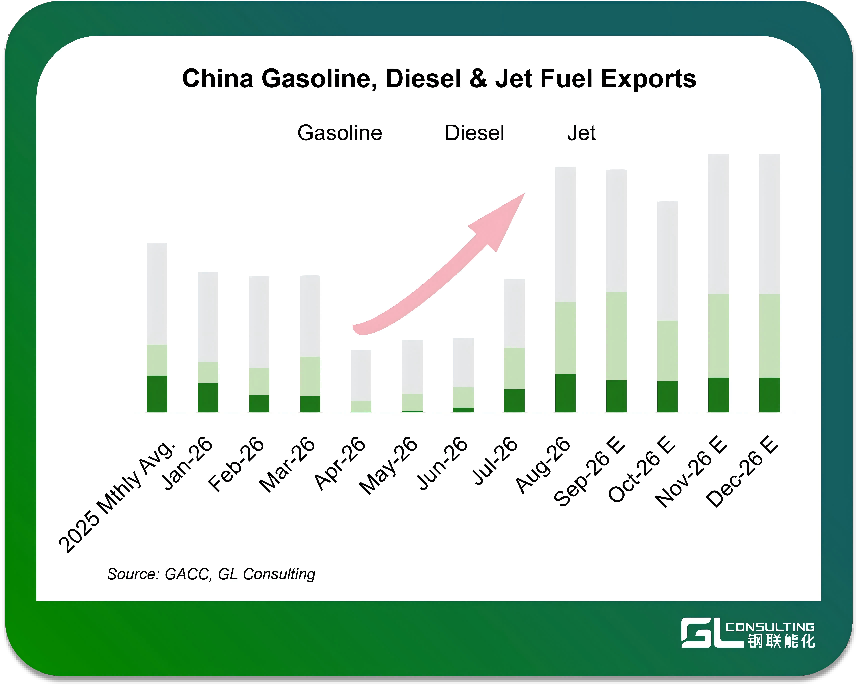
GL Consulting (premium think tank under Mysteel Group) estimates that the total quota available for Q4 is approximately 40% higher than actual export volumes in Q4 2025. On this basis, quota availability alone is unlikely to be the main constraint on export growth.
The commercial incentives are also supportive. China's domestic gasoline and diesel demand remains uneven, while export economics are attractive. As maintenance at Sinopec refineries eases and throughput recovers, additional barrels should become available for export in November and December.
However, ample quota headroom does not guarantee higher shipments. Domestic supply-security requirements, the pace of crude replenishment and changes in refined-product inventories could all affect the timing and volume of exports.
For market participants, actual export loadings will therefore be a more reliable indicator of incremental supply than quota allocations alone.
| Refinery runs are expected to recover in November–December, led by Sinopec
GL Consulting forecasts China's crude throughput to edge down by 0.5% month on month in October. Refined-product exports were temporarily suspended during the National Day holiday, and additional time is required for shipments to resume following the latest quota release. These factors may delay the translation of quota availability into physical export flows.
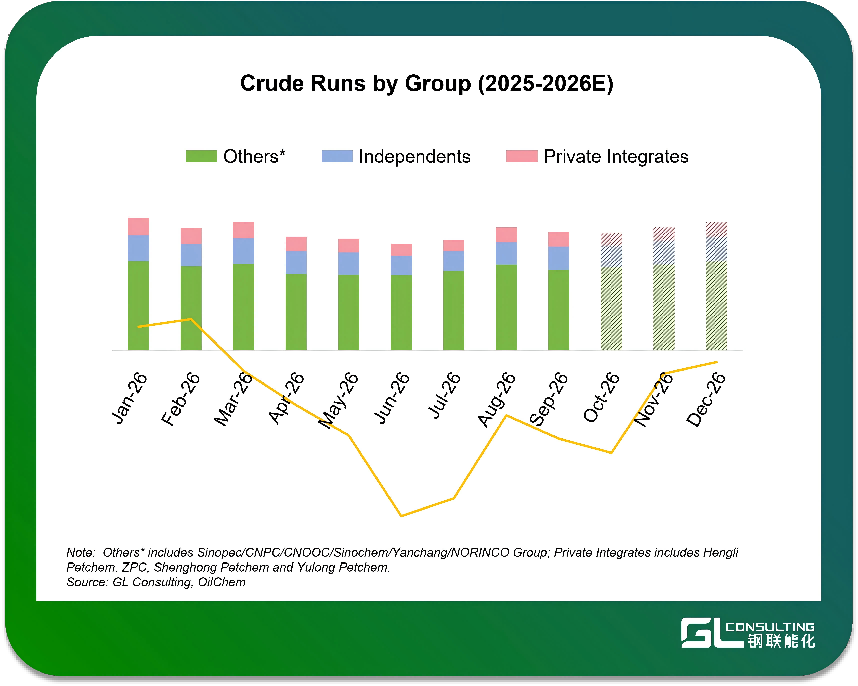
A recovery in throughput is expected in November and December, supported by three developments: previously purchased, lower-priced crude arriving at independent refineries; the gradual completion of maintenance at Sinopec facilities; and the allocation of additional export quotas to Sinopec.
The recovery, however, is unlikely to be uniform across refining groups.
Dalian Petrochemical is expected to resume operations in the second half of November. At the same time, PetroChina's maintenance activity is set to increase from November and reach a peak in December. As a result, PetroChina's throughput is expected to remain below its October level in both months.
A national recovery in refinery runs will not necessarily translate into higher output across all refiners. Incremental export volumes are more likely to be concentrated at Sinopec, where recovering processing capacity and greater quota availability are expected to coincide.
| Diverging gasoline and diesel demand will shape inventories
China's refined-product demand outlook remains uneven across product categories.
Gasoline: GL Consulting forecasts consumption to decline by 3.3% quarter on quarter in Q4, reflecting the seasonal slowdown following the National Day travel peak and continued substitution by new-energy vehicles.
Diesel: Consumption is expected to increase by 5.2% quarter on quarter, supported by year-end construction activity and improving freight demand. Structural substitution and cost pressures, however, are still expected to weigh on year-on-year performance.
As refinery runs recover, weaker gasoline demand and diesel supply growth exceeding demand growth should create scope for domestic refined-product inventories to bottom out and rebuild.
The scale of any inventory recovery will depend heavily on export execution.
If exports increase as expected, overseas markets will absorb a larger share of incremental supply, helping to contain domestic stock accumulation. If exports are delayed or restricted, more barrels will remain in the domestic market, increasing the risk of inventory builds and renewed pressure on refining margins.
Exports will therefore be a key balancing variable in China's Q4 refined-product market. The same increase in refinery output could result in higher overseas shipments or greater domestic stock accumulation, depending on how much supply refiners are permitted and incentivised to export.
| Crude arrivals are improving, but a sustained recovery in feedstock supply remains unconfirmed
China's crude arrivals have shown signs of improvement. Under the weekly arrival tracking used in this analysis, arrivals in the second week of October reached their highest level since July, with the increase driven primarily by Saudi Arabia and Brazil.
The improvement should support refinery throughput in the weeks ahead. However, a single week of higher arrivals is insufficient to confirm a sustained easing of feedstock constraints.
Two questions remain critical: will the stronger arrival rate persist, and will additional crude be directed towards refinery processing or inventory accumulation?
The distinction matters for the export outlook. Sustained crude arrivals would give refiners greater scope to raise runs and release more refined products to overseas markets. If arrivals weaken again, feedstock constraints could limit the anticipated recovery in processing and shipments.
Crude arrivals should therefore be assessed alongside refinery runs and inventory movements, rather than treated as a standalone indicator of supply recovery.
| Three variables will determine whether the export upside materializes
Export loadings
Physical shipments will show whether available quotas are translating into trade and how much incremental supply overseas markets can absorb. Loading data should carry more weight than quota announcements when assessing the near-term export trajectory.
Refinery runs and crude arrivals
The anticipated recovery in November and December will depend on crude availability and the timing of refinery maintenance. The divergence between Sinopec and PetroChina will be particularly important in determining where incremental exportable volumes originate.
Domestic supply security and overseas crack spreads
Even with attractive export economics, domestic supply requirements may limit the volume refiners can ship overseas. A renewed increase in Russian product supply or a decline in overseas refining crack spreads could also weaken export incentives. Conversely, firm overseas margins and sufficient domestic inventories would improve the prospects for higher shipments.
Together, these variables will determine whether available quotas translate into a material increase in exports or remain underutilized.
| GL Consulting's View: export growth is possible, but domestic balancing will determine the scale
China enters Q4 with substantial quota headroom and the prospect of recovering refinery throughput. On the supply side, November and December should benefit from the completion of Sinopec maintenance and the arrival of crude previously purchased by independent refiners.
On the demand side, weaker gasoline consumption and slower diesel demand growth relative to supply should create scope for additional barrels to move overseas.
The upside, however, remains conditional.
The decisive question is not how much quota China has available, but how much incremental refinery output can be released to overseas markets without compromising domestic supply security or destabilising inventories.
GL Consulting will continue to track export loadings, refinery throughput, regional refined-product inventories, domestic wholesale-to-retail price spreads and policy guidance, identifying deviations between actual market developments and the baseline forecast.
| Track China's refined-product market with China Oil Market Outlook
GL Consulting's latest China Oil Market Outlook Monthly - October 2026 examines the outlook for Q4 refined-product exports, refinery throughput, gasoline and diesel demand, and domestic inventory movements.
The report also assesses how crude supply, overseas refining crack spreads and domestic supply-security requirements could affect export execution.
To request the full report or the implications for China's refined-product exports and regional product supply, please contact the GL Consulting team at inquiries@mysteel.com.
Iron ore concentrates prices: China's major miners
Oct 17, 2026 11:01
Iron ore concentrates procurement prices: Shandong major mills
Oct 16, 2026 21:10
Coke export prices: FOB China
Oct 16, 2026 21:08
Mysteel Iron Ore Index
Oct 16, 2026 18:59
Imported iron ore prices: China's major cities
Oct 16, 2026 18:26