2025 Global Bunkering Rankings: Zhoushan enters top three as Chimbusco retains supplier lead
The results, released at the 9th World Oil Traders Conference in Zhoushan, place Singapore first with 56.18 million tonnes of marine fuel supplied, followed by Rotterdam and Zhoushan. China Marine Bunker (PetroChina), or Chimbusco, retained its position as the world's largest bunker supplier, reporting sales of 28.16 million tonnes.
Zhoushan's rise follows several years of expansion. The Chinese port entered the global top 10 in 2018, climbed to eighth in 2019 and fifth in 2021, and reached fourth in 2024 before entering the top three in 2025.
The latest rankings also incorporate an expanded reporting scope for Chinese ports, covering both bonded and domestic marine fuel supply. The change provides a broader measure of bunkering activity, although it requires care when comparing reported volumes with previous years.
Among suppliers, the combined sales of the global top 10 declined by 0.9% year on year to approximately 167.9 million tonnes. Individual results varied, reflecting differences in physical supply networks, geographic exposure and commercial priorities.
| Global Bunkering Ports: Zhoushan Joins the Top Three
Singapore maintained a substantial lead in global bunkering activity in 2025, supplying 56.18 million tonnes of marine fuel. Rotterdam ranked second, followed by Zhoushan with 8.54 million tonnes.
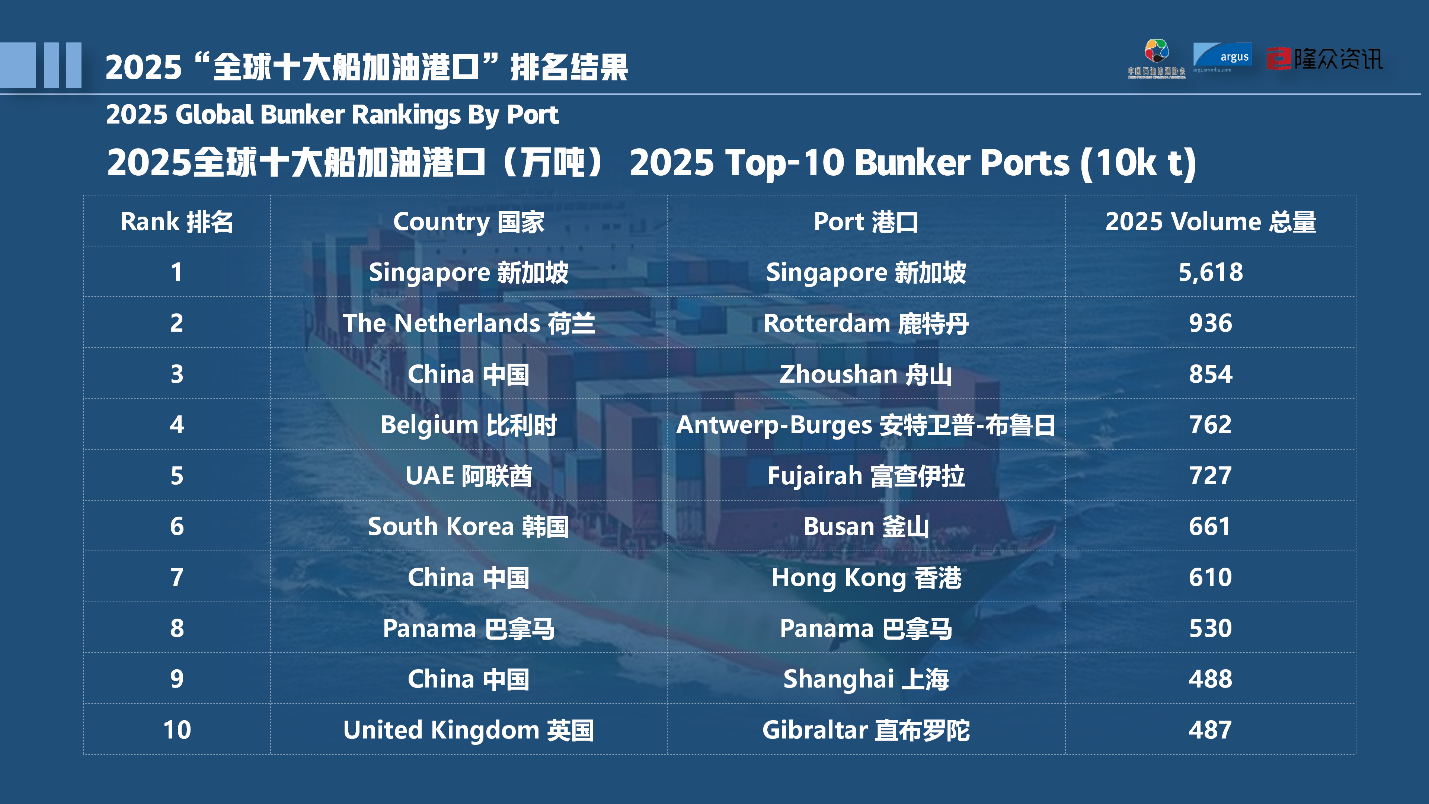
Source: Argus and Mysteel OilChem, 2025 Global Bunkering Rankings.
Zhoushan's rise reflects sustained growth in bonded fuel supply
Zhoushan's progress in the rankings has accompanied the expansion of its bonded bunkering business. In 2025, bonded marine fuel supply reached approximately 8.027 million tonnes, an increase of 10.56% year on year. Domestic marine fuel supply contributed a further 515,500 tonnes.
The port's position in the global rankings has advanced considerably since 2018, supported by its development as a marine fuel supply centre serving international shipping activity along China's eastern coast.
However, the change in reporting scope is important. Beginning with the 2025 rankings, Chinese port volumes include domestic marine fuel supply alongside bonded fuel. Earlier rankings used a narrower scope, meaning the latest total is not directly comparable with historical bonded-only figures.
The 10.56% increase in bonded supply provides a more consistent indication of Zhoushan's underlying growth in 2025.
Competition among bunkering hubs extends beyond supply volume
Zhoushan's growing scale strengthens its position among established bunkering centres in Asia and Europe. Its ability to gain further market share will depend on delivered fuel costs, supply availability, vessel turnaround efficiency and the range of marine fuels offered.
Singapore's lead remains substantial, reflecting the scale of its established bunkering operations. For emerging hubs such as Zhoushan, further growth will depend on the ability to attract international shipping customers through competitive pricing and reliable services.
| Global Bunker Suppliers: Chimbusco Maintains Its Lead
Chimbusco retained first place among global bunker suppliers in 2025, with sales of 28.16 million tonnes. Bunker Holding ranked second at 24 million tonnes, followed by Sinopec Fuel Oil Sales at 21.27 million tonnes.
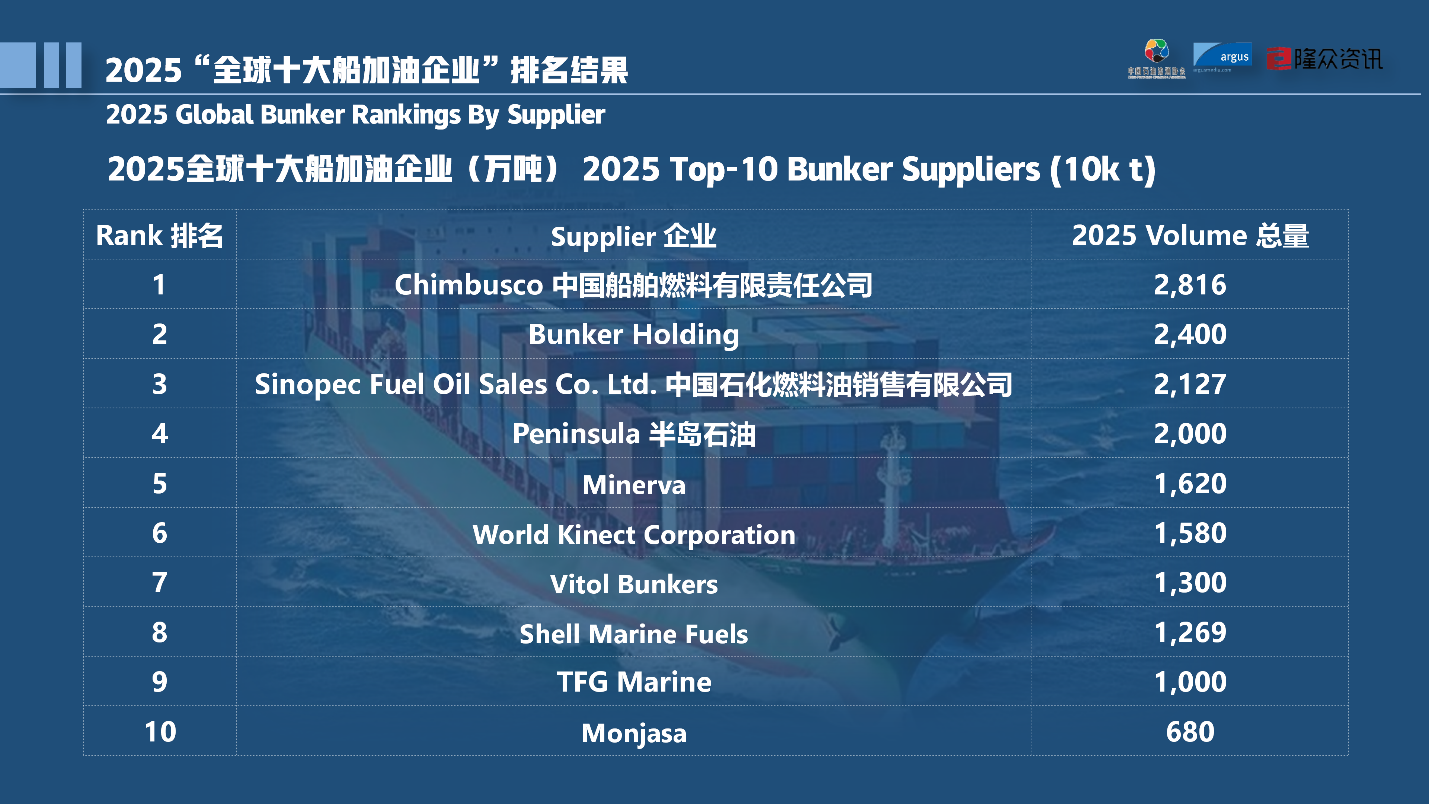
Source: Argus and Mysteel OilChem, 2025 Global Bunkering Rankings.
Supplier performance diverges as commercial strategies evolve
The 10 largest bunker suppliers recorded combined sales of approximately 167.9 million tonnes in 2025, down 0.9% from the previous year.
Chimbusco's sales were broadly unchanged year on year, maintaining its lead over international competitors. Sinopec Fuel Oil Sales, meanwhile, reported a 10.9% decline in sales to 21.27 million tonnes, although it retained third place.
Peninsula increased its sales by 11.1% to 20 million tonnes, supported by the expansion of its physical supply network. The company's investments across Europe, the Middle East and North America have strengthened its geographic coverage and supply capabilities.
World Kinect Corporation reported a 6.0% decline in sales to 15.8 million tonnes. According to the ranking presentation, the company has placed greater emphasis on profitability, including reducing exposure to certain lower-margin transactions.
The contrast between Peninsula and World Kinect illustrates the different commercial approaches among major bunker suppliers. Physical network expansion can support higher sales volumes and broader customer coverage, while a greater focus on margins may result in lower reported volumes.
These differences are increasingly relevant when assessing supplier performance, particularly in a market where geographic reach, working capital requirements and trading margins can vary considerably.
| Ranking Methodology: Combining Global Coverage with China Market Intelligence
The 2025 Global Top 10 Bunkering Ports and Top 10 Bunker Suppliers rankings were developed through the joint research efforts of Argus and Mysteel OilChem, drawing on global market information, Chinese port statistics and industry-level verification.
The methodology establishes a consistent framework for measuring supplier sales and assessing the scale of bunkering activity across major ports.
End-user sales form the basis of supplier rankings
Supplier rankings measure marine fuel volumes sold directly to end users. Transactions between suppliers and intermediaries are excluded to prevent double counting.
Sales volumes are consolidated at the group level, with subsidiary sales attributed to the parent company. Where a third-party bunker operator physically delivers fuel on behalf of another supplier, the volume is attributed to the supplier responsible for the commercial transaction.
This approach distinguishes commercial sales from physical delivery activity, allowing suppliers with different operating models to be assessed on a consistent basis.
Port statistics and industry verification underpin the assessment
The rankings primarily draw on official statistics published by port authorities and locally available port data, supplemented by company reporting.
These figures are cross-checked against information gathered through Argus's international market coverage and Mysteel OilChem's China-focused industry intelligence, including discussions with major bunker suppliers and fuel users.
The joint approach combines Argus's global marine fuel market coverage with Mysteel OilChem's local data collection capabilities, industry relationships and understanding of China's fuel supply chain.
For Chinese ports, the 2025 methodology includes domestic marine fuel supply in addition to bonded fuel. This broader reporting scope provides a more comprehensive account of marine fuel supplied at Chinese ports, while making historical comparisons dependent on consistent definitions.
Together, these measures improve the transparency of the rankings and provide a clearer basis for comparing commercial sales and physical bunkering activity across different markets.
| What the Rankings Reveal About Global Bunkering Competition
Port growth and supplier performance follow different commercial dynamics
Zhoushan's entry into the global top three and Chimbusco's position as the largest bunker supplier demonstrate China's significant presence across both physical bunkering infrastructure and marine fuel distribution.
However, the two rankings measure different activities.
Port rankings reflect marine fuel supplied at individual locations, while supplier rankings capture sales made by companies operating across multiple markets. A supplier may increase its global sales through geographic expansion without a corresponding rise in volumes at any single port.
This distinction is particularly important when evaluating investment opportunities and competitive positioning across the marine fuel supply chain.
Network coverage and margin management shape supplier strategies
The contrasting performances of Peninsula and World Kinect indicate that sales growth and profitability can lead suppliers towards different operating priorities.
Expanding physical supply networks can improve market access and strengthen relationships with shipowners and operators. At the same time, managing exposure to lower-margin business can support returns, even when reported sales volumes decline.
As a result, supplier rankings are best assessed alongside geographic coverage, delivery capabilities, customer relationships and financial performance.
Alternative marine fuels will influence future investment priorities
The development of LNG, biofuels, methanol and other alternative marine fuels is adding another dimension to competition among bunkering ports and suppliers.
Infrastructure availability, fuel economics, vessel compatibility and regulatory requirements will determine how quickly these products gain market share.
Established hubs benefit from existing supply networks and customer relationships, while expanding ports have opportunities to incorporate alternative fuel infrastructure into their longer-term development plans.
Investment decisions will depend on the pace of fleet adoption and the commercial viability of individual fuel pathways.
| Outlook: Converting Scale into Commercial Advantage
The 2025 rankings highlight China's growing role in the global marine fuel market, with Zhoushan entering the top three bunkering ports and Chimbusco maintaining its leadership among suppliers.
For port operators, the next stage of competition will centre on delivered fuel costs, supply reliability and operational efficiency. Suppliers will face decisions over physical network expansion, geographic coverage and margin management, alongside investment in alternative marine fuel capabilities.
The ranking results also underline the importance of consistent data definitions. Changes in reporting scope, supplier structures and commercial operating models can materially affect comparisons across markets and reporting periods.
The 2025 rankings highlight China's growing role in the global marine fuel market, with Zhoushan entering the top three bunkering ports and Chimbusco maintaining its leadership among suppliers. As marine fuel demand and shipping requirements evolve, pricing competitiveness, supply reliability and the ability to adapt to changing fuel requirements will be central to long-term performance.
GL Consulting, a premium think tank under Mysteel, together with Mysteel OilChem, will continue to monitor developments in China's energy markets, drawing on their combined research expertise and data capabilities to provide insights into the implications for global commodity trading and marine fuel businesses.
Prebaked anode prices: Shandong
Oct 23, 2026 11:25
Ultra-high power graphite electrode prices: China (including origin)
Oct 23, 2026 11:17
Ultra-high power graphite electrode prices: China (including origin)
Oct 22, 2026 11:17
Prebaked anode prices: Shandong
Oct 22, 2026 11:07
Prebaked anode prices: Shandong
Oct 21, 2026 11:12