China's copper scrap market faced a growing disconnect between nominal price competitiveness and actual market activity in the first three quarters of 2026. Although the refined-scrap copper price spread remained wide overall, scrap supply and consumption stayed weak, as reverse invoicing requirements and tighter tax compliance increased procurement costs and restricted domestic circulation. The resulting raw material shortages, combined with weak cost pass-through, weighed on scrap processing activity, and further influenced the broader copper market through weak substitution and falling supplement to smelting raw materials. Consequently, beyond price signals, close attention should also be paid to following tax policy developments and the market's adaptation.
Tighter tax compliance pushes up scrap procurement costs
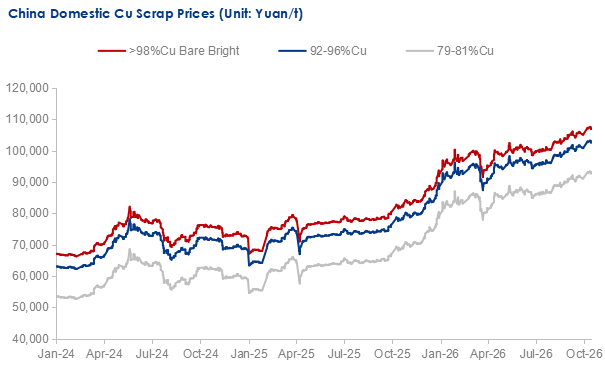
In the first three quarters of 2026, China's copper scrap prices generally fluctuated at elevated levels, supported by rising refined copper prices and increasing invoicing fees. Scrap prices are typically determined against refined copper prices, with adjustments for metal content, discounts and impurities, while invoicing fees have become an increasingly important component of actual procurement costs.
Source: Mysteel
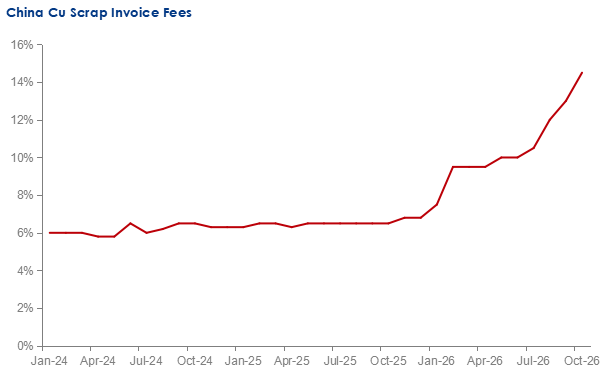
In copper scrap transactions, invoicing fees refer to the additional cost of obtaining compliant value-added tax (VAT) invoices, calculated as a percentage of prices. Market participants need VAT invoices to claim eligible input tax deductions and document procurement costs, but a substantial proportion of domestic scrap comes from individual collectors who cannot provide compliant invoices, making tax documentation a longstanding challenge for recyclers and invoicing fees vary across the industry.
China's reverse invoicing policy was introduced to address this issue by allowing qualified recycling enterprises to issue invoices to individual sellers. However, it caps each individual's cumulative sales invoiced through this mechanism at Yuan 5 million over a rolling 12-month period. Given the high value of copper scrap, this limit poses a practical challenge. At around Yuan 93,400/tonne currently for bare bright copper scrap, it covers only approximately 50 tonnes. A medium-sized processor purchasing thousands of tonnes per month would therefore need to coordinate with numerous individual suppliers to secure sufficient invoiced material, and sellers tend to raise invoicing fees in transactions.
As the policy was more strictly enforced in 2026, quota restrictions and tighter scrutiny of irregular invoicing practices increased the difficulty and cost of compliant procurement. Invoicing fees rose from around 7.5% at the beginning of the year to approximately 15% in October, significantly increasing buyers' costs.
Source: Mysteel
Wider refined-scrap spread fails to boost market activity
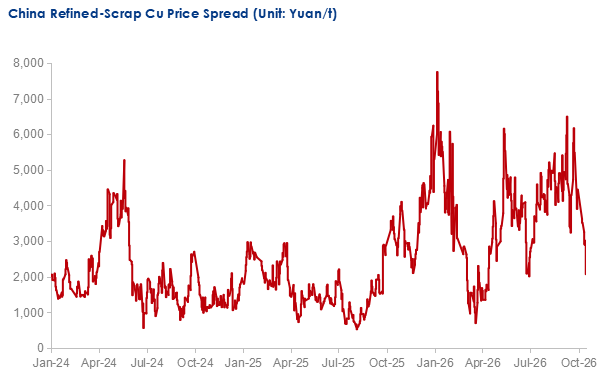
The refined-scrap copper price spread, measured as the spot price difference between refined copper and scrap copper, is a key indicator of scrap's substitution effect. Under traditional logic, a wider refined-scrap spread gives scrap copper a clear cost advantage, prompting downstream processors such as wire and cable manufacturers to increase scrap usage. Recycling enterprises and industrial firms would also accelerate scrap sales to capture profits. As a result, the supply of scrap copper circulating in the market would increase, and downstream consumption would also rise.
Entering 2026, the refined-scrap copper price spread remained generally elevated, supported by refined copper prices rising more notably than scrap. Its monthly average stood at around Yuan 5,500/tonne in January, narrowing during February-March while again fluctuating at high in the third quarter.
Source: Mysteel
Despite the wide spread, however, reverse invoicing and tighter tax compliance requirements made compliant domestic scrap harder and more expensive to obtain. Rising invoicing fees increased procurement costs, while restrictions on invoice issuance limited the volume of scrap entering formal processing channels. Consequently, the wider spread failed to trigger the usual increase in scrap supply or substitution for refined copper, and thus remained a useful indicator of relative prices but became less reliable as a standalone measure of scrap availability and substitution. Reverse invoicing therefore weakened scrap's traditional role as a buffer against rising refined copper prices, contributing to weakness in both scrap supply and demand.
Compliance burdens tighten scrap supply and weigh on processing activity
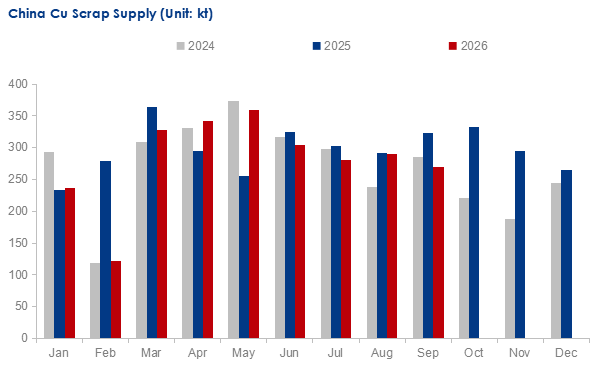
Tighter tax compliance requirements constrained China's copper scrap supply chain in the first three quarters of 2026. According to Mysteel, domestic copper scrap supply totaled 2.55 million tonnes in January-September, down 4.5% from 2.6707 million tonnes during the same period last year.
Source: Mysteel
Rising invoicing fees squeezed recycling margins, prompting some small and medium-sized collection outlets to reduce procurement or even suspend operations. Individual collectors unable to provide compliant invoices also faced increasing difficulties selling scrap into formal processing channels. Consequently, the availability of domestically sourced scrap with compliant documentation declined, making processors more dependent on large, compliant suppliers and reducing domestic supply flexibility.
Processors also increasingly turned to imports to secure raw materials, as imported scrap generally comes with customs import VAT payment documentation. Data from the General Administration of Customs of China (GACC) show that copper scrap imports reached approximately 1.87 million tonnes in January-September, up 10.5% from around 1.70 million tonnes a year earlier. However, the increase was insufficient to offset the decline in domestic circulation, indicating a shift in sourcing channels rather than a broad-based recovery in scrap availability.
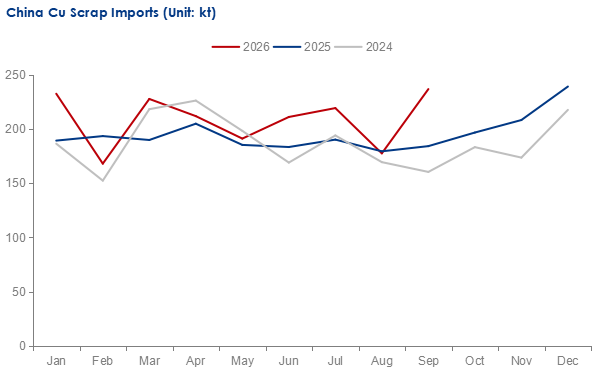
Source: GACC, Mysteel
The resulting feedstock constraints weighed on downstream processing. The average operating rate of secondary copper anode producers fell to approximately 35% in the first three quarters of 2026, down from 39% in the same period last year, while that of secondary copper rod producers dropped from 21% to around 14%, according to Mysteel's survey on sample secondary anode producers with a national capacity coverage of around 47%, and sample secondary copper rod producers with a coverage of about 38%. Some processors were forced to cut output or temporarily suspend operations because they could not secure sufficient raw materials.
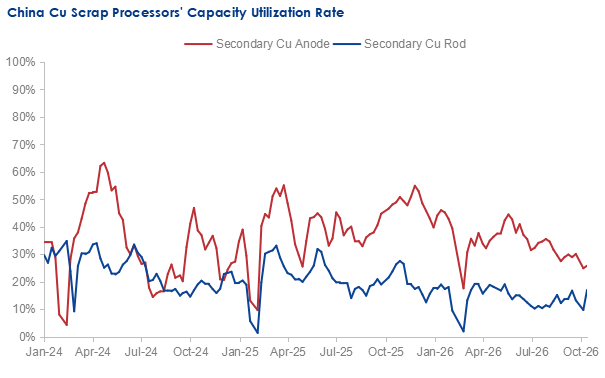
Source: Mysteel
Higher compliance costs further undermined processing economics. Processors faced a trade-off between paying more for scrap with compliant invoices and assuming tax compliance risks when purchasing material without appropriate documentation. Meanwhile, subdued end-user demand and largely needs-based purchasing limited secondary copper rod producers' ability to pass higher procurement costs on to customers, explaining their sharper operating rate declines compared with anode producers.
Together, these factors created a reinforcing cycle of supply constraints and weak processing activity. Compliance burdens reduced domestic scrap availability and raised procurement costs, while raw material shortages constrained production and weak cost pass-through discouraged further purchases. This also explains why the relatively wide refined-scrap copper price spread failed to stimulate a meaningful recovery in scrap consumption, as its nominal cost advantage was increasingly offset by compliance costs, restricted availability and weak downstream profitability.
Q4 Outlook: Persistent policy impact to limit scrap market recovery
China's copper scrap market is likely to remain constrained in the fourth quarter (Q4), under high compliance costs and limited domestic circulation. With tax enforcement remaining strict and Mysteel's latest research identifying no substantial local policy adjustments, domestic procurement difficulties are unlikely to ease significantly. Imports may provide a partial buffer, but the domestic supply shortfall is expected to persist.
High invoicing fees are also likely to continue squeezing processing margins and weighing on purchasing appetite, limiting the recovery in downstream operating rates. In addition, some enterprises may increase procurement toward year-end to meet annual production targets, intensifying competition for compliant scrap and potentially pushing invoicing fees higher.
Mysteel expects bare bright copper scrap prices to range from Yuan 91,000-95,000/tonne in Q4. Firm refined copper prices and tight scrap availability could support scrap prices, although weak downstream demand and limited cost pass-through may cap further gains.
The adjustments in the copper scrap industry could extend to the wider copper market. As compliant scrap becomes scarcer or more expensive, some processors may switch to refined copper, adding to demand when China's refined copper supply has already begun tightening. Meanwhile, reduced availability of scrap and copper anode could constrain supplementary feedstock supplies for smelters and potentially affect production.
Ultimately, the Q4 outlook will depend on compliant scrap availability, import supply and downstream processing economics. Unless domestic circulation improves or compliant procurement costs decline, the market is likely to remain caught between tight feedstock availability and weak processing profitability, with continued spillover effects on China's broader copper market.
Join Mysteel's Q3 Review & Q4 Outlook Copper FREE Webinar to dig deep into the volatile market! Check the link below to learn more, and register NOW to secure your spots:
Written by Mingyuan Wang, wangmingyuan@mysteel.com