China-U.S. trade relations enter a new phase after midterms: implications for energy and chemicals
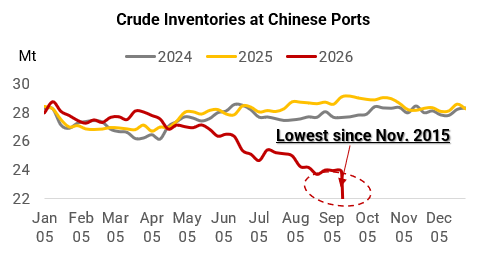
For energy and chemicals markets, the immediate implications extend beyond bilateral trade policy. Renewed volatility in Middle East oil supplies, China's tightening domestic diesel inventories and the potential for energy tariff relief are shaping the outlook. Analysis by GL Consulting (premium think tank under Mysteel Group) suggests that LNG remains the strongest candidate for future tariff concessions, while China's crude purchasing strategy and refined product exports will continue to depend primarily on market fundamentals.
Source: Mysteel OilChem
| Reciprocity Sets the Terms for Further China-U.S. Trade Negotiations
The September 23-25 summit translated the broader framework established in May into a reciprocal tariff-cut arrangement covering approximately $60 billion in bilateral trade. Around 90% of the products included in the proposed lists would return to most-favored-nation tariff rates, subject to further negotiations and implementation procedures.
The agreement covers agricultural products, consumer goods and selected industrial products, while energy commodities remain outside its immediate scope. Detailed product coverage, tariff schedules and implementation arrangements are expected to be addressed through the newly established China-U.S. Board of Trade, with its first meeting scheduled by the end of 2026.
The broader significance lies in the negotiating framework. Reciprocal concessions are increasingly central to discussions over purchases, tariffs and regulatory exemptions. This approach could improve the predictability of bilateral trade arrangements, although substantial differences remain over technology, critical minerals and national security.
The November 3 midterm elections have introduced another consideration. Democratic control of Congress is expected to increase scrutiny of the Trump administration's trade and foreign policies, potentially complicating legislative initiatives while leaving considerable scope for executive action.
GL Consulting expects bilateral engagement to continue through established consultation mechanisms. Incremental tariff concessions and commercial purchase agreements remain possible, while technology restrictions, export controls and strategic supply chains are likely to remain more difficult areas of negotiation.
| Middle East Supply Risks Continue to Shape China's Crude Purchasing Strategy
Energy security remains a significant consideration in China-U.S. relations, particularly as disruptions in the Middle East continue to affect global crude flows.
The September summit established common positions against Iranian nuclear weapons development and the imposition of tolls on international waterways. However, these political commitments have yet to translate into reliable shipping conditions through the Strait of Hormuz.
Recent developments reinforce the uncertainty. Renewed attacks on vessels in the Gulf pushed Brent crude higher on November 5, reversing part of the sharp decline earlier in the week. The market remains sensitive to developments in U.S.-Iran diplomacy, maritime security and the availability of alternative export routes.
For China, the resulting price volatility has direct implications for crude procurement and refinery economics.
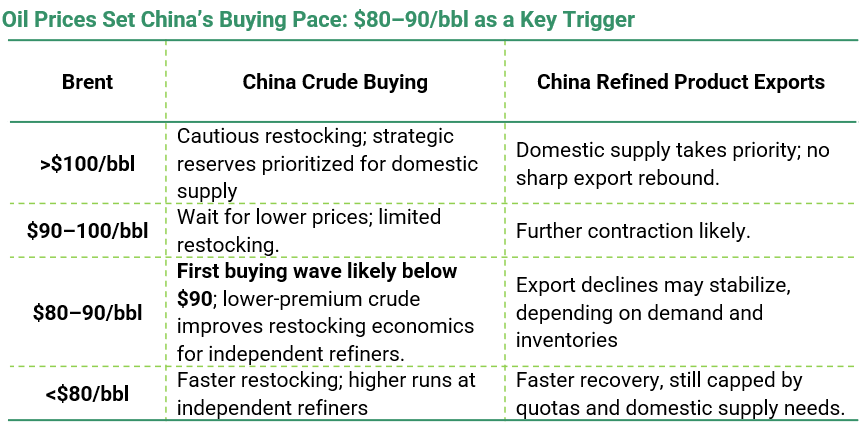
GL Consulting expects China's crude restocking activity to pick up if Brent falls below $90 per barrel, with purchases potentially accelerating below $80 per barrel. Lower-premium crude could also improve procurement economics for independent refiners.
Source: GL Consulting
The assessment assumes a gradual improvement in regional shipping conditions and crude availability. Renewed military escalation or prolonged disruptions could sustain a higher geopolitical risk premium and delay the anticipated recovery in Chinese crude purchasing.
China's longer-term strategy of diversifying crude suppliers and maintaining procurement flexibility is expected to continue, regardless of the direction of bilateral trade negotiations.
| China's Refined Product Exports Remain Constrained by Domestic Supply
China's refined product exports illustrate the limits of external policy pressure on domestic energy supply decisions.
Although Washington has called for higher Chinese fuel exports to help ease global supply tightness, export volumes remain primarily determined by refinery operations, domestic inventories, crude availability and export economics.
Recent market developments have reinforced these constraints.
China's refined product exports remain sensitive to domestic supply conditions, crude availability and refinery operating economics. While export quotas determine the maximum permitted volumes, actual shipments will depend on domestic inventory levels and refiners' ability to secure sufficient crude feedstock. A sustained recovery would require an improvement in these underlying conditions.
The tightening domestic balance has prompted refiners to restrict some local sales and reduce planned overseas shipments, despite relatively attractive export margins.
These developments suggest that the recovery in refined product exports anticipated earlier in the fourth quarter may take longer to materialize.
Export quota availability remains relatively ample, providing refiners with flexibility should domestic conditions improve. However, additional allocations do not necessarily translate into higher export volumes.
GL Consulting expects any sustained recovery to depend on improved crude arrivals, replenishment of domestic inventories and more favorable refinery operating conditions. China's domestic supply security is likely to remain the primary consideration in determining the pace of future exports.
| LNG Remains the Strongest Candidate for Energy Tariff Relief
Energy commodities were excluded from the September reciprocal tariff-cut arrangement, leaving potential concessions for subsequent negotiations.
Based on supply-demand fundamentals, import economics and strategic considerations, GL Consulting maintains the following ranking for the likelihood of future tariff relief:
LNG > LPG > Crude Oil
LNG: Strongest potential for tariff relief
Additional U.S. liquefaction capacity is increasing the need for long-term offtake agreements, while China's energy security strategy under the 15th Five-Year Plan emphasizes diversification and flexibility in gas procurement.
Greater access to U.S. LNG could expand China's supply options and strengthen its negotiating position with existing suppliers. However, subdued domestic gas demand, growing domestic production and alternative import sources reduce the immediate need for tariff concessions.
China's imports of U.S. LNG have remained limited since the escalation of bilateral tariffs in 2025. A meaningful recovery in trade would therefore require both commercially attractive pricing and sufficient progress in bilateral negotiations.
| LPG: Commercial competitiveness supports trade despite tariffs
U.S. propane has maintained a competitive position in the Chinese market, supported by expanding export capacity and disruptions to alternative Middle Eastern supplies.
According to the underlying GL Consulting research, U.S. LPG accounted for approximately 42% of China's seaborne LPG imports during the first three quarters of 2026, compared with roughly 33% in 2025.
The continued flow of U.S. cargoes indicates that Chinese importers and suppliers have been able to accommodate existing tariffs within commercial arrangements.
Although tariff relief could improve margins and procurement flexibility, the existing trade flows and overcapacity in China's propane dehydrogenation (PDH) sector limit the urgency of an agreement.
| Crude oil: Limited commercial incentives for tariff concessions
U.S. crude has a relatively small role in China's import portfolio, reflecting freight costs, supply alternatives and refinery configuration.
Many Chinese refineries are optimized for medium-to-heavy crude grades, while a substantial proportion of U.S. exports consists of lighter, lower-sulfur barrels.
These structural differences reduce the immediate commercial benefits of tariff relief. U.S. crude may remain a supplementary option within China's diversified import strategy, although a significant expansion in purchases appears less likely than in LNG or LPG.
| Downstream Tariff Cuts Could Support Plastics and Feedstock Demand
Potential tariff reductions on Chinese consumer goods could also have implications for the petrochemical value chain.
Products covered by the proposed tariff-cut framework include household appliances, molded plastic goods and consumer products containing polypropylene (PP), polyethylene (PE) and other polymer components.
Lower tariffs on U.S.-bound shipments could support Chinese manufacturers' export competitiveness and encourage additional orders, with potential benefits for domestic polymer demand and operating rates.
China's plastics industry has already demonstrated considerable export resilience. Customs data cited in GL Consulting's September research showed that China's PP exports increased 44.48% year on year during January-August 2026, supported partly by supply disruptions elsewhere in Asia and the Middle East.
Improved downstream demand could provide additional support for PDH operating rates and feedstock propane consumption.
However, the extent of any recovery will depend on the implementation of tariff reductions, the strength of new export orders and the sustainability of China's competitiveness in international plastics markets.
| The Next Test for China-U.S. Economic Engagement
With the U.S. midterm elections concluded, the next phase of bilateral engagement will be shaped by the implementation of existing trade commitments and the ability of both governments to manage persistent strategic differences.
The China-U.S. Board of Trade and other bilateral consultation mechanisms could provide greater continuity in economic negotiations. The effectiveness of these arrangements will depend on whether agreements on tariffs, purchases and regulatory issues can progress beyond summit-level commitments.
For energy and chemicals markets, several developments warrant close attention: the scope of future tariff concessions, China's domestic fuel supply balance, the recovery of crude shipments through the Strait of Hormuz and the response of Chinese importers to changes in global energy prices.
GL Consulting's assessment suggests that incremental progress in trade negotiations remains possible, with LNG offering the clearest commercial case for future energy tariff relief. Meanwhile, crude procurement, refined product exports and petrochemical feedstock demand will remain closely linked to underlying supply-demand conditions.
This article draws on the "Sept China-U.S. Summit: Reciprocity Becomes the New Rule" chapter of the China Policy Perspective Report, produced by GL Consulting, with market developments updated through November 5, 2026.
The full report provides detailed assessments of bilateral trade negotiations, energy tariff relief, China's crude purchasing strategy, refined product exports and the implications for the downstream petrochemical sector.
For the full report, click here and please contact inquiries@mysteel.com.
Met coke portside prices: Tianjin port
Nov 06, 2026 17:48
Class 1 met coke prices: China's major cities
Nov 06, 2026 17:38
Semi coke prices: Shenmu
Nov 06, 2026 17:36
Met coke prices: Linfen
Nov 06, 2026 17:34
Semi coke prices: Fugu
Nov 06, 2026 17:31