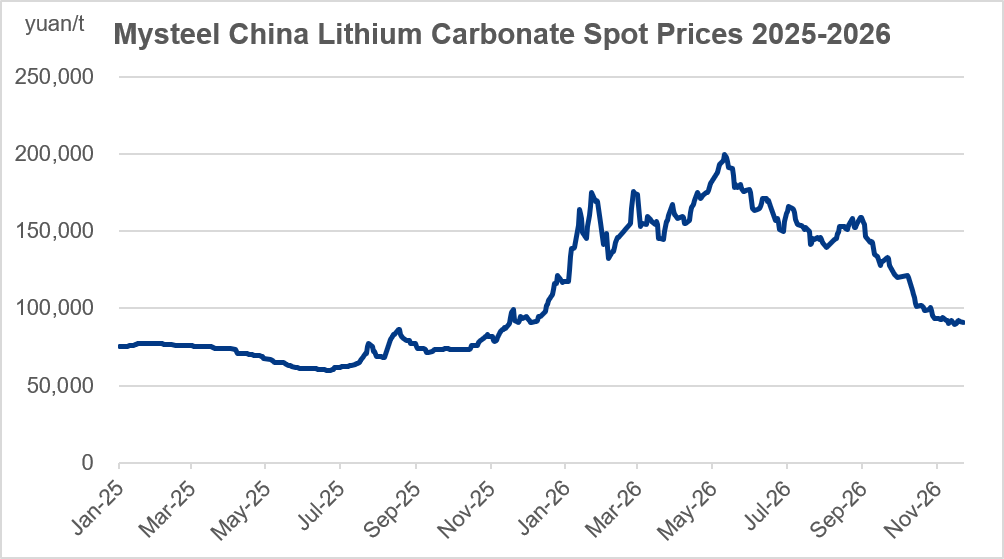
China's domestic lithium carbonate market experienced a pronounced inverted V-shaped trajectory in 2026. In detail, Mysteel assessed battery-grade lithium carbonate spot prices rose from Yuan 120,000/tonne at the start of the year to around Yuan 200,000/tonne in mid-May, then declined steadily to Yuan 90,000/tonne by November. Behind this volatility was a shift in the market's trading logic from the current supply-demand deficit to forward supply surplus expectations.
Looking ahead to 2027, global lithium resources will remain in deficit, but the gap is set to narrow, according to Mysteel's estimate. Meanwhile, the lithium carbonate inventories across the industry chain have fallen to multi-year lows, and costs will provide a floor for prices. Taking supply-demand, inventory, and cost factors together, battery-grade lithium carbonate prices in 2027 are expected to follow a pattern of "low in Q1, recovery mid-year, and high-level fluctuation in Q4", with a full-year average of about Yuan 100,000/tonne and a mainstream range of Yuan 80,000-120,000/tonne.
Looking back on 2026, the core feature of lithium carbonate price moves was the divergence between "real-world destocking" and "forward supply ramp-up expectations".
In H1, multiple factors pushed lithium carbonate prices to around Yuan 200,000/tonne in mid-May, when export tax rebate adjustments triggered rush exports, Zimbabwe announced a lithium concentrate export ban on February 25, and energy storage demand was released in a concentrated manner.
However, the market direction reversed in H2. And market expectations shifted from "destocking" to "restocking", and price valuations fell rapidly as restarts and commissioning advanced at Australian mines including Greenbushes, Pilgangoora, Bald Hill, Finniss, and Manono, and actual investment returns on energy storage projects fell short of expectations.
Source: Mysteel
Notably, visible inventories continued to draw down rapidly during the price decline. Based on Mysteel's tracking of 207 sampled players, the lithium carbonate inventories fell from 204,000 tonnes at end-May to around 100,000 tonnes at end-October. This indicates that the core of market pricing has shifted from the current deficit to supply growth expectations for 2027–2028. This "expectations-leading" characteristic is key to understanding potential 2027 price moves.
From a supply-demand balance perspective, the global lithium resource balance is projected at a 102,000-tonne deficit in 2026, narrowing to 84,000 tonnes in 2027 and flipping to a 181,000-tonne surplus in 2028. This implies that 2027 remains in a state of tight balance, though the degree of tightness eases. More importantly, market expectations of a 2028 surplus will be reflected in prices ahead of time in H2 2027.
Specially, the global lithium resource supply in 2027 is projected at 2.734 million tonnes LCE, up 21.0% YoY, with an increment of 474,000 tonnes broadly comparable to 2026 but with a more dispersed source structure.
On the demand side, global lithium resource demand in 2027 is projected at 2.818 million tonnes LCE, up 19.3% YoY, with growth slowing 23 percentage points from 2026. The slowdown stems mainly from the energy storage segment.
The global energy storage shipments are estimated at 1,080 GWh in 2026, with shipment growth slowing from 82.9% in 2026 to 33.2% in 2027, including 10% growth domestically and 40% overseas. Domestic electric vehicle (EV) penetration has reached high levels with limited room for major gains. As domestic automakers expand overseas and advance localization, overseas market expansion is expected to accelerate. Combined power and energy storage battery is estimated to drive lithium resource demand growth by around 20% globally in 2027.
Despite slowing demand growth, two factors will still support lithium carbonate prices in 2027.
First, the lithium carbonate inventory days across the industry chain are projected to fall from 65.1 days in 2026 to 43.7 days in 2027, equivalent to about 1.4 months of demand and at a multi-year low. Under low-inventory conditions, lithium prices are more sensitive to supply disruptions. That is, any mine production cuts, shipping delays, or policy changes could all amplify spot premiums.
Second, with 2027 global primary lithium supply projected at 2.564 million tonnes LCE, the output-weighted average cost is about Yuan 52,500/tonne LCE, with salt lake at Yuan 41,000/tonne, spodumene at Yuan 58,000/tonne, and lepidolite at Yuan 65,000/tonne. By cost percentile, the 50th sits at Yuan 56,000/tonne and the 90th at Yuan 70,000/tonne, with supply above Yuan 70,000/tonne totaling 221,000 tonnes LCE, or 8.6% of the total. This makes Yuan 70,000/tonne a strong price floor: if prices stay below it for long, marginal capacity keeps losing money, and supply-side concessions will be limited.
Taking supply-demand, inventory, and cost factors together, the battery-grade lithium carbonate spot price is projected to average Yuan 100,000/tonne throughout the year, with a mainstream range of Yuan 80,000-120,000/tonne.
By quarter, Q1 is the traditional off-season, and combined with the inertia of proactive downstream destocking, prices will come under pressure around Yuan 90,000/tonne, though full enforcement of Zimbabwe's ban will limit downside. In Q2, stage-specific feedstock tightness and low inventories will resonate, shifting the price center up to around Yuan 105,000/tonne. In Q3, lithium sulfate capacity ramp-up and increased Australian ore arrivals will gradually bring supply pressure to bear, with prices fluctuating at high levels. In Q4, long-term contract negotiations and pre-Chinese New Year restocking will support prices above Yuan 100,000/tonne, though 2028 surplus expectations will cap the extent of any rebound.
The 2027 price path hinges on four variables. First, Zimbabwe will fully ban lithium concentrate exports from January 2027, with local resources to be exported as lithium sulfate. Huayou's Arcadia 50,000-t/y plant has begun shipments, while SinoMine's Bikita 100,000-t/y project has slipped to July, hinting at H1 feedstock tightness. Relaxed enforcement or early full-capacity local output would raise supply markedly. Second, weaker-than-expected tenders and installations for energy storage projects could further trim demand growth. Third, faster sodium-ion and solid-state battery industrialization would expand the marginal hit to lithium demand, though sodium substitution itself depends on lithium prices, with high lithium price accelerating substitution in energy storage and capping lithium upside. Fourth, polies will shift demand pacing stage by stage, including resumed vehicle/vessel tax, January's battery export rebate cancellation, April's EV export rebate cut to 9%, September's battery consumption tax rise to 4%, and year-end expiry of halved purchase tax.
Written by Aggie Hu, huchenying@mysteel.com