PetroChina and Sinopec report solid Q3 refining profits as chemicals remain a strategic priority
Note: This article is excerpted and adapted from the November 2026 issue of GL Consulting's China Policy Perspective Report and presents only selected key research findings. For the full segment-by-segment earnings analysis, product yield estimates, Q4 export outlook and company-level data, please refer to the full monthly report.
Brent crude averaged $91.3 per barrel in Q3 2026, down 5.6% from the previous quarter, although prices remained elevated.
PetroChina reported quarterly net profit attributable to shareholders of RMB 51.84 billion, down 7% quarter on quarter, while its refining operating profit rose 38% to RMB 6.3 billion. Sinopec's quarterly net profit increased 54% to RMB 13.6 billion, with its refining segment generating approximately RMB 12.6 billion in profit, reversing losses recorded in Q2.
The recovery in refining profitability has drawn attention to changes in the two companies' product yields, particularly the increased emphasis on diesel and jet fuel production.
According to GL Consulting (premium think tank under Mysteel Group), these adjustments largely reflect short-term responses to market demand and relative product margins. The companies' longer-term investment priorities continue to favor high-end chemicals and advanced materials.
| Refining Profitability Improves Despite Diverging Earnings
Both PetroChina and Sinopec benefited from stronger refining performance in Q3 2026, even as their overall earnings followed different trajectories.
The improvement came amid lower crude prices, wider refined oil product crack spreads and inventory valuation gains, which collectively supported refining margins during the quarter.
The composition of earnings, however, differed between the two companies.
- For PetroChina, upstream oil and gas operations remained the primary earnings contributor, while refining, chemicals and natural gas sales provided additional support to quarterly performance.
- Sinopec experienced a more pronounced improvement in refining profitability, supported by recovering crude throughput, a more favorable product mix and improved export arbitrage opportunities.
These results point to a recovery in refining economics during Q3 2026, although the improvement was closely linked to prevailing market conditions and operating adjustments.
| Higher Refined Oil Product Yields Reflect Seasonal Margin Optimization
Both companies adjusted their refinery product yields in Q3, increasing the share of diesel and jet fuel in response to market demand and relative profitability.
Seasonal demand provided a favorable operating environment. Gasoline and jet fuel consumption benefited from peak travel activity, while diesel demand also offered support. Refiners consequently had greater incentives to optimize output towards refined oil products.
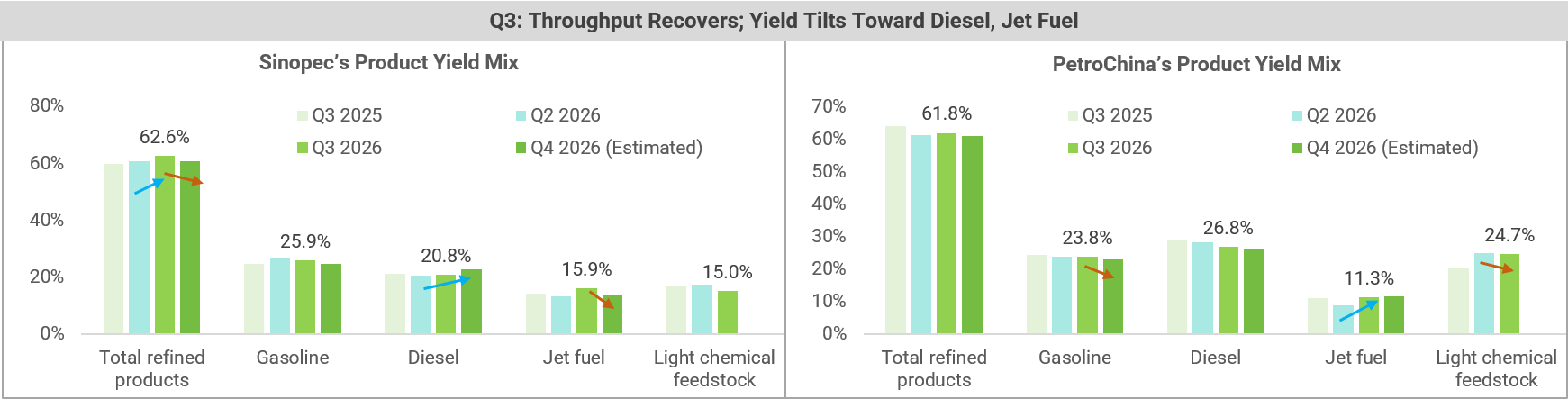
Source: Company filings, GL Consulting
However, GL Consulting expects the refined oil product yield at both companies to edge down in Q4 2026 as seasonal demand moderates, broadly in line with historical operating patterns.
The longer-term investment outlook also provides important context.
Despite the improvement in refining profitability, capital expenditure remains concentrated in higher-value chemicals and advanced materials. At Sinopec, capital spending in the chemicals segment during the first nine months of 2026 was approximately 1.7 times that of its refining segment.
This investment pattern suggests that the companies' strategic priorities remain largely intact, even as refinery operations respond to short-term changes in product margins.
The Q3 adjustment in product yields therefore appears consistent with seasonal operating optimization, with limited evidence of a broader reallocation of long-term investment away from chemicals.
| Q4 Refined Oil Product Exports Expected to Remain Elevated
Higher refined oil product output in Q3 has also raised expectations for China's export volumes in the final quarter of 2026.
GL Consulting forecasts that PetroChina and Sinopec's combined average monthly refined oil product exports will increase modestly from Q3 levels, remaining near their annual highs. Gasoline and jet fuel are expected to account for most of the additional shipments.
However, the scope for sustained export growth will depend on refinery feedstock availability, operating rates and product yields.
Additional externally sourced feedstocks contributed to refinery operations in Q3, but the resulting increase in processing volumes may be difficult to sustain at the same pace.
Independent refineries could raise operating rates modestly following improvements in feedstock availability, although expectations of lower international crude prices and changing refinery margins may influence their willingness to increase throughput.
As a result, the outlook for Q4 2026 exports remains supportive, but the anticipated increase is expected to be selective across products and refinery operators.
The recovery in refining profitability and higher refined oil product exports also warrants consideration alongside longer-term corporate strategies. While refinery output can respond relatively quickly to changes in margins and demand, capital allocation decisions remain tied to broader industrial priorities.
| Explore the Full Analysis in China Policy Perspective
This article presents selected findings from the November 2026 edition of GL Consulting's China Policy Perspective Report.
The full report provides a more detailed assessment of PetroChina and Sinopec's Q3 financial performance, strategic investment priorities and the implications for China's refined oil product market in Q4, including:
- Segment-level earnings: A breakdown of upstream, refining, chemicals and natural gas profitability at PetroChina and Sinopec, identifying the key contributors to Q3 performance.
- Corporate strategy: An assessment of changes in refined oil product yields, capital expenditure priorities and the long-term outlook for chemicals and advanced materials.
- Q4 export outlook: Forecasts for refined oil product exports, including the pace of recovery and additional gasoline and jet fuel shipments.
- Crude procurement and demand: Analysis of externally sourced feedstocks, independent refinery utilization, domestic refined oil product sales and Q4 supply-demand dynamics.
For a more comprehensive assessment of China's energy and chemicals policy developments, explore the China Policy Perspective Report or contact inquiries@mysteel.com to request a sample issue.
Existing subscribers may contact their account manager to access the November report.
Met coke portside prices: Tianjin port
Nov 25, 2026 17:43
Class 1 met coke prices: China's major cities
Nov 25, 2026 17:40
Met coke prices: Linfen
Nov 25, 2026 17:37
Class 1-equivalent met coke (CDQ) prices: China's major cities
Nov 25, 2026 17:32
Semi coke prices: Shenmu
Nov 25, 2026 17:30