BLOG: Dongjiakou port targets dust-free ore handling
Large, clean and highly efficient, the massive port complex located 700 kms southeast of Beijing, showed visitors how China – boasting the world’s largest (and still expanding) steel output and with a heavy reliance on iron ore imports – could balance sustained high levels of imports and the stocking of large volumes of raw materials while keeping the whole process comparatively free from heavy pollution including dust.
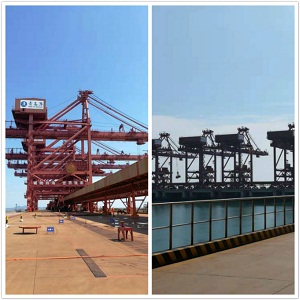
The 400,000-tonne iron ore terminal
Large
Dongjiakou, a deep-water port in southern Qingdao with year-round, ice-free shipping routes and an average water depth of 15 meters off the coast, was destined to be huge. When construction began in late 2011, it was envisaged the complex would eventually span 72 square kilometres (over 10,000 standard football fields), have a quay length yawning to 15 kilometres containing 112 berths, and have a capacity to handle a yearly throughput of 370 million tonnes in bulk materials and cargo.
Today, 18 of the berths have already been completed, enabling the port to handle comprehensive businesses covering containers, dry bulk goods, crude oil, LNG and chemical products including styrene, the port official told the visitors.
But undoubtedly the most impressive part of the port is its 400,000-tonne iron ore terminal, one of the world’s largest and capable of comfortably accommodating ultra-large vessels over 300 metres in length in all weather, according to the official. From the vessel via belt conveyor, the ore accumulates in a stock yard sprawling to 4 million square metres and with an ore holding capacity of 55 million tonnes. In addition, the port hosts an iron ore blending capacity of 50 million tonnes, the largest such facility in China. (Dongjiakou is also able to hold and blend five types of coal simultaneously for coke-making and has an annual coal blending capacity of over 11 million tonnes/year, visitors were told.)
Thanks to Dongjiakou’s cooperation with Brazilian miner Vale, some 12 million tonnes of BRBF ores were blended in 2018. This year however, as of late September less than 7 million tonnes of ore from Vale had been blended, a reflection of the drop off in Vale’s shipments this year following the tailings dam failure in January that reduced the company’s iron ore output, according to the official.
Though Dongjiakou boasts a large size and stocking capacity, operations at the port are far from lumbering, nevertheless.
High Efficiency
“Unloading a 400,000-tonne Valemax carrier will take only two full days,” the Dongjiakou official said, much to the surprise of the visitors. Dongjiakou Port, along with ports in Majishan and Dalian, is among the few Chinese ports that are able to receive Vale’s huge dry bulk ships, also known as Valemaxes.
“No
wonder I’ve seldom heard of vessel congestion at Dongjiakou, based on such
large capacity of (iron ore) unloading,” said a delegate from Northeast China.
During
the field trip, unloaders were grabbing Yandi fines from a Capesize carrier,
with no leaking of the fines from the grabber spotted.
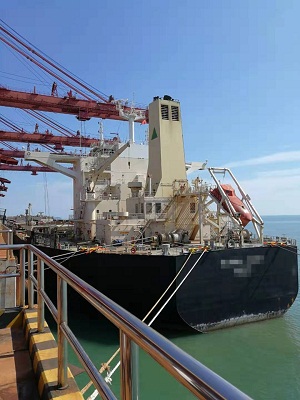
Ship unloading
With another three 200,000-tonne/day terminals and a 150,000-tonne/day terminal, Dongjiakou’s annual throughput capacity for dry bulk goods exceeds 100 million tonnes/year, with railways and waterways connecting the inter-transportation network. Thanks to its convenient access to road, rail and ship transportation, the port is able to serve as a transhipping area allowing large vessels to unload ore there which can then be loaded onto smaller vessels, trucks, or rail cars for the journey to steelmakers along the Yangtze River, for example, where large vessels cannot berth, Mysteel Global notes.
Indeed, the fast-developing transportation network extends Dongjiakou’s reach into the economic heartlands of Shandong, North China’s Hebei and Shanxi provinces, Central China’s Henan, Shaanxi in Northwest China and to other regions, according to the official.
Moreover, the pace of construction of the port itself is impressive.
“Building has been progressing well and fast!” exclaimed a delegate from Beijing. “When I visited Dongjiakou several years ago, nothing was here at the (iron ore) terminal.”
Within sight of the 400,000-tonne ore terminal also loomed the 300,000-tonne crude oil terminal where commissioning began in 2014 and which can handle crude oil tankers to 450,000-tonnes. Another oil terminal of the same size is under construction.
Clean
Size
is one thing, but with the Chinese central government’s determination to ensure
that the environment is no longer a casualty of economic development, Dongjiakou
is also amazingly clean. Standing close to the belt conveyor transporting ore
from the berths to the ore stacks, surprised visitors saw no iron ore fines
spilling from the fast-moving transporter. Thanks to the finely-sealed and
covered conveyor, only a whiff of light rust tickled the nostrils.
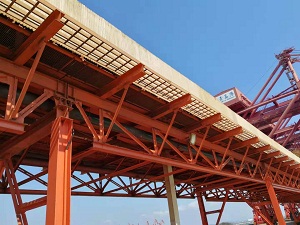 The belt conveyor
On the day the delegation visited, there was no strong
wind to cause havoc with dust. Yet even so, the small hills of iron ore at the
stock yard were covered with cloth to reduce dust and those stockpiles without
cover were being watered with a fine spray from pipes nearby. Adding another
layer of security against dust, Dongjiakou has also invested heavily in the
construction of a suppression wall, according to the official.
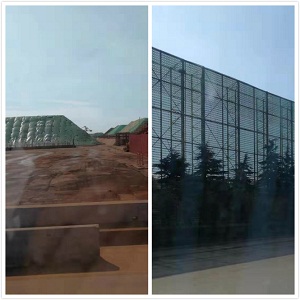 The cloth on the ore and dust suppression wall
As a
new ultra-large port (and one that is still under construction) Dongjiakou stands
apart. Yet such is the pace of infrastructure development in China, we can’t be
sure that it will reign forever, that even larger ports are not being planned
whose handling efficiency and application of technology will not dwarf those of
this port in south Qingdao. But for now at least, Dongjiakou shines as an
example of how ports of China can achieve quality development and still protect
the country's environment.
Written by Sean Xie, xiepy@mysteel.com
Edited by Russ McCulloch, russ.mcculloch@mysteel.com
Coking coal procurement prices: Shaoguan Iron & Steel
Sep 07, 2026 10:10
PCI coal procurement prices: Xingtai Iron & steel
Sep 07, 2026 10:10
Coking coal procurement prices: Liuzhou Steel
Sep 07, 2026 10:08
Coking coal prices: Hebi
Sep 07, 2026 10:07
Coking coal prices: Qujing
Sep 07, 2026 10:07