Overnight overseas macro sentiment turned constructive, driving synchronized gains across domestic and overseas aluminum prices. The softer US August ADP private payrolls data further dampened market expectations of Fed rate hikes, easing the dollar's drag on commodities.
Coupled with heightened Middle East geopolitical tensions lifting the risk premium across the commodity complex, multiple tailwinds converged to propel aluminum higher. As of the 10:15 close on Septempter 3, the SHFE aluminum front-month contract settled at Yuan 24,345/tonne, up 1.18% on the day; LME three-month aluminum finished at Yuan 3,303.5/tonne, edging up 0.27%, both onshore and offshore markets trading in firm tandem.
Beneath the price rebound, the domestic aluminum fundamental backdrop has materially firmed. The destocking pace has visibly accelerated, with multiple dimensions of visible inventory contracting in unison, pointing to a genuine, structural improvement in the industry's supply-demand balance that anchors a solid price floor.
According to Mysteel data, China's traders' inventory of primary aluminum fell to 789,000 tonnes on September 3, a sharp 20,000-tonne draw on a weekly basis. SHFE aluminum warrants stood at 234,189 tonnes, down 4,184 tonnes day-on-day, as exchange-deliverable supply keeps tightening and the spot market's available ingot tonnage grows increasingly scarce.
Notably, a divergent pattern has emerged between ingots and bars: national aluminum bar inventories across major consumption hubs ticked up 2,000 tonnes to 149,500 tonnes, underscoring a shift in how metal is flowing through the domestic supply chain.
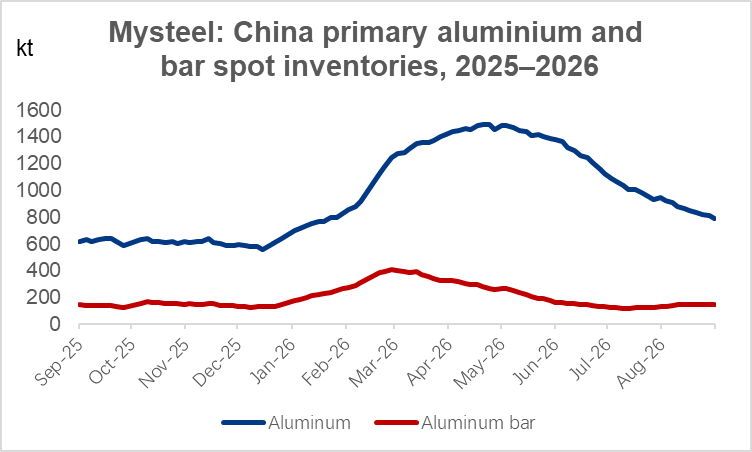
Source: Mysteel
On the supply side, the key driver behind the sustained ingot drawdown lies in the persistently elevated metal direct-casting ratio, more molten aluminum is being routed straight into bar, profile and downstream product lines, while output of large re-melted ingots has been curtailed meaningfully. Feedstock is increasingly bypassing the conventional ingot trading circuit and being absorbed directly at the fabrication stage, structurally shrinking the tradable ingot pool in the open market and continuously draining traders' ingot stocks.
On the demand side, resilience is gradually coming back online, lending further support to the destocking trend. With the market now squarely into the "Golden September" peak season, operating rates and procurement appetite at downstream fabricators have recovered steadily. Buyers have largely seized pullback windows to restock on a just-in-time, rigid-needs basis, steadily absorbing available ingot supply. That said, end-user purchasing remains largely disciplined, no signs yet of aggressive speculative stockpiling, with most mills sticking to order-driven replenishment. Whether the peak-season demand narrative actually translates into sustained, broad-based offtake remains the pivotal variable to watch and verify going forward.
In the near term, macro sentiment is the dominant driver of day-to-day price swings, while the underlying physical supply-demand picture dictates the broader trend. Persistently low LME aluminum inventories continue to provide a credible backstop for the overseas leg as well.
On balance, the aluminum complex is characterized by a backdrop of recurring macro crosscurrents on one hand and steadily improving fundamentals on the other, with tight tradable ingot availability and ongoing inventory draws offering firm price support. In the sessions ahead, aluminum is likely to hold a range-biased, modestly bullish tone, oscillating within the tug-of-war between lingering macro uncertainty and the still-unproven "Golden September" demand thesis.
Written by Regina WANG
wangjiaqie@mysteel.com