At Gastech 2026 in Bangkok on September 15, GL Consulting (premium think tank under mysteel group) Chief Consultant and Founder Liao Na shared the latest outlook for China's natural gas market, examining how weaker near-term demand, changing supply dynamics and the country's 15th Five-Year Plan are reshaping the market through 2030.
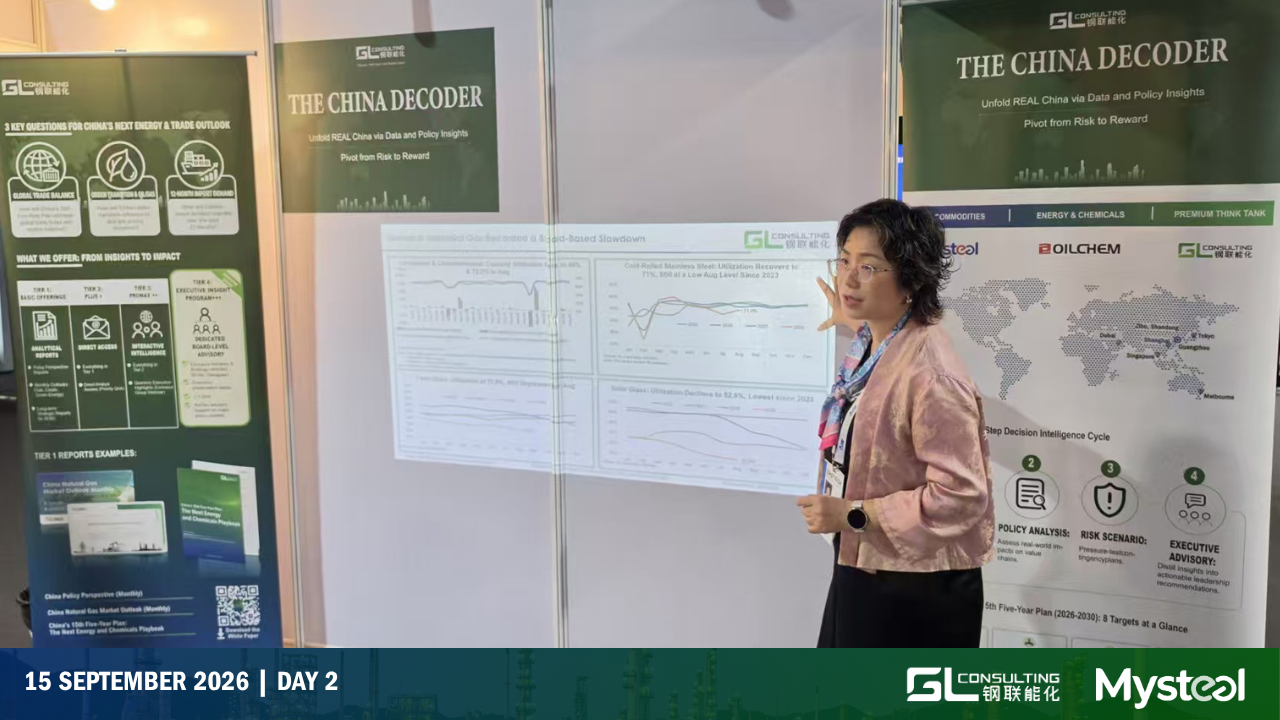
China's natural gas consumption is forecast to reach 427.2 bcm in 2026, up only 1.0% year on year, a marked slowdown from 3.2% growth in 2025. High gas prices following the Middle East conflict have weighed particularly heavily on price-sensitive industrial demand, which is expected to fall 7.2% this year. By contrast, transportation and power generation remain the main growth areas, with demand forecast to rise 14% and 6.6%, respectively.
The divergence is already visible in underlying operating data. LNG heavy-duty truck activity remains elevated, supporting transportation gas demand, while industrial gas consumption has weakened across sectors including glass, steel, paper and ceramics. Gas-fired power generation is also emerging as an increasingly important source of incremental demand as China expands flexible power capacity to support a renewable-heavy energy system.
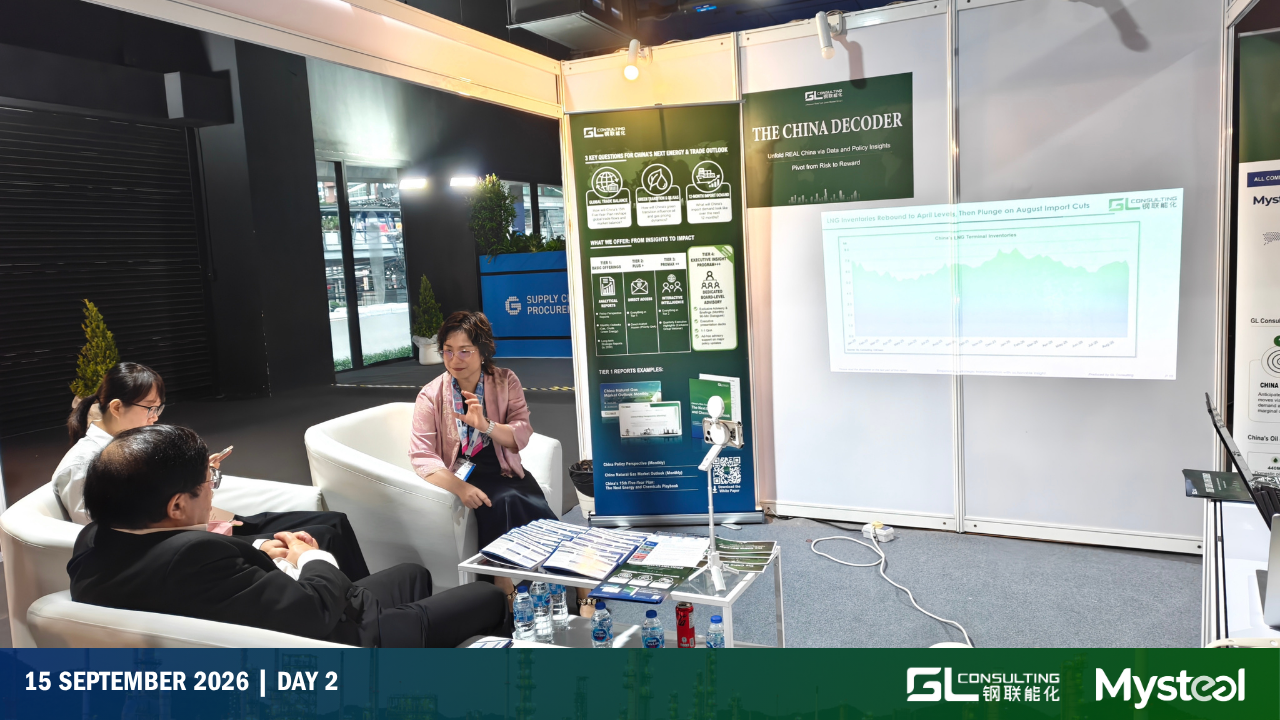
Why Is China's Domestic Gas Production Growth Slowing in 2026?
During the briefing, Liao also addressed a question on the slowdown in China's domestic natural gas production growth. GL Consulting expects domestic production to reach around 261.9 bcm in 2026, representing growth of approximately 2.5%, compared with 6.4% in 2025.
Liao highlighted three factors behind the slowdown.
First, China's seven-year action plan to increase domestic oil and gas reserves and production concluded in 2025, making some moderation in production growth in 2026 a cyclical development following several years of rapid expansion.
Second, maintenance was unusually concentrated between April and June. A number of gas fields, purification plants and processing facilities underwent maintenance during this period, particularly in Southwest China. PetroChina Southwest Oil & Gasfield launched what it described as its largest and most complex annual overhaul to date in April, involving an unusually large number of facilities. The scale and concentration of maintenance contributed to a year-on-year decline in domestic gas production in May.
Third, supply incentives have weakened. Higher prices following the disruption to Middle Eastern supply in the first half of the year coincided with soft domestic demand. With downstream consumption providing less pull on supply, the immediate need to accelerate production growth has eased compared with previous years.
The slower growth, however, does not signal a retreat from domestic supply security. Under the 15th Five-Year Plan, domestic gas remains a strategic anchor. GL Consulting expects China's annual natural gas production to exceed 300 bcm by 2030, maintaining a share of around 60% of total supply.
2027 Could Mark a Demand Recovery
The current weakness is expected to be concentrated in 2026. As geopolitical disruption eases, gas prices decline and imports recover, GL Consulting forecasts China's natural gas consumption growth to rebound to 4.3% in 2027. Over the 15th Five-Year Plan period, gas demand is projected to grow at an average annual rate of around 3.5%, with transportation and power generation providing the main incremental demand.
By 2030, transportation gas demand is projected to reach around 94.4 bcm, compared with 58.7 bcm in 2025, while gas demand for power generation could increase from 58.7 bcm to 85.7 bcm. Industrial demand is expected to recover more gradually, while chemical gas demand could trend lower.
This shift reflects the changing role of natural gas under the 15th Five-Year Plan. With coal and oil consumption expected to peak before 2030, natural gas is positioned as a transition fuel that can support energy security while providing flexibility alongside the expansion of renewable energy. Policy priorities are increasingly focused on domestic production, infrastructure connectivity, storage flexibility and diversified supply.
Supply flexibility is also set to improve. China's gas storage working capacity is expected to reach 80 bcm by the end of the 15th Five-Year Plan period, including around 50 bcm from underground storage and more than 30 bcm of gas-equivalent capacity from LNG tanks. This expansion could provide a larger buffer against international price volatility and short-term disruptions to maritime supply.

Missed the Briefing at Gastech?
GL Consulting will host two more China gas market briefing sessions at Gastech 2026 on September 16.
The sessions will cover China's latest natural gas supply and demand outlook, the implications of the 15th Five-Year Plan, and the key drivers shaping the market toward 2030.