China's commercial gasoline and diesel stocks near a seven-year low
GL Consulting (premium think tank under Mysteel group) expects the domestic products market to remain relatively tight through October, with inventories unlikely to rebuild materially. The key swing factor will be export availability: as domestic supply tightens and seasonal demand strengthens, refiners are likely to prioritise the domestic market, limiting product exports.
Commercial stocks are falling as supply growth lags demand
China's gasoline and diesel inventories have continued to draw down in recent weeks, reaching near seven-year lows.
The immediate explanation is straightforward: supply has not kept pace with demand.
On the supply side, refinery maintenance reached its annual peak in July. Although turnaround activity eased in August and September, the volume of capacity affected remains relatively high, continuing to constrain refined product output.
China: Refinery Throughput Losses in 2026
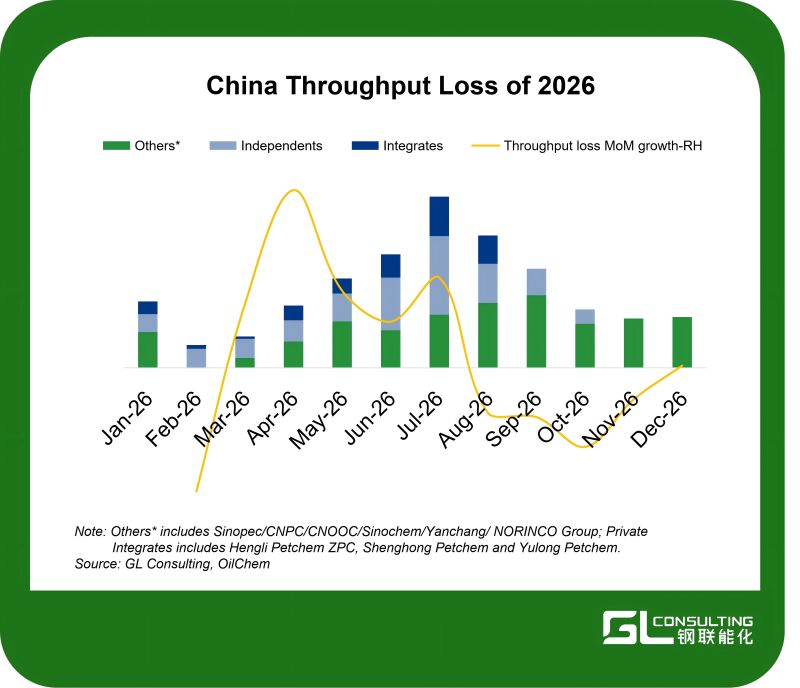
This means the end of the peak maintenance season has not yet translated into a full recovery in available supply. Refinery utilisation remains constrained across parts of the system, keeping the market tighter than the headline recovery in operating rates might suggest.
Demand is being supported by both domestic consumption and exports
The other side of the balance is demand.
China's refined product market has benefited from two sources of additional offtake during the third quarter.
First, refined product exports increased sharply during July–September, drawing additional barrels out of the domestic market.
Second, domestic demand remained firm. Peak summer travel supported gasoline consumption, while autumn harvesting activity and pre-season restocking ahead of the traditional September–October peak provided additional support to diesel demand.
China: Gasoline, Diesel and Jet Fuel Exports
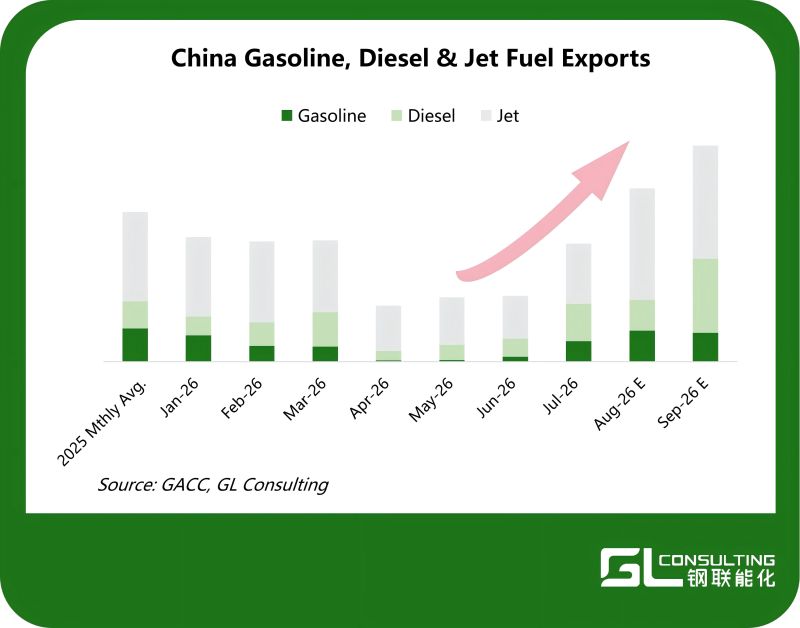
The result is a market in which both domestic consumption and external demand are drawing on a constrained supply base.
This helps explain why inventories have continued to decline despite the easing of refinery maintenance from its July peak.
The near-term balance should remain tight through October
GL Consulting expects China's refined products market to remain in a relatively tight balance through the end of October, with limited scope for a meaningful inventory rebuild.
Three factors underpin this view.
Refinery supply remains constrained
The increase in refinery throughput expected in October is likely to come primarily from major state-owned refiners. Their ability to raise runs, however, will be constrained by tighter crude availability.
At the same time, independent refiners and large private refining complexes face a combination of weaker refining margins and tighter crude supply. GL Consulting therefore expects operating rates across these segments to soften during September and October.
Domestic demand should provide the next leg of support
As China moves further into the seasonal demand window from mid-September, downstream restocking is expected to increase.
This should continue to draw down existing commercial stocks, particularly for diesel as agricultural activity and seasonal logistics demand pick up.
Exports are likely to give way to domestic supply
With domestic supply already relatively constrained and internal demand strengthening, refiners are likely to prioritise the domestic market.
This should reduce refined product exports in the near term, effectively redirecting barrels that would otherwise have been shipped overseas back into the domestic balance.
The combination of constrained refinery runs, firmer domestic demand and lower exports should keep the market relatively tight through October.
The key issue is not whether stocks are low, but how the balance changes next
The current inventory drawdown is an important market signal, but inventories alone do not determine the sustainability of the tightness.
The next phase will depend on the interaction between refinery runs, crude availability, seasonal demand and export economics.
That creates a moving supply-demand balance rather than a static inventory story.
Our base view is that domestic product availability will remain relatively constrained in the near term. However, any faster-than-expected recovery in refinery runs, improvement in crude availability, or weakening in domestic demand could change the balance quickly.
For market participants, therefore, tracking inventory levels in isolation is no longer sufficient. The more important question is how the major supply and demand variables are moving relative to each other.
What this means for refiners and oil market participants
The current market points to several practical implications.
For refiners, the key variable is the relative economics of domestic sales versus exports. A tighter domestic market should increase the incentive to retain barrels locally, particularly while export margins become less competitive.
For traders, the key opportunity lies in monitoring the timing of refinery restarts, crude availability and export quota utilisation. Small changes in any of these variables can have an outsized impact on regional product balances.
For downstream consumers, the persistence of low commercial stocks increases the importance of procurement timing and inventory management ahead of the next supply-demand inflection point.
The broader message is that China's refined products market is currently being driven less by an outright demand boom than by the interaction between constrained supply, seasonal demand and export flows.
GL Consulting's view: the tight balance is likely to persist, but the next swing factor is supply
The current drawdown in China's commercial gasoline and diesel stocks is unlikely to reverse materially before the end of October.
However, this is not simply an inventory story. It is a supply-demand balance story, with refinery availability and export flows likely to determine how long the tightness lasts.
GL Consulting will incorporate this view into the monthly forecast framework of China Oil Market Outlook, while our analysts will continuously recalibrate the balance on a weekly basis as new refinery, inventory, demand and trade data become available.
This approach provides a more dynamic view of China's oil products market, tracking not only where inventories are, but also why they are moving and what that implies for the next stage of the market.
The monthly China Oil Market Outlook provides the underlying data, forecasts and refinery-level analysis used to track the balance. The report includes:
- Monthly refinery throughput forecasts for September–December, together with refinery-by-refinery maintenance schedules
- Refinery utilisation and refining margin tracking, with separate coverage of major state-owned refiners and Shandong independent refiners
- Daily crude and refined product inventory tracking, including estimated days of consumption
- Monthly refined product supply-demand balances for September–December
- Export quota utilisation and export economics
- Analysis of how domestic price-cap adjustments flow through to refining margins
To enquire about subscription options or request the full table of contents and a sample chapter, please contact inquiries@mysteel.com.
Imported manganese ore portside prices: Qinzhou port
Sep 23, 2026 09:33
CRC prices: Shanghai
Sep 23, 2026 09:33
Carbon steel scrap prices: Zhangjiagang
Sep 23, 2026 09:33
H-Beam prices: Taiyuan
Sep 23, 2026 09:32
Met coke prices: Linfen
Sep 23, 2026 09:31