Balancing security and growth: China gas 2030 - supply realism, demand reset, 15th FYP pivot
This year's Gastech discussions reflected a clear shift in priorities. Energy security, resilience, optionality and sovereignty moved closer to the centre of the conversation, as geopolitical risks, changing trade flows and rising power demand prompted the industry to reassess the strategic role of natural gas. Gas is increasingly being considered in the context of system stability and dispatchable power, rather than fuel supply alone.
At the same time, Asia's role in the global gas market is evolving. Industrialisation and electrification remain important demand drivers, while AI and data centres are creating another layer of power demand. This means the discussion is moving beyond how much LNG Asia will need toward how supply portfolios, infrastructure, contracts and investment can support growth, security and decarbonisation together.
LNG contracting was another recurring theme. Flexibility is becoming increasingly important across pricing mechanisms, destination rights, supply portfolios and diversion options. In a more fragmented market, the ability to redirect cargoes and manage multiple sources of supply can carry significant value alongside headline procurement costs.
The connection between natural gas, electricity and AI also became much more visible at Gastech. Data centres and advanced manufacturing require high-density and reliable power, while grid expansion and project delivery are emerging as major constraints. The discussion is therefore extending from resource availability to whether power generation, grids and infrastructure can actually be delivered on time.
For China, this changing global context comes at an important point as the country enters its 15th Five-Year Plan period. China remains a major variable for the Asian gas market, yet understanding its future influence requires more than tracking headline LNG import volumes. Domestic gas production, pipeline imports, long-term LNG contracts, spot procurement and increasingly sophisticated portfolio management all shape when China buys, at what price, and under what contractual structure.
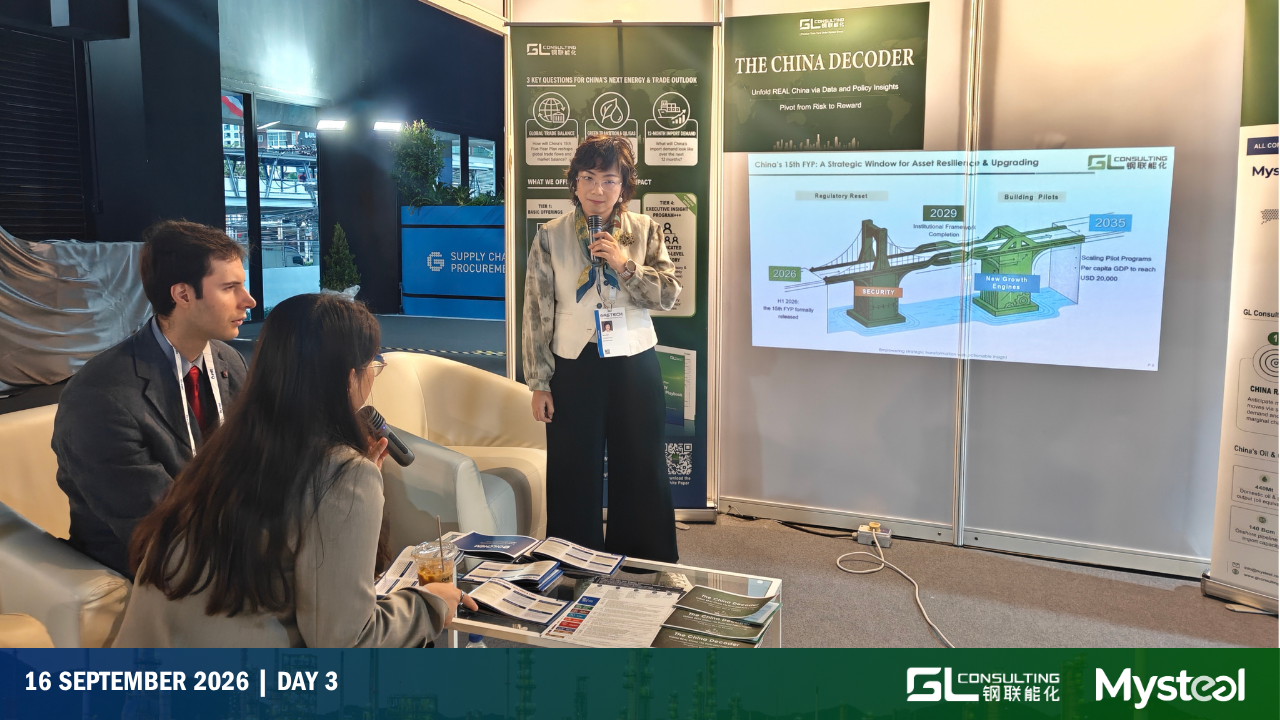
This was also the focus of GL Consulting's on-site briefings. Through our China's 12-Month Gas Demand Outlook, we examined how demand drivers, sector trends and changing market conditions could shape China's gas consumption and LNG requirements over the coming year.
Across Gastech, one message became increasingly clear: the next phase of the gas market will be shaped by the interaction between security, demand realism, infrastructure capability, contractual flexibility and policy direction. For companies exposed to China and the wider Asian gas market, understanding how these variables interact will be increasingly important as the market moves toward 2030.
If you missed the briefing, contact inquiries@mysteel.com for the briefing deck:
Balancing Security and Growth: China Gas 2030 - Supply Realism, Demand Reset, 15th FYP Pivot
Mysteel portside iron ore spot basis
Sep 22, 2026 18:25
Mysteel Portside Iron Ore Indices (PORTDEX)
Sep 22, 2026 18:25
Imported iron ore prices: China's major cities
Sep 22, 2026 18:18
Iron ore portside prices: Lianyungang port
Sep 22, 2026 18:16
Iron ore portside prices: Huanghua port
Sep 22, 2026 18:14