Chile's copper supply outlook is facing renewed uncertainty as labor disputes at two major mines coincide with a prolonged decline in national production and a series of weather-related and operational disruptions. While some earlier interruptions have eased, the simultaneous strike at Centinela and the threat of industrial action at Escondida could further tighten supply at a time when the global copper concentrate supply growth is already far behind demand surges.
Copper production at Chile has been falling
Chile's copper production had already weakened before the latest labor disputes emerged. National output fell 7.8% year on year over January-August 2026, while August production dropped 12.8% year on year to 369,500 tonnes, its lowest monthly level since February 2011, according to Chile's National Statistics Institute (Instituto Nacional de Estadísticas, INE). The decline reflects the combined effects of declining ore grades, operational disruptions and other mine-specific challenges.
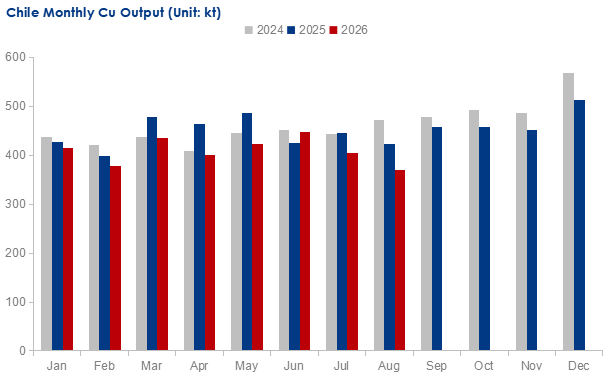
Source: INE
Declining ore grades and mature mine life are significantly weighing on existing operations, as major producers in Chile are having to process more ore to maintain output. Escondida is a clear example, with its FY2026 (July 2025-June 2026) production falling around 3%, mainly because of lower concentrator feed grades, despite record throughput.
Regarding operational disruptions, severe winter storms from July 17 to 21 disrupted operations at Andina and El Teniente, curtailed non-essential activities at Los Pelambres and restricted port operations in central Chile. Although most affected operations had recovered by early August, the disruption had lasting implications for production expectations. On August 13, Antofagasta Minerals lowered its 2026 copper output guidance from 650,000-700,000 tonnes to 625,000-655,000 tonnes following weather-related operational difficulties at Los Pelambres.
Labor disputes put two major mines in focus
The most immediate supply risk is concentrated at Centinela and Escondida, where labor negotiations have reached critical stages.
At Centinela, operated by Antofagasta Minerals, an indefinite strike began on October 7 after negotiations failed to produce an agreement. As of October 13, the strike remained ongoing. Though Antofagasta stated that the annual production guidance will be maintained, the union has warned that output could begin to decline after roughly two weeks and that November production could be halved if the dispute persists. Centinela produced 240,400 tonnes of copper in 2025, accounting for more than 35% of Antofagasta Minerals' total output. A prolonged stoppage could therefore affect global supply growth. The parties are scheduled to resume negotiations through voluntary mediation on October 13, making the outcome a key near-term indicator for supply.
Meanwhile, labor tensions at Escondida, the world's largest copper mine, have brought a second major source of uncertainty. BHP submitted its final wage proposal to the mine's supervisors' and staff union on September 22. The following day, a fatal workplace accident prompted a temporary suspension of operations, although production subsequently resumed gradually. The labor dispute continued despite the operational recovery. Between September 28 and 30, approximately 95% of participating union members rejected BHP's proposal and voted to authorize a strike. BHP has headed into mediation, and the final result needs close attention.
Safety incidents add to operational uncertainty
Labor disputes are not the only concern. Safety incidents have also drawn attention to the operational risks facing Chilean mines.
On October 11, an avalanche at El Teniente killed two workers and injured another, while the open-pit area had already been suspended because of adverse weather. As of October 13, no additional production impact had been confirmed, and the investigation was ongoing. Separately, a worker died at Codelco's Radomiro Tomic mine on September 26, with operations suspended where the accident happened.
These incidents reinforce the importance of safety management and operational continuity. Depending on investigation findings and any subsequent precautionary measures, safety-related suspensions could create additional uncertainty.
Negotiation developments need close attention
A recent assessment by GEM Mining Consulting quantified the vulnerability of Chilean copper supply, estimating that an average 5.2% of production at 14 major mines is exposed to disruptions across eight risk categories, including labor disputes, weather, water availability, safety and geo-technical conditions. Importantly, the index measures potential production exposure rather than forecast losses. Nevertheless, it underscores the risk that multiple disruptions could widen the gap between planned and actual mine output, particularly as labor disputes at Centinela and Escondida threaten to compound Chile's existing supply constraints.
Consequently, the negotiations at Centinela and the approaching deadline in the Escondida dispute are therefore critical near-term developments. A timely settlement could limit further losses, whereas prolonged or simultaneous stoppages would intensify pressure on Chilean copper production and add to the risks facing an already tight global copper concentrate market.
Written by Mingyuan Wang, wangmingyuan@mysteel.com