Recent export sales data disclosed by the Minerals Marketing Corporation of Zimbabwe (MMCZ) show that the country's mineral exports are undergoing an unprecedented surge. As of September 30, 2026, Zimbabwe's mineral export sales reached US $4.735 billion, up 101.8% YoY. Lithium products, at US $2.159 billion, accounted for 45.6% and surpassed platinum group metals (PGMs) for the first time to become the country's largest foreign-exchange-earning mineral.
Lithium export volumes rose only about 20% YoY, but export value quadrupled, with the increment almost entirely from revaluation. This means lithium prices bring considerable elasticity to Zimbabwe's export revenue, amplifying gains on the upside and equally amplifying shocks on the downside.
According to MMCZ's website, Zimbabwe's annual lithium ore export volumes have trended upward. The Gwanda lithium mine accumulated large stockpiles in November–December 2025 with almost zero exports, reflecting strategic holding for better prices, and quarterly exports declined accordingly. A sudden ban on lithium concentrate exports was imposed on February 25, 2026, suppressing Q1 2026 lithium ore exports; quotas were restored in Q2, with the first batch issued in early April; and from Q3, accumulated stockpiles were accelerated for concentrated export, with mines rushing to ship cargoes from Zimbabwe to ports before the 2027 ban takes effect.
The full cycle from Zimbabwean mines to Chinese ports is 60-80 days, meaning MMCZ's monthly export statistics may take two to three months to show up as imports in Chinese customs data. Compared with 2024 and 2025, however, Zimbabwe's January–September 2026 exports show a large gap versus Chinese customs data for the same period, with Zimbabwe's exports exceeding China's customs imports by about 500,000 tonnes. Meanwhile, Chinese customs recorded January–September 2026 lithium sulfate imports of 4,380 tonnes, while MMCZ disclosed exports of up to 33,807 tonnes for the same period.
Typically, Zimbabwe's lithium ore is trucked from mines to Mozambique's Beira port and South Africa's Durban port, then shipped to China from these two ports. The data gap mainly reflects inventories at Beira and Durban ports and cargoes still at sea, that is, large volumes of lithium ore and lithium sulfate are sitting in Durban, Beira, and in transit.
High port inventories stem from two factors. First, Beira port congestion from May to August 2026 persisted, with clustered vessels, weather disruptions, insufficient yard capacity, and low terminal efficiency restricting shipments. Second, with Zimbabwe set to fully ban lithium concentrate exports in 2027, 2026 is a "rush export window". The mines are accelerating shipments to Beira and Durban ports before year-end, but China-bound shipping is capacity-constrained at Beira. Exports are already counted while arrivals lag, creating a scissors gap.
Looking ahead at Q4 2026, Zimbabwe's mines will continue to make every effort to fully consume 2026 quotas out of Zimbabwe, and Q4 2026 exports are expected to reach at least 500,000 tonnes. Due to shipping capacity constraints, China's monthly imports from Zimbabwe are estimated at 100,000-150,000 tonnes, and not all lithium ore can be shipped to China by end-2026; inventories at Beira and Durban ports will serve as a buffer starting Q1 2027.
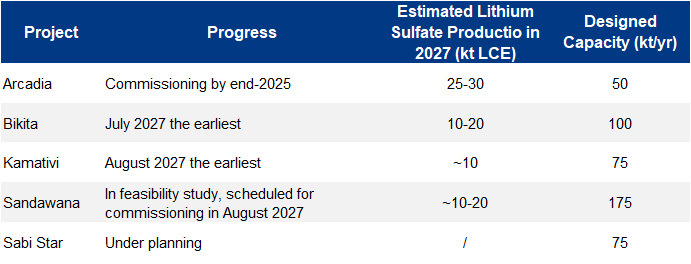
For 2027, under the most pessimistic 2027 scenario, a full lithium concentrate export ban takes effect, with only lithium sulfate exports allowed. Port inventories can cover normal feedstock supply to China through Q1 2027, but in Q2–Q3 most lithium sulfate plants will not yet provide stable supply, creating a stage-specific feedstock gap. Full-year supply to China in 2027 would be about 120,000–150,000 tonnes LCE.
Source: Public news
In the most optimistic scenario, all mines are already building lithium sulfate plants, so quotas similar to 2026 are restored after a one-to-two-month shipment pause. Combined with Zimbabwe's shipping capacity, supply to China in 2027 would reach about 250,000 tonnes LCE.
Risks of falling short of expectations exist. The equipment debugging and process issues may delay commissioning, and some enterprises may encounter mixed spodumene + petalite ore, with difficult roasting process debugging and output below expectations. For example, Arcadia's lithium sulfate project was commissioned in October 2025, but formal lithium sulfate shipments began only in April 2026.
In short, high port inventories give Zimbabwe's lithium ore shipments roughly a one-quarter buffer after the 2027 ban takes effect. The key variables for 2027 feedstock supply to China are the ban's enforcement intensity, whether the government grants stage-specific quota transitions for projects under construction, and the commissioning progress of each mine's lithium sulfate plant.
A clear judgment is difficult for now. Zimbabwean officials are firm on enforcement, repeatedly ruling out any extension. Yet lithium is a key foreign-exchange earner, and strict enforcement would sharply cut export revenue in H1 2027, while lithium sulfate plants under construction are slated for H2 2027 commissioning with a high delay risk. That gives the government an incentive to grant some stage-specific quota transition.
Written by Aggie Hu, huchenying@mysteel.com
Join our free webinar on October 29 to look into the supply-demand balance for 2027 and the price trajectory.