China's manufacturing PMI slips back into contraction as new orders weaken
The most concerning signal is the weakening order pipeline. New orders fell to 49.4, while the backlog of orders dropped to 44.1, suggesting that insufficient order replenishment could place further pressure on production in the months ahead.
The slowdown, however, is far from uniform. High-tech and equipment manufacturing remain in expansion, while consumer goods, energy-intensive industries and smaller manufacturers face greater pressure. For businesses exposed to China, sector-level demand and order recovery are becoming more important indicators than the headline PMI alone.
| Seasonal Normalization, but Underlying Demand Is Also Weakening
China's manufacturing PMI declined to 49.3 in October, down 0.8 points from September. The non-manufacturing PMI fell to 49.7, while the composite PMI also dropped to 49.7, placing all three headline indicators below the expansion threshold.
October typically sees some seasonal moderation after September's quarter-end production push. September's reading also benefited from front-loaded deliveries for the Christmas season. However, October's 0.8-point decline was roughly twice the historical seasonal average, suggesting that holiday-related factors alone cannot explain the deterioration.
Weakness across new orders, backlogs and purchasing activity provides further evidence of softer demand.
The distinction matters: October's PMI decline reflects both seasonal normalization and a genuine weakening in underlying demand, rather than a temporary holiday-related adjustment alone.
| The Order Pipeline Is the Bigger Warning
October's manufacturing sub-indices point to a broad-based slowdown in production and demand.
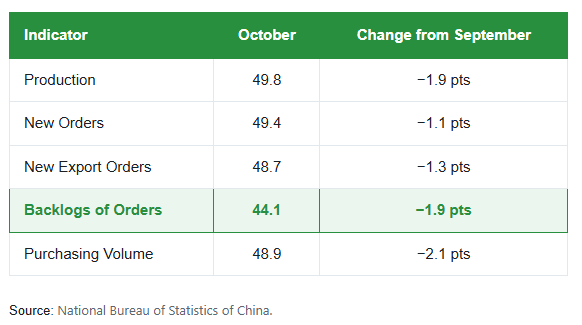
Two signals deserve particular attention.
First, the narrowing gap between production and new orders does not indicate a demand recovery.
The difference between the two index readings narrowed from 1.2 points in September to 0.4 points in October. However, this was primarily because production fell faster than new orders, not because demand strengthened. New orders remained below production at 49.4, indicating that weaker demand is increasingly feeding through to production adjustments.
Second, the backlog of orders remains a significant risk.
At 44.1, the index remains deep in contraction territory. This points to insufficient replenishment of outstanding orders. Unless new orders recover in November, production may face further downward pressure as existing orders are fulfilled without adequate replacement.
| Export Values Remain Strong, but New Orders Are Cooling
China's September exports reached US$447.18 billion, up 36.3% year on year, while the trade surplus stood at US$133.53 billion. Strong shipments of AI-related hardware, integrated circuits and automobiles, alongside price effects, supported the increase.
However, October's new export orders index fell 1.3 points to 48.7, returning below the expansion threshold.
The apparent divergence reflects the difference between a lagging indicator and a forward-looking one.
Export values reflect shipments already delivered, including orders placed and brought forward ahead of the Christmas season. Meanwhile, the decline in new export orders suggests that fresh demand is losing momentum.
Several factors could limit further growth. Higher oil prices may weigh on overseas purchasing power, China's market share in some non-US destinations is already relatively high, and price increases in AI-related hardware may prove difficult to sustain.
China's exports are not necessarily entering a period of outright contraction, but the pace of growth is likely to normalize. Businesses should therefore be more cautious about extrapolating September's exceptionally strong export performance into the coming months.
| Manufacturing Divergence Is Becoming More Pronounced
The October PMI data do not indicate a uniform manufacturing downturn. Performance continues to vary significantly across sectors and enterprise sizes.
High-tech and equipment manufacturing remain sources of resilience.
The high-tech manufacturing PMI stood at 51.3, marking its 21st consecutive month of expansion. Equipment manufacturing registered 50.6, remaining above the expansion threshold for an eighth consecutive month, supported partly by infrastructure investment under China's "Six Networks" initiative.
Production and new orders indices in computer, communications and electronics, as well as railway, shipbuilding and aerospace manufacturing, remained above 53.
Traditional demand-sensitive sectors continue to face pressure.
The consumer goods manufacturing PMI fell to 48.8, down 1.9 points from September, as post-holiday restocking slowed and new orders dropped by more than three points. Energy-intensive industries declined to 47.3, weighed down by weakness in property-related activity and the seasonal slowdown in construction.
Textiles, non-metallic mineral products and non-ferrous metal smelting also experienced weakness in both production and demand.
The divergence extends to enterprise size. Large manufacturers remained in expansion at 50.2, while medium-sized and small manufacturers fell to 48.4 and 47.5, respectively. Small manufacturers have now remained in contraction for six consecutive months.
For businesses assessing China exposure, this means aggregate manufacturing indicators can obscure substantial differences in downstream demand. High-tech and equipment-related demand remains relatively resilient, while traditional industrial chains and smaller manufacturers face greater pressure.
| Input Cost Pressure Is Easing, but Margin Recovery Remains Uncertain
In October, the purchasing price index fell 4.0 points to 56.8, while the output price index declined 2.3 points to 51.7. The gap between the two diffusion indices narrowed from 6.8 to 5.1 points.
The narrowing was partly driven by corrections in upstream commodities, including non-ferrous metals, indicating some easing in input cost pressure. However, crude oil remains supported by geopolitical premiums, and relevant petrochemical price indicators remain elevated.
For downstream manufacturers, the cost squeeze may have eased at the margin, but weak end-user demand continues to limit their ability to pass higher costs through to customers. The improvement in the price-index gap should therefore not be interpreted as a fundamental recovery in profitability.
This is also consistent with a moderation in the monthly momentum of China's Producer Price Index (PPI), although its year-on-year performance remains supported by a low comparison base.
|What Should Businesses Watch Next?
October's PMI points to a combination of seasonal normalization, weaker domestic demand and cooling export orders. High-tech manufacturing provides a partial offset, but pressure across traditional industries and smaller enterprises remains significant.
Three indicators will be critical in assessing whether manufacturing activity can stabilize:
- New order recovery: Whether new orders and backlogs begin to improve, providing a stronger basis for production and procurement.
- Infrastructure execution: Whether planned investment translates into actual construction activity and materials demand, supporting traditional industrial sectors.
- Export order stabilization: Whether new export orders recover above the 50 threshold and sustain that improvement.
The key concern is not simply that China's manufacturing PMI has fallen to 49.3, but that weakening orders may continue to feed through to production.
For international companies exposed to China's energy, chemicals and industrial markets, monitoring sector-level demand, order replenishment and infrastructure activity will be essential to assessing the next stage of China's manufacturing cycle.
For a deeper assessment of China's industrial demand and its implications for energy and chemicals markets, contact GL Consulting (premium think tank under Mysteel Group) to arrange a discussion with our analysts.
Ultra-high power graphite electrode prices: China (including origin)
Nov 03, 2026 11:21
Prebaked anode prices: Shandong
Nov 03, 2026 11:15
Prebaked anode prices: Shandong
Nov 02, 2026 11:13
Ultra-high power graphite electrode prices: China (including origin)
Nov 02, 2026 10:46
Ultra-high power graphite electrode prices: China (including origin)
Oct 30, 2026 11:20