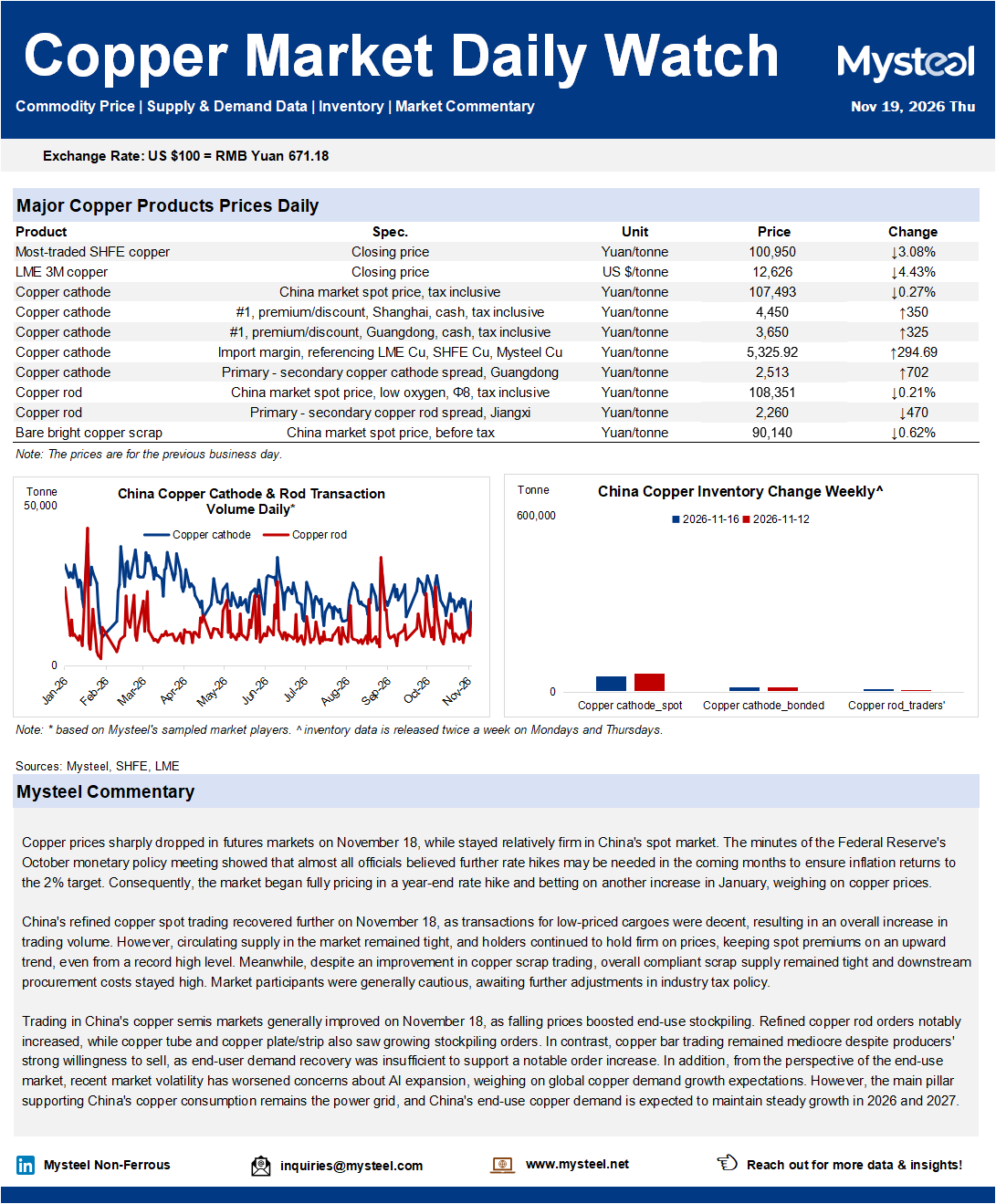
Copper prices sharply dropped in futures markets on November 18, while stayed relatively firm in China's spot market. The minutes of the Federal Reserve's October monetary policy meeting showed that almost all officials believed further rate hikes may be needed in the coming months to ensure inflation returns to the 2% target. Consequently, the market began fully pricing in a year-end rate hike and betting on another increase in January, weighing on copper prices.
China's refined copper spot trading recovered further on November 18, as transactions for low-priced cargoes were decent, resulting in an overall increase in trading volume. However, circulating supply in the market remained tight, and holders continued to hold firm on prices, keeping spot premiums on an upward trend, even from a record high level. Meanwhile, despite an improvement in copper scrap trading, overall compliant scrap supply remained tight and downstream procurement costs stayed high. Market participants were generally cautious, awaiting further adjustments in industry tax policy.
Trading in China's copper semis markets generally improved on November 18, as falling prices boosted end-use stockpiling. Refined copper rod orders notably increased, while copper tube and copper plate/strip also saw growing stockpiling orders. In contrast, copper bar trading remained mediocre despite producers' strong willingness to sell, as end-user demand recovery was insufficient to support a notable order increase. In addition, from the perspective of the end-use market, recent market volatility has worsened concerns about AI expansion, weighing on global copper demand growth expectations. However, the main pillar supporting China's copper consumption remains the power grid, and China's end-use copper demand is expected to maintain steady growth in 2026 and 2027.