Cold wave sweeps China, ferrous market feels the chill
Steel demand in East and Central China has fallen off markedly since Monday in tandem with the arrival of the cold snap, with daytime temperatures in some areas barely reaching above zero degree Celsius, Mysteel Global noted.
On Tuesday, China's meteorological authority renewed an orange alert, the second highest in a four-tier warning system, for a cold wave as a strong cold front has been sweeping across most parts of central and east China from Monday, Xinhua News Agency reported.
"I can feel that steel demand has gradually softened lately, (and) the only reason I can think of is the sudden freeze in the air," a steel trader in Central China's Henan province told Mysteel Global. Transportation of steel products has felt nearly no effect, he stressed.
A steel trader in East China's Jiangsu was similarly unfazed. "Demand weakens around this time every year and some (construction) projects have started to wrap up work for this year," he said. "But the weather is forecast to be clear in coming days with no snow or rain predicted for here – just the lowered temperatures – so our sales can still be maintained," he told Mysteel Global.
Northern China feels the cold sooner and the declines in temperature are steeper so this year, most construction companies there had already halted their operations before last weekend's cold snap arrived, Mysteel Global notes. But the weather in East China remained mild last week, so this wave of cold air is pummelling demand in eastern provinces more severely than in northern regions – even though temperatures in East China are still higher than in the north.
In comparison, daytime temperatures in South China were still around 4-5 degrees C as of Wednesday, about half the average temperature of 10 degrees C last week before the chill descended. Building contractors there are still "accelerating work (to finish before the Chinese New Year holiday in middle February) and still have strong demand for steel products," according to an official with a local steel mill selling steel for construction use. He reckoned that the current high demand would last until at least mid-January.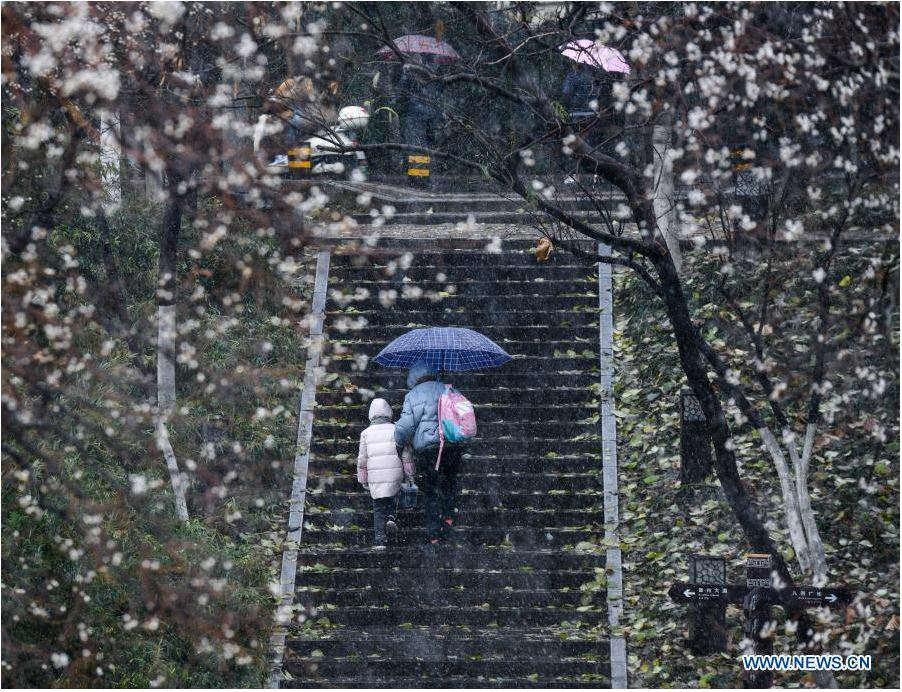
Heavy snow falling in Hefei, in East China's Anhui province
Source: Xinhua
On the other hand, transportation of raw materials including iron ore, coking coal and coke had been affected by the temperature drop and the snow and sleet accompanying it, especially in North China.
"For example, at Lanqiao port (in North China's Shandong province), port operations including iron ore transportation via trucks were slightly affected by snow yesterday, but with the weather improved today so the disruptions will largely ease," a Rizhao-based iron ore trader said.
"The snow's impact was limited. In fact, prior to this, the smoggy weather due to air pollution over the past week had a greater impact on port operations," he added.
An iron ore procurement official with a Hebei-based still mill also confirmed that their iron ore transportation via trucks has not been affected by the cold weather.
As for coking coal and coke, deliveries by road have been more strongly impacted than by rail. "The snow in North China has partially slowed coking coal and coke deliveries, though end-users have continued to increase bookings," observed a Shanxi-based market watcher.
According to Shanxi's Department of Transportation, the entrances of some highway link roads have been temporarily blocked by authorities to prevent accidents from the snow and black ice.
So far, the sudden snow has a had limited impact on railway transportation, Mysteel Global understands. Nevertheless, as rail operators in North and Northwest China are prioritizing thermal coal transportation to meet the country's need for power generation for heating, wagon availability for transporting coking coal and coke to steelmakers is tight.
Written by Anna Wu, wub@mysteel.com, Olivia Zhang, zhangwd@mysteel.com, Victoria Zou, zyongjia@mysteel.com and Sean Xie, xiepy@mysteel.com
Edited by Russ McCulloch, russ.mcculloch@mysteel.com
Mysteel Iron Ore Index
Apr 08, 2026 19:34
Iron ore concentrates procurement prices: China's major mills
Apr 08, 2026 18:47
Imported iron ore prices: China's major cities
Apr 08, 2026 18:23
Iron ore portside prices: Lanqiao Port
Apr 08, 2026 18:15
Iron ore portside prices: Jingtang port
Apr 08, 2026 18:13
