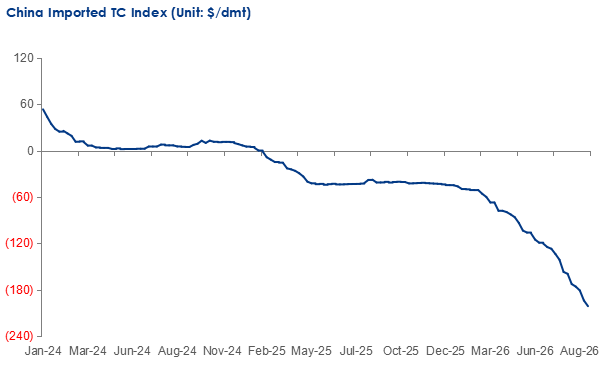
Mysteel's imported copper concentrate spot treatment charge (TC) index stood at -$201.56/dmt as of September 4, continuing hitting historic lows after declining sharply over the past three years. The collapse in copper concentrate TCs is no longer simply a reflection of a tight market, but is the price signal of a structural supply-demand imbalance that is increasingly reshaping the copper industry.
The underlying mismatch is clear. Mine supply is struggling to generate meaningful growth, while global smelting capacity has expanded far faster. As too much smelting capacity competes for too little concentrate, physical scarcity has shifted bargaining power toward miners and pushed TCs deep into negative territory. The impact, however, extends well beyond smelting margins. Persistently negative TCs are redistributing value from smelters toward miners while widening the gap between well-integrated and standalone smelters. Enterprises with upstream resources, secured concentrate and strong by-product revenues are better positioned to withstand the squeeze, while spot-dependent smelters face growing pressure to cut output, consolidate or exit. The roots of this shift can be found on both sides of the market.
Source: Mysteel, CSPT
Mine supply growth slows with less elasticity
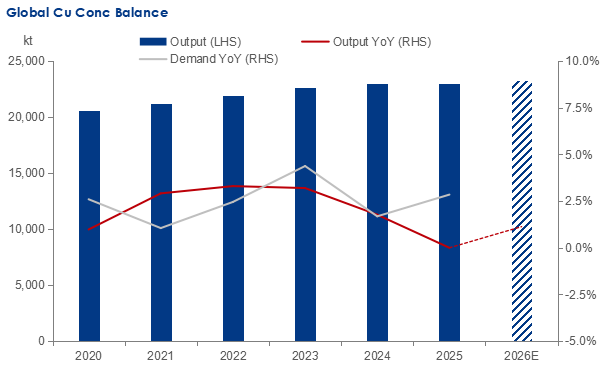
The first structural problem is insufficient mine supply growth. According to ICSG, global copper mine production has grown at a CAGR of less than 2% over the past five years, with growth slowing over the period. More importantly, the mining industry has limited ability to respond quickly when demand increases.
Source: Mysteel, ICSG
Three structural constraints are behind this. First, declining ore grades and mature mine life are weighing on existing operations. Major producers, particularly in Chile, are having to process more ore to maintain output. Escondida is a clear example, with its FY2026 (July 2025-June 2026) production falling around 3%, mainly because of lower concentrator feed grades, despite record throughput. Second, the contribution of large new mines remains limited and slow. Greenfield projects take years to permit, finance and develop, while brownfield expansions generally provide smaller additions. Although several major projects could bring meaningful volumes over the longer term, much of the new supply is back-loaded, with some large greenfield projects unlikely to contribute significant volumes until the 2030s.
Third, operational and geopolitical risks are making existing supply less reliable. Grasberg illustrates the problem. Following the September 2025 mud-rush incident, its restart has been phased, with production expected to reach only around 65% of capacity in H2 2026, 80% by mid-2027 and full capacity only toward the end of 2027. Even when disrupted supply is expected to return, it cannot necessarily return quickly.
The issue is therefore not that global mine supply is falling. It is that the industry cannot quickly generate enough supply to keep pace with downstream demand. This is what makes the current concentrate shortage increasingly structural rather than simply cyclical.
Smelting capacity keeps expanding
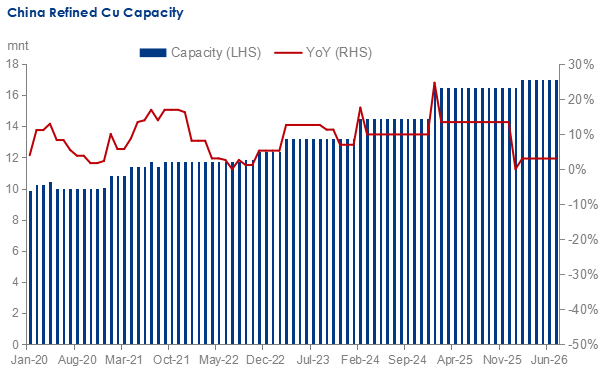
While mine supply has become less elastic, smelting capacity has continued to expand. According to ICSG data, global refining capacity grew at a CAGR of around 2.53% between 2020 and 2025, compared with only 1.87% for mine production. The gap is much wider in China, where refining capacity expanded at around 8.92% CAGR over the same period.
Source: Mysteel
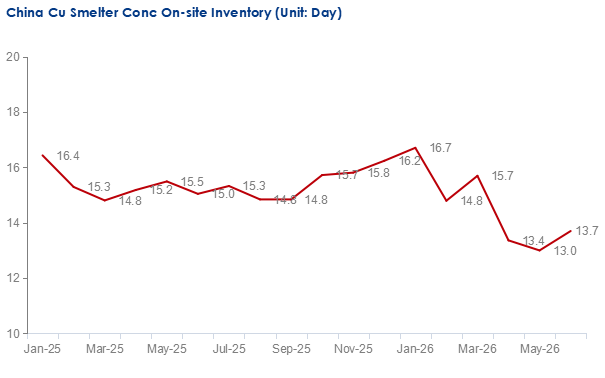
And physical market data suggest that the influence is becoming increasingly obvious. China's concentrate imports remained above 2 million tonnes per month in 2026, but declined year on year from April. January-June arrivals fell around 9% YoY, while average port inventories have remained below 2025 levels. Smelter raw-material coverage has also fallen to around 15-20 days, compared with a more typical 25-30 days, although part of this decline reflects greater use of alternative feedstocks such as scrap. The market is therefore moving beyond a situation where concentrate is simply expensive to process. Physical availability itself is becoming a constraint.
Source: Mysteel
Despite this mismatch, Chinese smelters maintained relatively high output, which creates one of the key contradictions in the current market.
TCs have fallen far below the level needed to cover Chinese smelting costs. Excluding by-product revenues, we estimate the breakeven TC for Chinese smelters at around $17-25/dmt. Yet refined copper production still increased around 1.7% YoY in H1 2026.
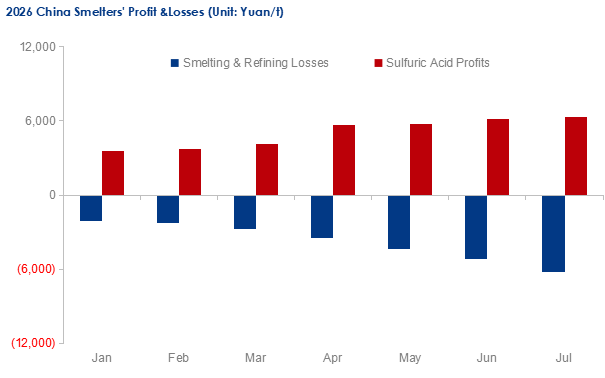
Why haven't smelters cut production more aggressively? The answer is largely by-product economics. Sulfuric acid has provided an important cushion. A typical tonne of refined copper generates around 3-4 tonnes of sulfuric acid, while prices surged nearly 80% from the beginning of 2026 to their peak in early July.
July provides a useful illustration. Based on July average TC/RC and sulfuric acid prices, we estimate a core smelting loss of around Yuan 6,227-6,282/t of refined copper. Assuming approximately four tonnes of sulfuric acid per tonne of copper, sulfuric acid alone contributed around Yuan 7,206/t. This helps explain why smelters have remained relatively resilient despite deeply negative TCs.
Source: Mysteel
But this is a cushion, not a solution. Sulfuric acid prices have already fallen from their July peak as supply has loosened, while demand remains relatively weak. Scrap has also provided an alternative source of feedstock, but tighter tax policies in 2026 have increased costs and constrained scrap flows. In other words, both major buffers are becoming less effective.
The pressure is already beginning to reach production. Mysteel's July survey showed refined copper output declining both month on month and year on year, with around 11,000 tonnes of cuts attributed to raw-material constraints. If concentrate remains scarce while by-product support weakens, the pressure that has so far been absorbed through margins will increasingly have to be reflected in lower smelter utilization and refined copper production.
From smelting margin compression to industry profit redistribution
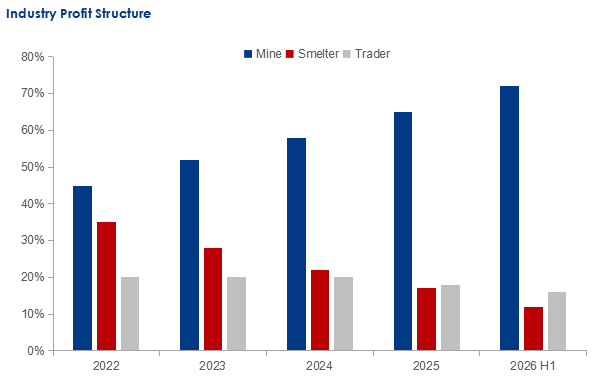
This is where the current concentrate squeeze becomes more significant for the industry's long-term structure. Our view is that deeply negative TCs represent more than a cyclical downturn in smelting profitability. They signal a redistribution of value along the copper value chain. When concentrate becomes scarce, high-quality and low-cost mineral resources gain bargaining power. Miners can capture a larger share of the overall copper economics, while smelters compete for increasingly scarce feedstock.
Source: Mysteel
But the impact is not uniform across the smelting industry. Smelters with upstream resources, high proportions of long-term concentrate contracts and strong by-product revenues are better positioned to withstand the squeeze. Smaller and more spot-dependent smelters are considerably more exposed. Mysteel's H1 2026 survey illustrates this divergence: highly integrated smelters with around 70% of concentrate secured through long-term contracts benefited from stronger feedstock security and by-product revenues, while smaller, more spot-dependent smelters saw profits deteriorate or even move into losses.
This creates a growing incentive for leading companies to secure upstream resources, increase long-term commitments, diversify feedstocks or expand further downstream. Vertical integration is therefore becoming not only a strategy for margin protection, but also a strategy for feedstock security. At the same time, weaker smelters face increasing pressure to reduce operating rates, consolidate or exit.
Smelting capacity concentration to become part of the adjustment
The industry is already attempting to address the imbalance collectively. Chinese Smelters Purchase Team (CSPT), consisting of leading smelters in China, agreed to reduce concentrate-based smelting capacity utilization by more than 10% in 2026, covering around 70% of China's refined copper capacity.
However, implementation is difficult. Individual smelters still have strong incentives to maintain production because of continuous-process requirements, long-term contracts, by-product revenues and the risk of losing market share. This creates a classic collective-action problem. What is rational for an individual smelter may not be rational for the industry as a whole. As a result, capacity adjustment is likely to be gradual rather than uniform. The strongest and most integrated players should be better positioned to maintain production, while high-cost, spot-dependent capacity will face increasing pressure.
Over time, this should lead to greater industry concentration and vertical integration, rather than simply a broad-based recovery in smelting margins.
Conclusion
The copper concentrate market is entering a fundamentally different phase. The problem is not simply that TCs have fallen to unprecedented levels. The underlying issue is that mine supply is becoming structurally less elastic while smelting capacity remains abundant and continues to expand.
For now, strong sulfuric acid revenues, alternative feedstocks and long-term contracts have delayed the full adjustment. But as these buffers weaken, the pressure is increasingly likely to move from margins to operating rates and refined copper production. The eventual adjustment will therefore extend beyond TCs.
First, value is being redistributed from smelters toward miners. Then, capacity itself will be redistributed within the smelting sector. In this environment, resource ownership, feedstock security and vertical integration will become increasingly valuable, while weaker and more spot-dependent smelters face growing pressure to consolidate or exit. Deeply negative TCs are therefore not just a symptom of today's concentrate shortage, but are becoming a mechanism through which the copper industry is being structurally reshaped.
Written by Mingyuan Wang, wangmingyuan@mysteel.com
Edited by Zhaorui Cui, cuizhaorui@mysteel.com