Lithium carbonate prices held steady through China's National Day holiday over October 1-7, 2026, hovering near yearly lows with producers favoring long-term contracts and traders staying sidelined. Yet, peak-season demand and destocking in October will support lithium prices, while supply growth expectations will likely cap the upside, pointing to rangebound trading near term.
In detail, the downstream buyers completed a round of concentrated front-loaded restocking, boosting spot transaction volumes before the National Day holiday. During the holiday, both spot and futures markets were closed, keeping spot trading lackluster, and the industry focused on digesting pre-holiday orders, with market prices broadly stable.
During the holiday, lithium carbonate spot prices were largely stable based on Mysteel's assessment. Premium grade lithium carbonate was assessed at Yuan 120,500-122,000/tonne, battery-grade at Yuan 118,500–122,000/tonne, and industrial-grade at Yuan 116,000–119,500/tonne.
Source: Mysteel
Lithium carbonate spot prices have now neared year-to-date lows. Lithium converters mainly maintain shipment through long-term contract, with poor willingness to sell on a spot basis and a firm stance on prices. On the spot market, traders' marketable inventories have remained low after pre-holiday destocking, with most adopting a wait-and-see approach in the near term.
On the supply side, Mysteel's latest survey showed that China's domestic lithium carbonate production for September 2026 was 114,700 tonnes, up 7.7% month on month (MoM), though lower than early-September production schedule guidance.
Specially, due to tightening feedstock and falling lithium prices, planned production increases at some lepidolite-based lines failed to materialize; spodumene-based producers saw mixed output changes, roughly flat overall. The domestic production schedules for October 2026 are 115,900 tonnes, up 1.1% MoM, a slower pace than in September.
On the demand side, both the power and energy storage end-markets continue to show relatively high prosperity. China's September 2026 LFP production read 603,200 tonnes, up 4.78% MoM, with most industry players running at full capacity, though actual output at some LFP producers fell short of expectations due to production line issues.
In October 2026, China's LFP production is expected to rise to 625,000 tonnes, up 3.61% MoM, with capacity continuing to ramp up in Sichuan, Inner Mongolia, and Hubei. Some enterprises have slowed capacity commissioning and ramp-up due to production line testing, feedstock supply constraints, and margin pressure, while toll-processing order volumes have risen. The ternary cathode material market, squeezed by LFP cathode, still faces output pressure.
On feedstock, lithium converters' earlier restocking was generally smooth, and lithium ore supply tightness has eased somewhat compared with Q2, though the overall situation has not shifted substantially. Further observation is needed on Australian ore capacity release and Zimbabwean lithium ore arrivals in China.
Since September, the lithium ore processing fees have slightly recovered but only modestly, still not enough to encourage marginal capacity to raise capacity utilization rates further.
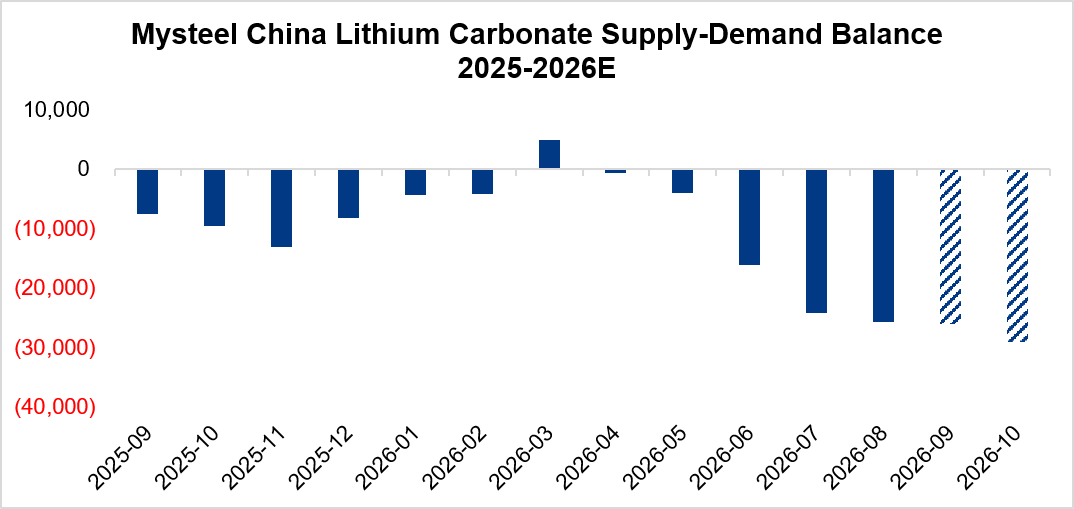
Overall, October remains a traditional peak consumption season for lithium battery materials, with LFP production schedules at high levels. Amid export tax rebate adjustments, the export rush of battery and cathode active materials have front-loaded some demand. Demand is expanding faster than supply, and the monthly supply-demand gap may widen to about 29,000 tonnes, with total visible inventories continuing to draw down. That is, destocking support coexists with supply-side incremental expectations weighing on prices, and lithium carbonate prices are expected to continue fluctuating range-bound in the near term.
Source: Mysteel
Written by Aggie Hu, huchenying@mysteel.com