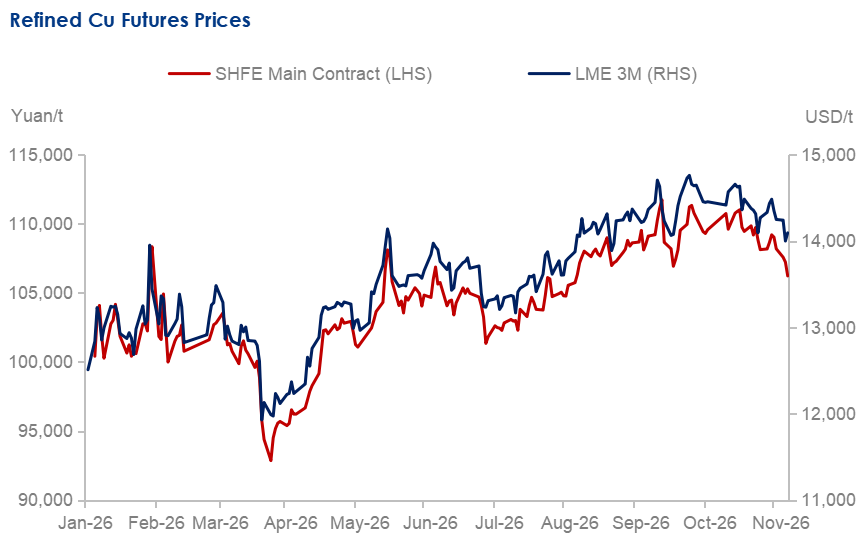
Copper prices fell sharply on November 3, as the SHFE main contract closed at Yuan 106,090/tonne, down by 1.39% and right at its intraday low, while LME three-month copper dropped more than 3% during the session to a low of $13,883/tonne, the weakest level since August 19, before recovering some ground to close at $14,034.5/tonne, down by 2.03% on the day. During the night session on November 5, copper prices fell further by 1.29% to a low of Yuan 104,270/tonne. The sharp sell-off raised fresh questions about the sustainability of the metal's record-breaking rally. After months of gains, copper prices suddenly came under pressure with a cooling of the AI narrative and disruptions surrounding the U.S. midterm elections. Yet the retreat in futures prices was not accompanied by a comparable deteriorating in China's physical market, where low inventory, constrained smelter output and elevated spot premiums continued to point to tight supply.
Source: SHFE, LME, Mysteel
What broke the rally
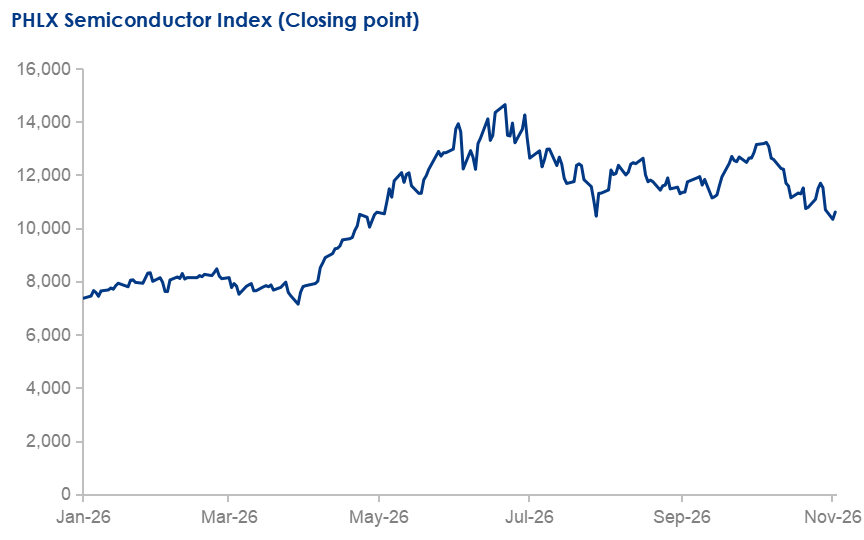
Understanding the decline requires returning to the story behind 2026's rally. LME copper climbed from $11,700/tonne to a record $14,875/tonne on September 10, with AI-driven data-center demand one of the core supports. Precisely because so much of the gain was built on that narrative, any loosening of the narrative invites a sharp retreat. The trigger came from U.S. equity markets, Intel's fourth-quarter revenue guidance came in far below expectations, and disappointing results from Google and Amazon led investors to question the sustainability of AI data-center capital expenditure. If the returns on AI capex are deferred, the forward demand premium priced into upstream metals such as copper and tin must be revalued. Funds liquidated liquid long positions first, and copper fell accordingly.
Source: Nasdaq, Mysteel
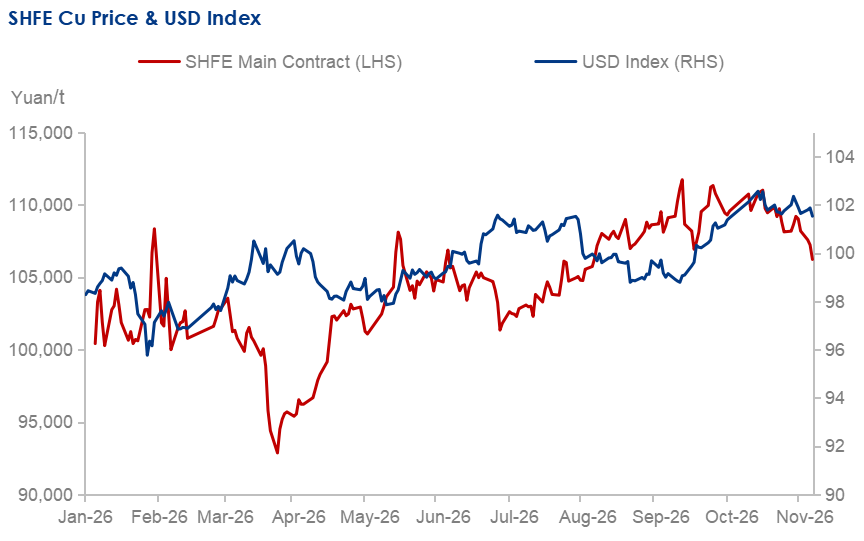
Two macro factors added to the pressure, the first being monetary policy. After hotter-than-expected September U.S. CPI data, markets raised the odds of a Federal Reserve rate hike at the December meeting, keeping the USD index elevated and capping valuations across the entire nonferrous market. The second is the U.S. midterm elections. With voting under way on November 3, risk appetite contracted and long positions in offshore risk assets were trimmed.
Source: SHFE, Fed, Mysteel
Additionally, the rebound in LME inventories proved the last straw. LME copper inventory surged in early November to 312,300 tonne, a four-month high, undermining the squeeze-like tightness that had underpinned prices. Combined with the heavy accumulated profits from the long rally, long positions were exited en masse and copper prices dropped.
In short, the fall was a rout in financial positioning driven by the resonance of a loosening AI narrative, rising rate-hike expectations, election-related risk aversion and LME deliveries. The marked divergence between the futures plunge and an even tighter physical market is the key reference point for judging where copper goes from here.
Fundamentals still anchor the floor
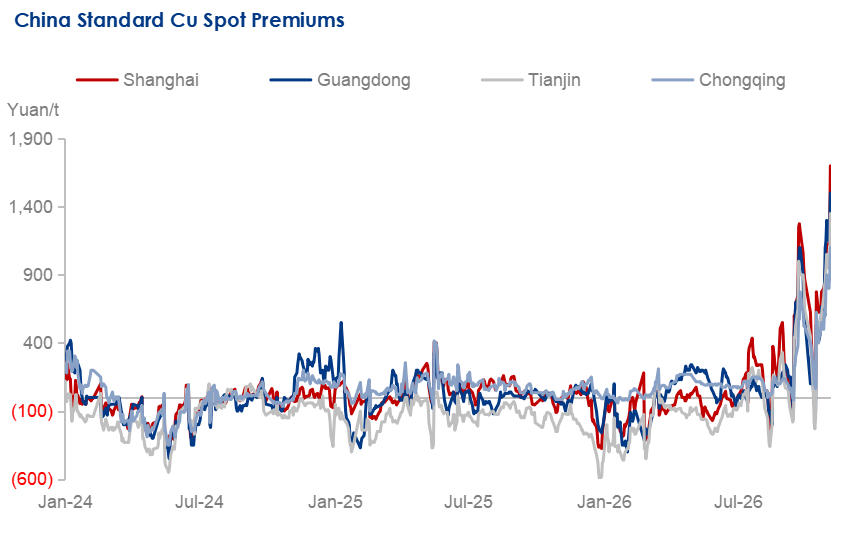
The physical market tells a different story. Mysteel's survey shows China's refined copper retail inventory at only about 67,400 tonne as of November 5, an absolute low for this time of year. Meanwhile, deeply negative copper concentrate treatment charges (TCs) have widened smelter losses, and estimated refined copper output for November is only 1.0523 million tonnes, down about 7.73% year on year. Supply therefore remains tight. Shanghai refined copper spot premiums widened to Yuan 1,175/tonne on November 3 and further to Yuan 1,700/tonne on November 4 and Yuan 1,950/tonne on November 5, while the Yangshan copper premium held near $200/tonne, a historically elevated level. In other words, the selling has been concentrated in financial positioning, while the tight physical balance has not reversed. This is a collapse of expectations, not a collapse of reality.
Source: Mysteel
Short-term outlook: range-bound, but with a weak bias
With the U.S. midterm election settled, markets have begun repricing the policy consequences of a Democratic sweep of both chambers, and both of copper's bullish threads are under pressure. The first is tariffs, the House Democratic leader has said they will push legislation to terminate the existing tariff measures, clearly cooling expectations of refined copper tariffs from January 1, 2027. If the tariffs fail to materialize, the excess copper stockpiled in the U.S. could flow back and pressure non-U.S. markets. The second is AI, the correction in technology stocks has already led markets to mark down data-center capex expectations, and the Democrats' regulatory posture toward AI and data centers, together with the victories of anti-data-center candidates, may slow project approvals and construction timelines. Together, these forces risk squeezing out the AI-related demand premium further.
There is a benign side, tariff removal and a push to end the U.S.-Iran conflict could slow inflation and, in time, weaken the U.S. dollar's drag on copper. But that transmission is indirect and lagged. Disinflation must first be confirmed in the data before December FOMC pricing changes, and a geopolitical easing would itself drain the supply-risk premium out of the price. In the near term, macro factors and market sentiment are therefore likely to remain headwinds for copper.
On fundamentals, Mysteel's survey suggests that fourth-quarter (Q4) maintenance and feedstock shortages will remove close to 90,000 tonne of refined copper output per month on average, with surveyed Q4 production down about 3.3% year on year. Even allowing for a modest import supplement, the tight spot balance is unlikely to improve materially, and year-end inventories should remain at low levels, continuing to support spot premiums and the price floor.
In the base case, with pressure above and support below, copper is likely to trade in a range with a somewhat lower center, SHFE copper at Yuan 104,000-108,500/tonne and LME copper at $13,700-14,300/tonne in the near term. Three dates warrant close attention. First, the December 8-9 FOMC meeting, where the rate decision will determine whether dollar-side pressure materializes. Second, official signals on U.S. refined copper tariffs, currently the single variable with the widest bull-bear disagreement and the highest elasticity. Third, the 2027 copper concentrate long-term contract negotiations at year-end. If the benchmark TC is set in negative territory, it would further confirm concentrate tightness and strengthen longer-term cost support.
Overall, the recent copper decline was a valuation correction driven by macro sentiment and positioning flows. A softening AI narrative stripped out the demand premium, rising rate-hike expectations and election-related risk aversion eroded risk appetite, and LME inventory deliveries undermined the case for a squeeze. Yet the fundamental reality has not reversed, with tight mine supply, low non-U.S. refined inventories and high premiums. Copper is likely to remain range-bound with a weak bias in the near term, while a genuine directional move still hinges on clarity from the December FOMC meeting and U.S. import tariffs.
More regular analysis and comprehensive data on China's copper industry are available in Mysteel Copper Weekly, Mysteel Copper Monthly, and Mysteel Copper Database. Reach out to us via Mysteel's official website: Latest & Reliable Copper Market Price in China | Mysteel, and follow Mysteel Non-Ferrous for more insights!
Written by Zhaorui Cui, cuizhaorui@mysteel.com
Edited by Mingyuan Wang, wangmingyuan@mysteel.com