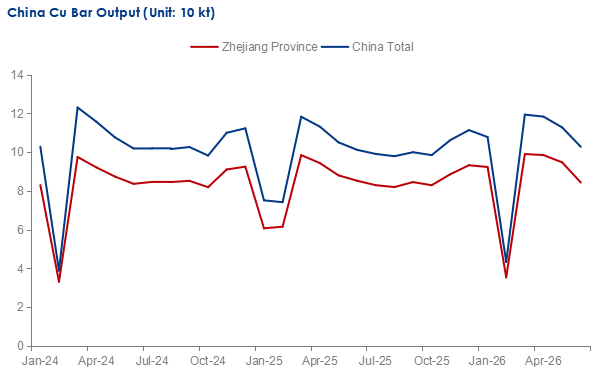
Typhoon Bavi, the strongest typhoon to make landfall in Zhejiang in July since 1949, temporarily disrupted production at copper bar manufacturers across the province during July 11-12. However, according to Mysteel's survey, the impact on overall supply was limited, as most producers suspended operations for only one production shift to two days before quickly resuming normal operations on July 13.
As one of China's two largest copper bar production hubs alongside Guangdong, Zhejiang plays a key role in domestic copper bar supply, accounting for about 70% of total capacity, making weather-related disruptions closely watched by the market.
Data source: Mysteel
After making dual landfalls in Taizhou and Wenzhou on July 11, Typhoon Bavi brought strong winds, heavy rainfall, and widespread transportation disruptions across Zhejiang. In response, the provincial government activated its highest Level I emergency response, while several cities suspended schools, work, production, public transport and business operations, requiring temporary shutdowns of industrial operations.
Mysteel surveyed 13 copper bar producers in Zhejiang and found that production disruptions were widespread yet generally short-lived. Five producers in Shaoxing suspended operations for half a day to one day, with some canceling night shifts. Two producers in Taizhou halted production between July 11 and 12 before fully resuming operations on July 13. Meanwhile, six producers in Ningbo and Jiaxing suspended production for one to two days. Overall, last week's copper bar output is expected to decline.
Production losses were driven primarily by employee commuting difficulties, temporary government-mandated shutdowns, and precautionary safety measures rather than damage to manufacturing facilities. Several producers also suspended raw material deliveries and downstream shipments for one day as transportation was briefly interrupted.
Most disruptions were concentrated between the night of July 11 and the morning of July 12. As road conditions improved and the typhoon moved north, production and logistics rapidly returned to normal as of July 13, with no significant backlog of orders reported.
Despite Bavi's intensity, its impact on Zhejiang's copper bar market was largely short-term and operational rather than structural. The brief production suspensions resulted in temporary reduction in weekly output and had little influence on overall market supply.
Looking ahead, seasonal demand weakness is expected to remain the primary factor shaping the copper bar market. As the traditional off-season continues, sluggish downstream consumption is likely to exert a much greater influence on prices and production than temporary weather-related disruptions. While extreme weather events may periodically interrupt regional operations, their impact is expected to remain limited unless they cause prolonged transportation disruptions or widespread damage to production facilities.
Don't miss Mysteel's H1 2026 Copper Market FREE Webinar! Check the link below to learn more, and register to secure your spots:
H1 2026 Saw Intertwined Contradictions in China's Copper Market - What's Next for H2?
Written by Mingyuan Wang, wangmingyuan@mysteel.com