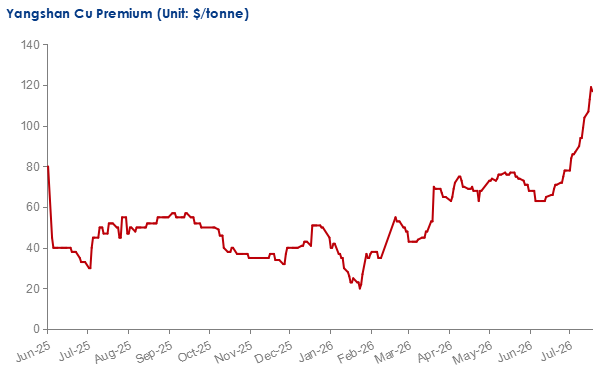
China's Yangshan copper premium surged to a historical high of $119/tonne as of July 22, up from $45/tonne at the beginning of 2026. The sharp increase indicates that Chinese buyers are paying increasingly higher premiums to secure imported copper, despite the traditional downstream consumption off-season and already elevated copper prices. Combined with high domestic spot premiums over SHFE prices, the rising import premium suggests that physical tightness is intensifying across China's copper supply chain, extending beyond the raw material sector.
Source: Mysteel
From global copper concentrate tightness to domestic scrap supply limitations and slowing refined copper production growth, multiple supply channels are facing constraints in China. Meanwhile, U.S. tariff-driven copper stockpiling further reduces available inventory in global markets, intensifying overall supply tightness.
Copper concentrate tightness as origin of the supply squeeze
The copper concentrate market represents the starting point of the current supply squeeze. Although concerns over mine supply have been widely discussed, underlying structural challenges have continued to intensify, limiting the global copper supply response to rising demand.
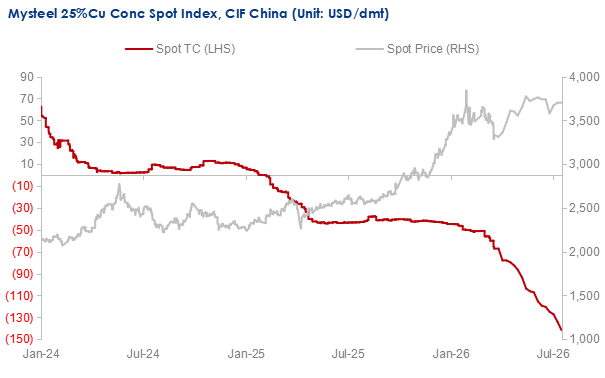
Mysteel's clean copper concentrate spot treatment charge (TC) index fell to -$141.5/dmt as of July 17, reaching historically low levels amid persistent concentrate shortages and strong smelting demand. Negative TCs indicate that smelters are competing aggressively for limited raw materials, highlighting the severity of the current supply imbalance.
Source: Mysteel
The fundamental issue lies in insufficient growth in global copper mine supply, with the International Copper Study Group (ICSG) lowering its 2026 global copper mine production growth forecast from 2.3% to 1.6% in April 2026. Most incremental supply is expected to come from brownfield expansions, selective greenfield projects and technological improvements, while large-scale new projects remain limited. Meanwhile, the industry faces increasingly challenging operating conditions, including declining ore grades, infrastructure constraints and rising development costs. These structural barriers suggest that additional mine supply is unlikely to arrive quickly enough to alleviate the current market tightness.
Recent quarterly reports from some miners also showed weaker copper output. Grupo Mexico's second-quarter copper production declined 3.7% year on year, while BHP's copper output fell 5% due to lower production at Escondida and Pampa Norte. South32 also reported lower copper production, impacted by ongoing adverse weather conditions. Meanwhile, short-term supply disruptions have further intensified market sentiment. Severe winter weather in Chile recently disrupted mining and logistics operations in central and southern regions, attracting market attention given Chile's status as the world's largest copper producer.
Overall, persistent structural constraints and recurring disruptions suggest that copper concentrate availability will remain tight and limit copper supply growth in the near term.
Scrap supply tightness in China adds pressure
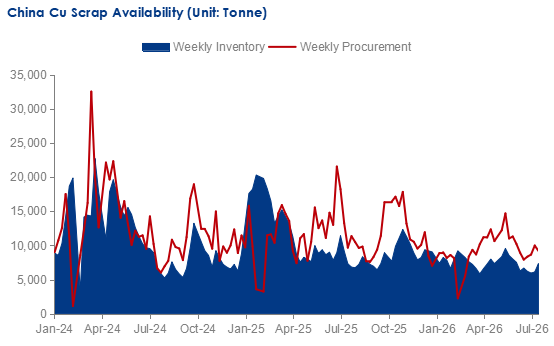
China's copper scrap spot supply has also begun to face constraints, reducing an important buffer for refined copper raw material availability.
Recent tightening of copper scrap tax and invoice management policies in China has reduced the availability of compliant domestic scrap supply, weakening an important source of refined copper raw materials. Although the reverse invoicing policy was introduced to improve market regulation and address long-standing compliance issues, its implementation has created short-term challenges for the recycling industry. Specifically, the annual Yuan 5 million invoice limit for individual sellers, combined with stricter tax inspections, has increased compliance costs across the recycling chain. Market participants told Mysteel that scrap invoice costs rose from around 7% previously to approximately 10% in the first half of 2026, significantly squeezing recycling margins. As a result, many small recycling operators have reduced collection activities or exited the market, weakening the flexibility of China's scrap supply system. Meanwhile, a growing share of scrap is struggling to enter formal processing channels due to compliance constraints.
Source: Mysteel
The impact of tight copper scrap supply is spreading across the industry chain and indirectly increasing pressure on the refined copper market. On one hand, as scarce copper concentrate supplies have prompted some smelters to increase demand for alternative copper-bearing materials, demand for copper scrap from the smelting sector has risen, as scrap is a key raw material for secondary anode production. Consequently, shrinking scrap availability has further intensified competition for raw materials. On the other hand, some downstream processors that previously relied on scrap have been forced to shift toward refined copper due to difficulties in securing competitively priced secondary materials, further tightening refined copper supply.
Refined copper output growth slows as tight raw material takes effect
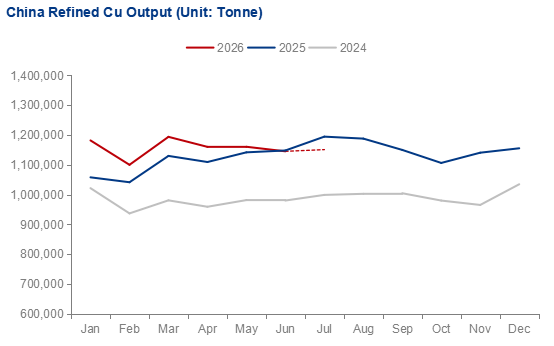
China's refined copper output growth has slowed in 2026. According to Mysteel's survey, China's refined copper production declined month on month in June, also marking the first year-on-year decrease in recent years. The decline was mainly driven by intensive maintenance activity, with 11 smelters conducting maintenance during the month and reducing output by approximately 76,000 tonnes, the largest monthly production impact so far this year.
Source: Mysteel
The production pressure has continued into July. Six smelters are scheduled for maintenance, including two plants extending their maintenance from June, with an estimated impact of around 38,000 tonnes. Mysteel expects China's refined copper output in July to reach 1.1508 million tonnes, only increasing 0.5% month on month while remaining down 3.65% year on year.
With copper concentrate TCs remaining deeply negative and scrap supply constrained, smelters are facing increasing challenges in securing sufficient raw materials. Although high prices of by-products such as sulfuric acid previously supported smelter profitability, allowing smelters to continue purchasing expensive raw materials to maintain production, tightening raw material availability is now beginning to affect the physical refined copper market, marking an important turning point.
U.S. tariff-driven stockpiling intensifies global spot copper tightness
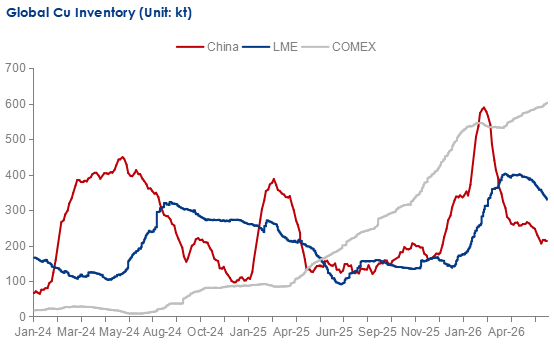
However, the ICSG stated in its latest monthly report that the global refined copper market actually recorded a surplus of 18,000 tonnes in May 2026, compared with a deficit of 145,000 tonnes in April. Over the first five months of the year, the copper market experienced a surplus of 221,000 tonnes, versus a surplus of 117,000 tonnes in the same period last year. The contradiction of historically high copper prices and supply surplus was primarily caused by U.S. tariff expectations, which resulted in significant inventory accumulation at COMEX warehouses and reduced available inventory in non-U.S. regions.
Source: Mysteel
The continuous U.S. stockpiling has reduced the availability of freely accessible copper in global markets. As inventory become increasingly concentrated in the U.S., other consuming regions face greater competition for deliverable material, contributing to stronger premiums such as those seen at China's Yangshan port. Therefore, tariff expectations are acting as an accelerator, transforming an existing supply shortage into more visible physical tightness outside the U.S. Going forward, global copper flows are expected to continue adjusting, as uncertainty over U.S. refined copper tariffs persists while China's rigid demand for copper remains resilient.
Summary
The surge in China's Yangshan copper premium indicates that China's supply squeeze is no longer limited to upstream concentrate constraints but has spread across the entire supply chain, from scrap availability to refined copper spot supply. Although global refined copper statistics still point to a modest surplus, physical markets are increasingly characterized by regional imbalances and intensified competition for spot material.
The combination of structural mine supply constraints, tightening secondary copper availability and declining refined copper production is providing strong support for copper prices in China. Looking ahead, copper prices will increasingly depend on whether supply growth can keep pace with physical demand. If mine disruptions persist, China's scrap availability remains constrained and global inventory continue to be tightened by U.S. tariff expectations, the market could face further upward price pressure. Therefore, beyond frequent macroeconomic disruptions, copper market fundamentals may warrant greater attention in the second half of 2026.
Don't miss Mysteel's H1 2026 Copper Market FREE Webinar! Check the link below to learn more, and register to secure your spots:
H1 2026 Saw Intertwined Contradictions in China's Copper Market - What's Next for H2?
Written by Mingyuan Wang, wangmingyuan@mysteel.com
Edited by Zhaorui Cui, cuizhaorui@mysteel.com