Price: Firm copper scrap prices narrow refined-scrap price spread
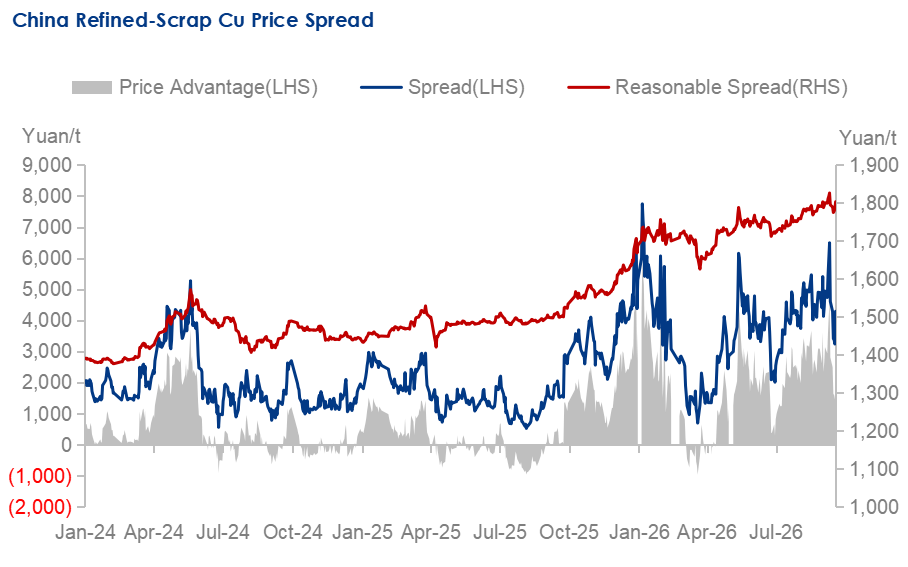
Refined copper prices fell then rebounded last week, with the weekly average moving lower. Although copper scrap prices tracked copper price fluctuations, limited improvement in the tight scrap supply kept them relatively firm, with a smaller decline than refined copper, so the refined-scrap copper price spread narrowed last week. Going forward, the impact of the reverse invoicing policy is expected to keep domestic copper scrap supply tight with little short-term improvement. With holders holding back sales to support prices, copper scrap prices are expected to remain firm, and the refined-scrap copper spread is also expected to stay at a relatively high level. Copper scrap invoice points were 13% in September, significantly increasing scrap costs, making it difficult to continue using the refined-scrap copper price spread as an indicator of substitution between refined copper and copper scrap in actual transactions.
Data Source: Mysteel
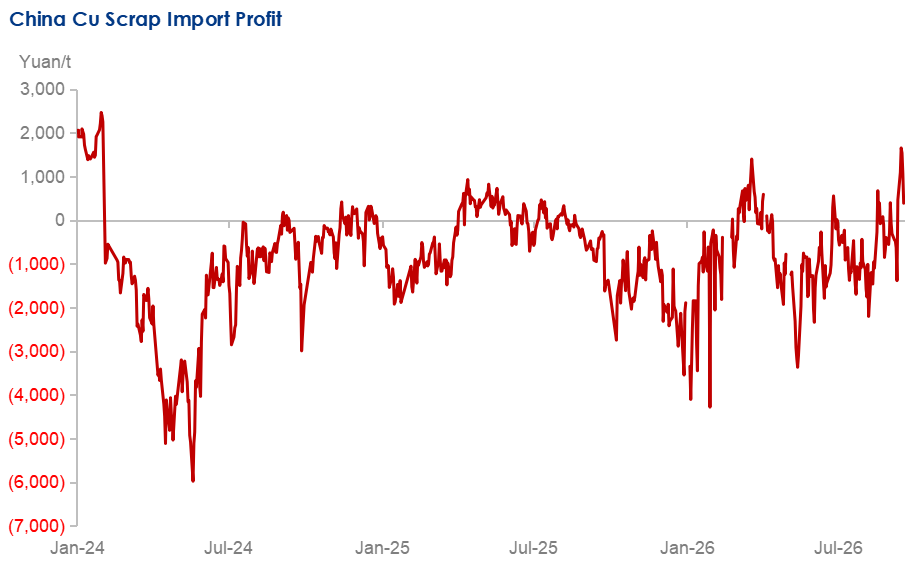
The weekly average import prices for red copper scrap (99%-99.5% Cu) in China decreased slightly last week. Meanwhile, amid volatile domestic and overseas copper scrap prices, China's copper scrap import profit increased sharply, ranging from Yuan 388.87/tonne to Yuan 1,653.10/tonne. Looking ahead, the constraints of the reverse-invoicing policy on China's scrap sector will be hard to ease in the near term, and invoice shortages are likely to intensify, keeping demand for imported scrap strong. Therefore, China's copper scrap import volumes are expected to remain relatively high in the near term.
Data Source: Mysteel
Supply: Price volatility limits improvement in copper scrap spot liquidity
China's copper scrap spot market circulation improved only modestly last week. For red copper scrap, upstream traders generally held low inventories and prioritized delivering previous high-priced orders early in the week. As prices rose later, trading sentiment improved, small and medium-sized sellers became more willing to sell, and traders saw better performance in both procurement and sales. For brass scrap, early in the week, copper scrap prices weakened, and upstream traders restocked small volumes on dips but showed little willingness to sell, leaving spot circulation thin. As prices rebounded later, traders became more active in selling, but insufficient low-priced inventory narrowed trading margins, making a significant increase in shipments unlikely. Looking ahead, given tax policy uncertainty, copper scrap spot supply in China is unlikely to improve significantly, and the overall market is expected to remain characterized by high prices and limited supply.
Demand: Pre-holiday restocking demand below expectations
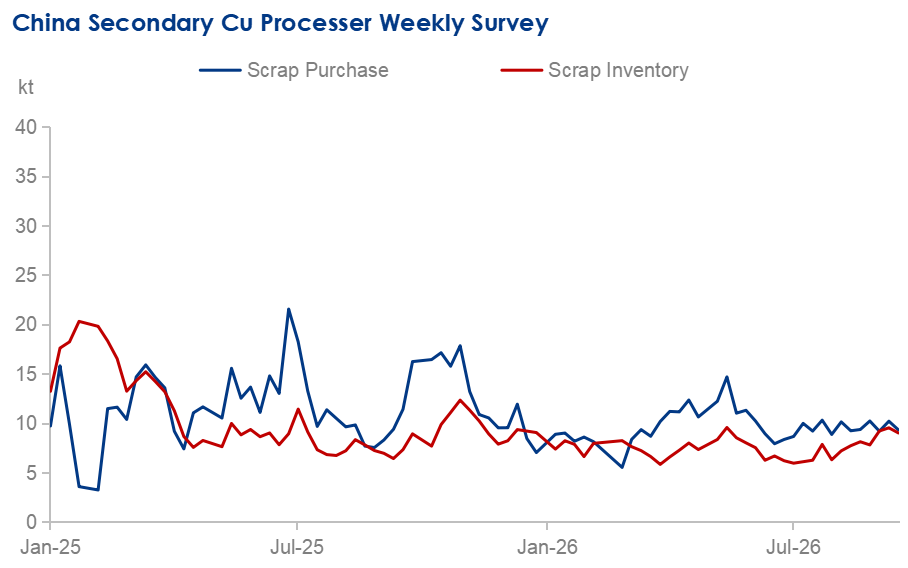
China's copper scrap spot trading volumes fell last week. For red copper scrap, downstream companies faced little pressure on raw material inventories and mainly purchased on an as-needed basis. Although the Mid-Autumn Festival and National Day holidays are approaching and some companies started restocking plans, high prices and tight compliant invoiced spot supply slowed restocking progress. For brass scrap, end-user restocking demand, coupled with a sharp mid-week copper price pullback, improved orders at downstream brass processing companies and lifted brass scrap demand. However, most companies remained cautious in purchasing and maintained low raw material inventories, with actual purchasing increases limited.
The core contradiction in the secondary copper processing industry recently is not simply insufficient demand or excess supply, but the difficulty of aligning effective supply with actual demand under tax compliance constraints. Tax compliance is a hard bottleneck limiting capacity utilization. Upstream copper scrap recycling generally struggles to provide compliant invoices, and tighter regulation leaves companies facing input invoice shortages and audit risks. Invoiced copper scrap supply is scarce, making it difficult for companies to purchase and stockpile in large volumes. Meanwhile, high prices tie up significant capital, further dampening purchasing and trading appetite.
Looking ahead, the secondary copper processing industry is expected to continue operating at low approaching the holidays, and its raw material restocking demand is unlikely to improve significantly, so copper scrap market trading is expected to remain at a low level.
Data Source: Mysteel
More regular analysis and comprehensive data on China's copper industry are available in Mysteel Copper Weekly, Mysteel Copper Monthly, and Mysteel Copper Database. Reach out to us via Mysteel's official website: Latest & Reliable Copper Market Price in China | Mysteel, and follow Mysteel Non-Ferrous for more insights!
Written by Zhaorui Cui, cuizhaorui@mysteel.com
Edited by Mingyuan Wang, wangmingyuan@mysteel.com