Approaching the 2026 China's National Day holiday (October 1-7), the copper market in China has been seeing deepening supply tightness. Conventionally, downstream and end-use enterprises would stockpile raw materials in advance to support holiday production, which usually boosts pre-holiday consumption and thus copper prices. However, constrained refined copper output and low inventory this year drove spot premiums sharply higher, limiting downstream and end-user stockpiling, when performance among end-use sectors has already been uneven.
According to Mysteel's survey on 30 copper smelters, 52 copper rod producers, 15 copper foil producers, 14 copper tube producers, and 10 copper bar producers, smelters are entering the holidays with little finished inventory and facing mounting pressure from raw-material shortages and production cuts, while downstream processors show widely divergent stockpiling and holiday production plans.
Supply tightness occurs as the major constraint
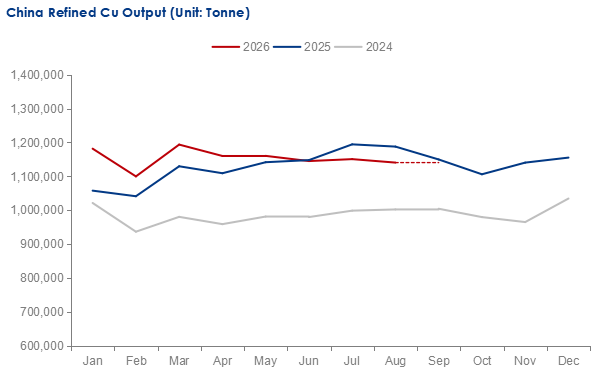
Survey results show that all sample smelters will maintain normal production during the holiday, as a usual practice to avoid additional costs from shutting down and resuming furnace operations. Yet despite continued production, only four of the 30 surveyed smelters reported that they would be able to maintain normal finished product inventory levels. Most reported little or no copper inventory, with production and shipments closely synchronized and some material already pre-sold. With little inventory acting as a buffer, even normal production is largely being absorbed by immediate shipments to downstream customers.
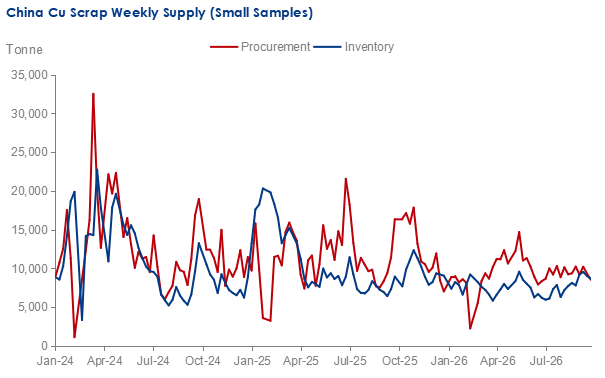
The current refined copper supply tightness can be mainly attributed to raw material issues. Regarding concentrate, Mysteel's imported copper concentrate spot treatment charge (TC) index stood at -$224.63/dmt as of September 24, indicating extremely tight raw material availability and causing severe losses to smelters. Meanwhile, by-product sulfuric acid prices have been declining, gradually removing an important source of profit support to smelter operations. In the scrap market, ongoing tax policy adjustments have been limiting compliant scrap supply in China, limiting its ability to supplement primary raw materials. Based on Mysteel's assessment, production losses attributable to raw material tightness and declining feed grades are estimated at approximately 33,000 tonnes in August and 35,000 tonnes in September, while related monthly production reduction is expected to approach 90,000 tonnes in the fourth quarter of 2026. Overall, the combination of limited supply, weak raw material availability and deteriorating smelter economics leaves the market entering the holiday with unusually little supply flexibility.
Source: Mysteel
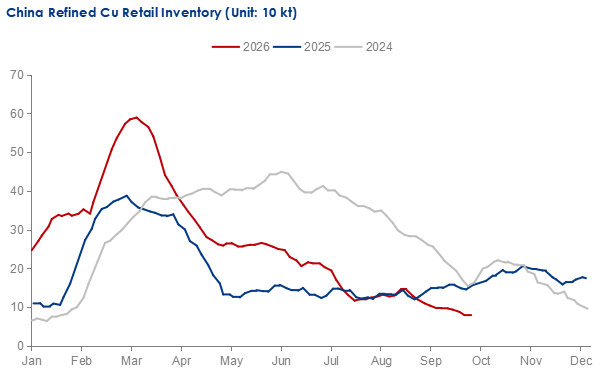
The tight supply is already visible in China's copper inventory. Refined copper retail inventory in China stood at 80,700 tonnes as of September 28, remaining at a relatively low level compared with the same period in previous years. More importantly, most smelters are prioritizing direct shipments to downstream processors rather than replenishing warehouses. Only 5 of 30 surveyed smelters plan deliveries to warehouses during the holiday, totaling only around 15,000 tonnes. As a result, although China's refined copper inventory is still expected to increase post-holiday, the actual increase will be limited to around 10,000-20,000 tonnes, less than the usual 20,000-30,000 tonne range in previous years.
Source: Mysteel
The physical copper tightness can also be reflected in elevated spot premiums. On September 23, #1 refined copper spot premiums in Shanghai reached Yuan 1,300/tonne, the highest level this year, which notably suppressed downstream stockpiling. In contrast, the spot premium was only Yuan 45/tonne on September 24, 2025. The sharp rise in premiums therefore reflects tightening physical availability rather than a broad-based recovery in demand.
Downstream pre-holiday stockpiling appears divergent and price-sensitive
Amid tight raw material availability, downstream stockpiling has been limited and increasingly differentiated by sectors.
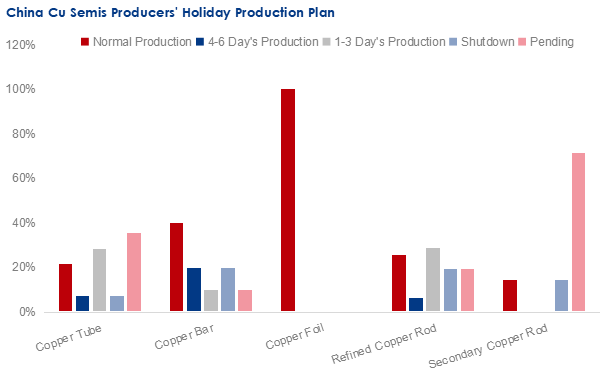
Firm cable and wire demand and falling raw-material inventory have prompted refined copper rod producers to actively secure refined copper, although purchases remain concentrated during price dips and some producers have already reduced output because of insufficient feedstock. Meanwhile, copper foil provides a clearer example of genuine demand strength reinforcing an already tight supply environment. All 15 surveyed producers plan to maintain normal or near-full-capacity operations during the holiday, supported by robust demand from the electronics and new-energy sectors. Producers therefore actively seek for raw materials in advance.
The picture is more cautious in the copper tube sector. Producers are stocking according to orders and production schedules, with some purchases brought forward for holiday logistics. However, weak end-use demand and high copper prices are limiting restocking.
The impact of raw material issues on pre-holiday stockpiling and production is more obvious in copper bar and secondary copper rod markets. Due to the ongoing tax policy adjustments in the copper scrap industry, scrap with compliant invoices is limited and costly, with imported copper scrap unable to fully complement the gap, leaving scrap processors facing high raw material costs and constrained availability.
Consequently, most brass bar enterprises are reluctant to make large purchases amid high price volatility, generally favoring small, needs-based procurement. Manufacturers operating normally throughout the National Day holiday have some restocking needs, but procurement will depend on actual order conditions. Secondary copper rod producers faced with more severe constraints, as production is primarily determined by available scrap copper. Among 21 surveyed secondary copper rod producers, 3 reported probable shutdowns due to insufficient raw materials and orders, 15 noted that holiday and future production will depend on raw material procurement, and only 3 are expected to maintain normal operations. That makes secondary copper rod a supply-constrained downstream sector, rather than a straightforward demand indicator.
Source: Mysteel
Downstream holiday production plans vary on divergent demand expectations
Holiday production plans also diverge across copper semis sectors. A large number of refined copper rod producers have routine maintenance plans, with days of shutdown varying according to orders and raw material availability. Copper tube producers generally plan 2-3 days of production, and will focus on maintaining furnace temperature, as demand expectations stay relatively weak compared with the same period in previous years. Copper bar producers, particularly smaller firms, are expected to take longer breaks due to slow demand recovery. Meanwhile, secondary copper rod production remains highly dependent on the availability of invoiced scrap, making its holiday supply outlook particularly sensitive to policy and raw-material constraints. In contrast, copper foil plants are expected to maintain near-normal operations, in response to robust demand.
Source: Mysteel
Outlook
The post-holiday copper market in China is likely to remain fundamentally shaped by the tension between tightening supply and increasingly price-sensitive demand.
For refined copper, the inventory accumulation during the first week after the holiday is expected to be weaker than in previous years, with inventory potentially returning to a downward trend in the second week. Import arrivals will therefore become an increasingly important factor for domestic supply. Meanwhile, October will see concentrated smelter maintenance, with around 10 smelters and 3.28 million tonnes of annual refining capacity affected. Combined with raw-material shortages and widening losses, stronger incentives for production cuts could further reinforce the tight spot market.
Among semis sectors, refined copper rod supply is likely to remain tight after concentrated holiday maintenance, while the secondary copper rod market will remain constrained by scrap circulation and invoice policies. Copper bar demand should recover modestly with post-holiday restarts but will remain dependent on end-user orders, while copper tube demand is likely to improve only modestly as October air-conditioner production still remains below year-earlier levels. Copper foil should remain the strongest segment, supported by robust demand and limited capacity growth.
Beyond the physical market, macro developments, especially U.S. monetary policy and uncertainty over U.S. refined copper import tariffs, will remain important sources of short-term price volatility. Nevertheless, the fundamental balance remains supportive. Tight concentrate availability, declining refined copper supply and relatively resilient demand are likely to keep the physical market under pressure. With China's futures market closed during the National Day holiday, overseas market movements and macroeconomic developments could amplify price volatility when domestic trading resumes post-holiday.
Written by Mingyuan Wang, wangmingyuan@mysteel.com
Edited by Zhaorui Cui, cuizhaorui@mysteel.com