Premium: Low arrivals of domestic and imported supply lift spot premium
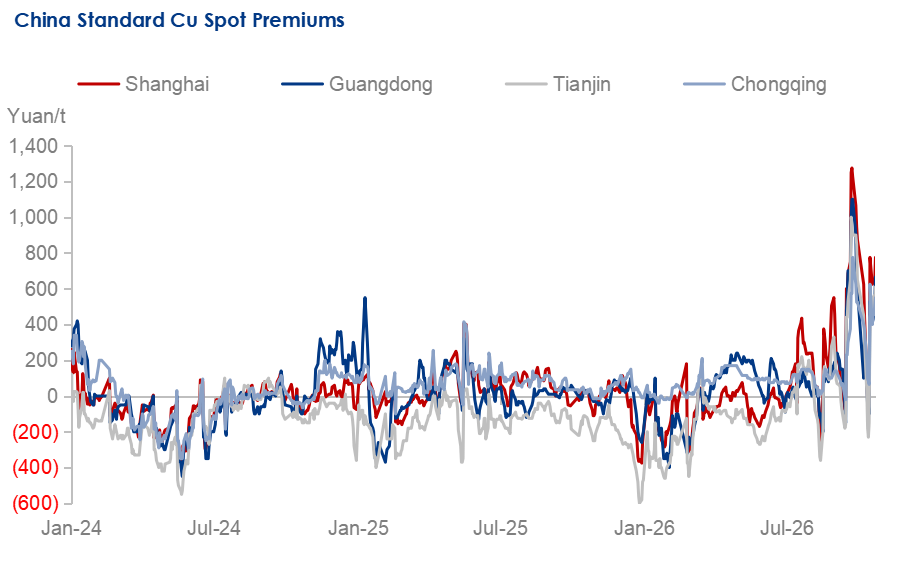
China's refined copper spot premium rose significantly last week. During the week, smelter shipments remained limited and imported copper arrivals also declined, tightening market availability. Meanwhile, holders' bullish sentiment on copper prices also provided strong support for the spot premium.
 Data Source: Mysteel
Looking ahead, China's refined copper spot supply is expected to remain tight in the near term, while downstream consumption will be resilient at low prices. The spot premium is therefore expected to stay at a relatively high level overall. However, supply tightness in Tianjin is expected to ease, which may slightly weigh on the spot premium. According to Mysteel, refined copper spot premium ranges are forecast with Shanghai at Yuan 600-900/tonne, Guangdong at Yuan 500-1,000/tonne, Tianjin at Yuan 300-700/tonne, and Chongqing at Yuan 300-700/tonne this week.
Supply: China refined copper spot supply tight across markets last week
China's refined copper spot supply was tight last week. In Shanghai, smelter shipments were low and imported copper inflows fell from the previous week, tightening spot availability. In Guangdong, although concentrated arrivals from smelters and traders boosted supply last Monday, availability tightened again as supply declined and downstream buying increased at low prices. In Tianjin, some smelters remained under maintenance, leaving limited tradable spot copper. In Chongqing, faster long-term contract pickups also tightened spot supply.
Looking ahead, supply is expected to improve in some markets such as Tianjin, as completed maintenance would ease tightness. Overall, however, with smelter shipments still limited in most markets and imported copper volumes expected to decline, China's refined copper spot supply is likely to remain tight in the near term.
Demand: High premium curbs spot trading volume
China's refined copper spot trading slowed last week. In Shanghai, downstream buyers showed strong wait-and-see sentiment early in the week amid high copper prices and mainly purchased only for rigid demand. As copper prices fell later, purchasing demand was released and spot trading activity rose. In Guangdong, downstream buyers were also inactive at high prices early in the week, mainly taking delivery under long-term contracts. Although the subsequent price decline effectively activated restocking demand, high premiums clearly restrained any expansion in transaction volume. In Tianjin, purchase volumes rose somewhat after the price drop, but with holders holding firm on prices, overall transaction volume improved only modestly. In Chongqing, transactions were mainly long-term contract deliveries, while spot trading was constrained by high premiums. Overall, although the copper price pullback stimulated downstream consumption to some extent, high premiums caused actual refined copper spot trading volume to fall week on week.
According to Mysteel's survey of 56 Chinese refined copper trading enterprises (including smelters, traders and downstream processors), China's refined copper spot trading volume was 11,900 tonnes between October 19-23, down by 5,400 tonnes, or 4.33%, from the October 12-16 figure.
Looking ahead, refined copper spot premiums are expected to remain relatively high in the short term, and macroeconomic disturbances may increase price volatility. Therefore, China's refined copper spot trading is unlikely to improve significantly in the short term.
Import: Cargo arrival delays slow imported copper trade
During October 19-23, as copper prices fluctuated at home and abroad, losses on China's refined copper import trade narrowed and turned into profit on last Friday. However, trade remained loss-making most of last week and supply was tight , so trading volume was low. Meanwhile, fewer vessels arrived at Shanghai's Yangshan Port, and premiums for refined copper warehouse warrants and bills of lading there rose week on week. Looking ahead, some vessels may be delayed by typhoons, so China's refined copper imports are expected to remain low in the short term, and refined copper premiums at Yangshan Port are unlikely to fall.
Inventory: China's refined copper retail and bonded inventory decline WoW
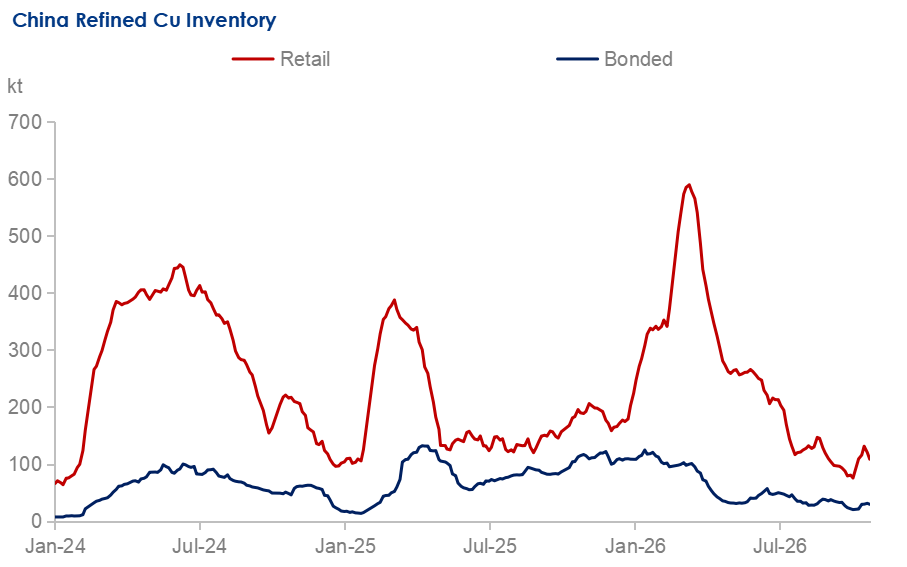
China's refined copper retail inventory declined last week. Imported copper arrivals into the market were relatively limited during the week, so warehouse inflows were modest. Although some smelters still made shipments, the increase was likewise limited. Meanwhile, copper prices drifted lower through the week, and downstream restocking on dips remained resilient, leading inventory to return to destocking. Looking ahead to this week, as some import shipment schedules have been delayed to the month-end, imported copper arrivals are still expected to stay relatively limited, while falling copper prices are likely to lift downstream consumption. Therefore, China's refined copper retail inventory is expected to continue falling.
China's refined copper bonded inventory also edged lower, mainly because some warehouse cargoes were cleared through customs and imported into the domestic market. Looking ahead, current port arrivals may face delays due to typhoon, and with domestic smelters making relatively few export shipments, warehouse inflows are likely to remain limited during the week. Meanwhile, given the high domestic premiums, some cargoes are still expected to be cleared into the domestic market. Therefore, China's refined copper bonded inventory is also expected to keep declining.
Data Source: Mysteel
The COMEX-LME refined copper price spread stayed low, averaging $119.14/tonne over October 19-23, increasing by $5.47/tonne week on week. The LME cash-3M settlement spread remained high, averaging $138.2/tonne for the week, up by $1.6/tonne week on week. With LME cash premiums elevated, LME inventories rebounded, while the narrow COMEX-LME copper price spread limited inventory growth at COMEX. Looking ahead, the U.S. refined copper tariff ruling is a key factor shaping global refined copper inventory trends from Q4 2026 to H1 2027. If implemented as scheduled, COMEX inventories will remain high, while LME inventories are expected to stay in a tight balance due to tight non-U.S. spot supply. If the ruling is further delayed or weakened, COMEX inventory backflow and an LME inventory rebound may occur simultaneously.
More regular analysis and comprehensive data on China's copper industry are available in Mysteel Copper Weekly, Mysteel Copper Monthly, and Mysteel Copper Database. Reach out to us via Mysteel's official website: Latest & Reliable Copper Market Price in China | Mysteel, and follow Mysteel Non-Ferrous for more insights!
Don't miss Mysteel's Q3 2026 Copper Market FREE Webinar! Check the link below to learn more, and register to secure your spots:
Written by Zhaorui Cui, cuizhaorui@mysteel.com
Edited by Mingyuan Wang, wangmingyuan@mysteel.com