Price: Smaller scrap price decline narrows refined-scrap copper price spread
China's refined copper spot prices decreased by 1.17% week on week last week. Although copper scrap prices fell along with copper prices, the decline was only 0.31%, so the refined-scrap copper price spread narrowed last week. The copper scrap invoice rate, referring to the additional cost of obtaining compliant value-added tax (VAT) invoices, was raised again in October, further pushing up tax-inclusive scrap prices. This significantly squeezed downstream processors' profit margins, and making it difficult to continue using the refined-scrap copper price spread as an indicator of substitution between refined copper and copper scrap in actual transactions.
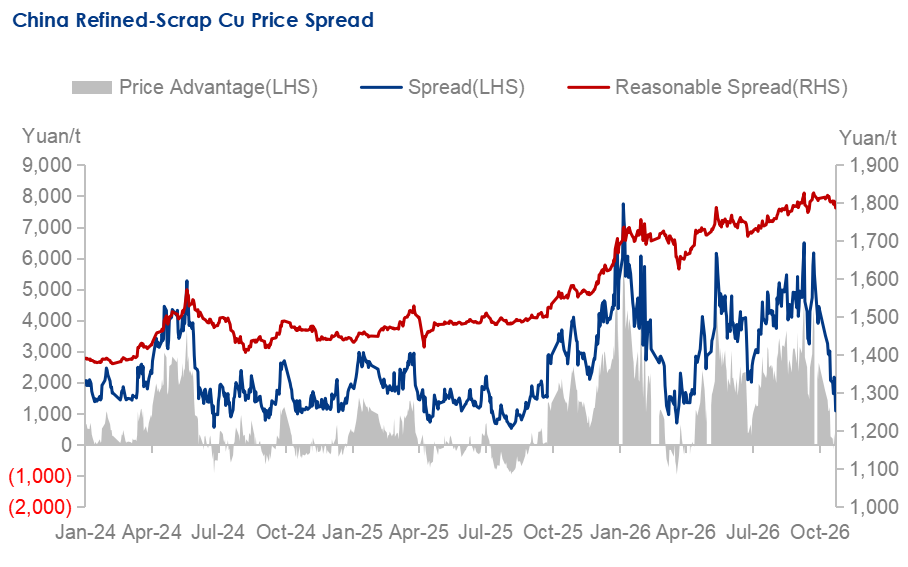
Data Source: Mysteel
The average import prices for red copper scrap (99%-99.5% Cu) in China between October 19-23 decreased 0.30% compared with the price between October 12-16. Meanwhile, amid volatile domestic and overseas copper scrap prices, China's copper scrap import profit rose further last week, ranging between Yuan 2733.08/tonne and Yuan 4096.38/tonne. Looking ahead, the constraints of the reverse-invoicing policy on China's scrap sector will be hard to ease in the near term, and a shortage of tax-inclusive, reasonably priced scrap copper is likely to intensify, keeping demand for imported scrap strong. Therefore, China's copper scrap import volumes are expected to remain relatively high in the near term.
Supply: Lower prices lead to tightening spot supply
The overall downward shift in refined copper and copper scrap prices last week reduced spot circulation in the copper scrap market. For red copper scrap, upstream traders were cautious. After selling at high prices early in the week, most held low inventories, while buying and selling both turned quiet after prices fell. For brass scrap, upstream holders sold moderately at highs early in the week. As prices declined later, reasonably priced material became hard to find, slowing spot circulation. Looking ahead, prices face macro disturbances in the near term, so sellers may remain cautious, further limiting spot circulation.
Looking ahead to Q4, the reverse invoicing policy is expected to remain under strict enforcement. As tax authorities roll out fully digitalized electronic invoices and tax risk early-warning mechanisms, the efficiency of tax collection and administration keeps improving and corporate compliance costs continue to rise. Based on the latest survey of regional policies, no locality has so far introduced substantive measures to ease the impact of reverse invoicing, as most are taking a wait-and-see stance or making tentative, exploratory adjustments. The tightening of the reverse invoicing will therefore continue to curtail domestic scrap copper circulation in Q4.
Demand: Downstream copper scrap purchases decline WoW
Downstream copper scrap purchases diverged last week. For red copper scrap, downstream firms faced weak supply and demand and were reluctant to buy. Spot deals were clearly diverged, concentrated among a few price-competitive producers, with tax-invoiced scrap accounting for a large share. For brass scrap, end-use demand was average, mostly limited to essential purchases, so downstream orders were limited. Meanwhile, with copper scrap prices staying high, producers had to keep quotes firm to preserve margins. Consequently, finished-product quotes were hard to lower, which further suppressed order growth and raw-material demand, leaving the market in a standoff.
Looking ahead, downstream processors' purchasing appetite in Q4 will likely be weighed down by persistently high invoice rates. Even though some year-end rush to complete orders still exists, continuously rising invoice rates are pushing up tax-inclusive procurement costs and severely compressing processing margins, prompting a number of enterprises to cut or suspend production. Operating rates at secondary copper rod producers are forecast to stay within the 14%-17% range in Q4, with little prospect of a marked recovery. Processing margins for secondary copper anodes are also unlikely to improve, with overall consumption for copper scrap limited.
More regular analysis and comprehensive data on China's copper industry are available in Mysteel Copper Weekly, Mysteel Copper Monthly, and Mysteel Copper Database. Reach out to us via Mysteel's official website: Latest & Reliable Copper Market Price in China | Mysteel, and follow Mysteel Non-Ferrous for more insights!
Don't miss Mysteel's Q3 2026 Copper Market FREE Webinar! Check the link below to learn more, and register to secure your spots:
Written by Zhaorui Cui, cuizhaorui@mysteel.com
Edited by Mingyuan Wang, wangmingyuan@mysteel.com