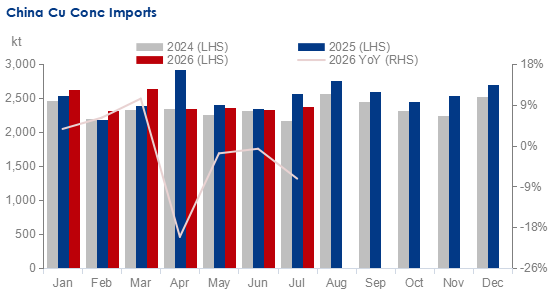
China's copper ore and concentrate imports totaled 2.3785 million tonnes in July 2026, up 1.87% month on month but down 7.09% year on year, marking the fourth consecutive month of year-on-year decline, according to the the General Administration of Customs of China (GACC). Total imports reached 16.9846 million tonnes in January to July, down 1.8% year on year, with the decline widening from 0.9% in the first half (H1) of the year. Although import volumes remained relatively high in H1, the year-on-year decline indicated worsening supply concerns.
Source: GACC
By regions, China imported 4.2808 million tonnes of copper concentrate from Chile in H1, down 8.3% year on year and accounting for 29.3% of total imports. Imports from Peru totaled 3.7383 million tonnes, down 0.9% year on year and accounting for 25.6%. Combined imports from the two countries reached 8.0191 million tonnes, representing 54.9% of total imports, with Chile accounting for the majority of the decline.
Chile's major copper mines have been experiencing output declines amid falling ore grades, increasingly complex ore characteristics, and pressure on recovery rates entering 2026. In May, production at Codelco, Escondida, and Collahuasi all fell by double digits year on year. By contrast, Peru's copper production remained on an overall growth trajectory, suggesting that the decline in its copper concentrate exports to China was more likely attributable to shipment disruptions. Meanwhile, China's copper concentrate imports from Mongolia rose 26.9% year on year in H1, supported by the continued ramp-up of underground production at Oyu Tolgoi. Imports from Russia surged 96.3% year on year, driven by higher copper concentrate output, stronger trade flows to China, and a low base in the same period last year. Together, Mongolia and Russia partially offset the decline in South American supplies.
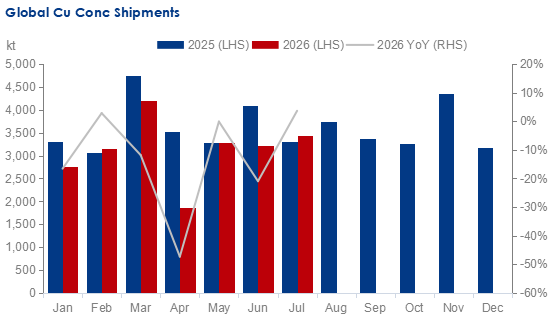
According to Mysteel's survey, global copper concentrate shipments totaled approximately 17.5172 million tonnes in H1 2026, down 6.8% year on year and 5.6% from H2 2025. By region, shipments from Chile totaled 7.0875 million tonnes, down 2.4% year on year, while those from Peru fell 10.0% to 4.4500 million tonnes. Shipments from Indonesia and Africa declined by 85.0% and 56.3%, respectively. Shipments from other regions increased 13.0% year on year, providing some offset to declines from major supply regions, but the increase was insufficient to fully compensate for the overall shortfall.
Source: Mysteel
Global copper concentrate shipments recovered to 3.4357 million tonnes in July, up 6.3% month on month and 3.63% year on year. Shipments from Peru and Africa increased 22.5% and 77.3% month on month, respectively, marking the main sources of growth. In contrast, Chilean shipments fell 14.7% month on month and 19.4% year on year, weighed down by extreme weather and declining ore grades at major mines. The recovery in shipments from Peru and Africa in July may provide some support for China's copper concentrate imports subsequently. However, the decline in Chilean shipments highlights diverging supply trends across major producing regions. If the increases from Peru, Africa and other regions fail to persist, arrivals in China could come under renewed pressure.
On the smelting side, Mysteel's survey on the blister copper production of 41 smelters in China with a total production capacity coverage of 95% showed that mined copper blister output totaled 4.678 million tonnes in H1 2026, up 1.7% year on year, with most of the increase concentrated in the first quarter. In the second quarter, output edged down amid tightening raw material supplies and concentrated smelter maintenance, indicating that constraints on raw material availability were becoming an increasingly significant drag on smelter production. Moreover, although China's copper smelting capacity continues to expand entering 2026, tighter raw material supply and extremely low treatment charges suppressing profits have delayed some new projects.
Overall, copper concentrate supply is expected to remain tight overall in H2 2026, with limited growth expected. The recovery in overseas shipments in July should provide some support for subsequent arrivals, but supply recoveries in major source regions such as Chile and Indonesia are expected to remain limited, while the DRC's restrictions on concentrate exports will further constrain availability. Incremental supply will therefore rely mainly on Peru, Mongolia, Russia, and parts of Africa, although the sustainability of these increases remains uncertain.
Written by Mingyuan Wang, wangmingyuan@mysteel.com