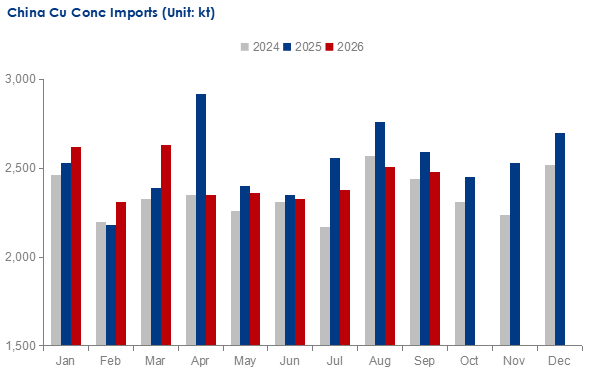
China's copper concentrate imports declined both month on month and year on year in September, reversing the monthly recovery seen over the previous two months, as reduced shipments from Chile weighed on arrivals.
Source: GACC
China imported 2.48 million tonnes of copper concentrate in September 2026, down 1.2% month on month and 4.3% year on year, according to the General Administration of Customs of China (GACC). From January to September, total imports reached 21.97 million tonnes, down 3.1% from the same period last year. September marked the end of two consecutive months of month-on-month growth in copper concentrate imports. Meanwhile, the year-on-year decline extended to a sixth consecutive month since April 2026, indicating persistent supply tightness in China's copper concentrate market.
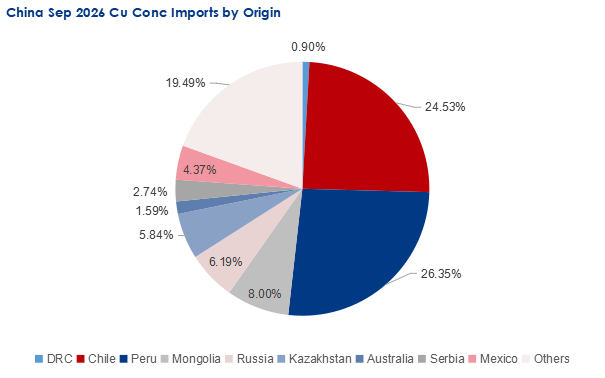
By country of origin, imports from Chile and Australia recorded notable declines in September, both month on month and year on year, while increased volumes from Peru and Russia partially offset the reductions. China imported 608,300 tonnes of copper concentrate from Chile in September, down 26.36% from August, accounting for 24.53% of China's total imports during the month. Meanwhile, imports from Australia dropped by 42.88% month on month, reaching 39,323 tonnes. In contrast, imports from Peru increased by 23.58% month on month to 653,500 tonnes, and imports from Russia also grew by 23.97% to reach 153,600 tonnes.
Combined imports from Chile and Peru reached approximately 1.26 million tonnes, accounting for 50.88% of China's total imports. Their combined share highlights the continued importance of the two South American countries in China's copper concentrate supply chain, despite the divergent performance in September.
Source: GACC
Looking ahead, China's copper concentrate imports may face additional pressure in October. The month marks the peak maintenance season for domestic copper smelters, while limited output contributions from newly commissioned capacity are expected to weigh on industry operating rates and concentrate consumption. Meanwhile, some smelters have largely completed their raw material procurement targets for 2026, further suppressing demand. With annual long-term treatment and refining charge (TC/RC) negotiations approaching, spot market activity also loses momentum as buyers and sellers adjust their procurement strategies ahead of the negotiations.
Written by Mingyuan Wang, wangmingyuan@mysteel.com